Join the Conversation

Join the Conversation.
I invite your comments, suggestions, and additional information about any topic mentioned.
Showing posts with label Rufus Putnam. Show all posts

Thursday, July 3, 2025

Rufus Putnam’s Map


The Map

CLICK TO ENLARGE
Map drawn by Rufus Putnam showing British forces discovered during his reconnaissance mission north of New York City in October 1776. Map image courtesy of Bill Reynolds, retired historian at Campus Martius Museum.

     Marietta's founder Rufus Putnam was energetic, creative, and persistent. Give him an impossible task and he'd figure out a way to "git 'er done." Early in the Revolutionary War, he served with the rank of Colonel as an engineer. Engineers built structures, fortifications, and roads to support the Army.

     After the Continental Army's disastrous defeat in the Battle of Long Island in late August 1776, Washington skillfully withdrew the Army at night across the East River to lower Manhattan Island. Morale was low; prospects against superior British forces were grim.

     The Army was forced to adopt a new strategy: win by not losing, by surviving. They began a long, fighting retreat, avoided major losses, conserved resources, and lived to fight another day, as the saying goes. The "Retreat to Victory," as historians call it, began with Rufus Putnam's help. Unless noted, quotes (including spelling and punctuation) are from Putnam’s memoir.

     Washington had wanted the Army to remain in New York City on lower Manhattan. He sent Putnam and General Mifflin out  "...to reconnoiter the country between Kingsbridge & Morrisania & eastward (today's Bronx area)..." They reported to Washington and his staff that the Army was in danger of being surrounded and cut off. General Washington ordered a retreat from New York. Putnam: "...this measure was the Selvation of the army," enabled by "the discoveries made by Miflin & my Self."

     The Army then needed a safe area to store supplies and regroup. On October 19, General Washington dispatched Putnam along with Colonel Reed and 20 soldiers to scout areas north of the City. They reached the heights at East Chester but saw little. Colonel Reed had to return to headquarters.

     Putnam continued - alone on horseback. He started towards White Plains where the Army had a large supply depot. He recalls: "I did not then know where White plains was, nor where the road I had taken would carry me." But he figured it out on his own. He disguised himself and learned of British positions by observation and from some friendly local residents. He was cautious but not deterred in his mission; if captured by the British he could have been hung as a spy.

     Enter...the map. Putnam was a skilled surveyor. He made a sketch of the area for Washington showing British units dangerously close to White Plains. Washington was surprised by Putnam’s findings - and frustrated. “He complained very feelingly of the Gentlemen from New York from whome he had never ben able to obtain a plan of the country.” He thought White Plains was a secure area. General Washington immediately ordered troops toward White Plains; they marched through the night. Putnam's observations “and an interposing providence” had saved the Army "...from a probabal total destruction." Putnam was a man of faith, acknowledging God’s  (“Providence”) favor and guidance on numerous occasions during his life.

CLICK TO ENLARGE. Close up of map showing British forces that Putnam learned about, from left to right, Hessian Grenadiers, British Regiments, British guards, 16th and 17th Light Dragoons, and Grenadiers & Light Infantry

     One Army historian: "despite Putnam's lack of (formal) training, the Commander in Chief quickly grew to regard him as his favorite engineer." Washington had appointed Rufus as Chief Engineer just a few months earlier. Putnam recognized the importance of engineers to the Continental Army. He had submitted a detailed plan to create a permanent Corps of Engineers. George Washington sent the plan with his recommendation to Congress, and complimented Putnam, “…he is indefatigable (in his work) and possesses more practicale Knowledge in the Art of Engineering than any other...”

     Rufus Putnam resigned as Chief Engineer in December but accomplished much in other roles during the War. He commanded Massachusetts units at the Battle of Saratoga victory and appears in a U. S. Capitol Rotunda painting of the British surrender, oversaw building of Fort Putnam at West Point, and spent months lobbying the Massachusetts legislature for support of their Army units. He later helped engineer (can’t resist using that term) the creation of the Northwest Territory and settlement of Marietta.

     Special thanks to local historian Bill Reynolds for showing me Putnam’s original map and the story behind it.

Friday, January 24, 2025

Marietta at President Trump’s Inaugural

    There was a guy from Marietta in the Capitol Rotunda at President Trump's inaugural. You did not hear or see him in the mainstream or social media. He did not speak, but was likely listening and watching. Who was this man? Rufus Putnam, our founder. He stands watch over the proceedings in the Capitol Rotunda, along with other Revolutionary War patriots, in the  painting by John Trumbull "Surrender of General Burgoyne." Putnam is immediately to the right of the man in white, shown in the close-up photo.

“Surrender of General Burgoyne” at the Battle of Saratoga by 
John Trumbull viewed. CLICK TO ENLARGE

Close up showing Rufus Putnam

Trumbull painting in the background; President Trump speaks at bottom of photo (cropped) 
by Andrew Narvik/Pool/Reuters. CLICK TO ENLARGE

     Rufus Putnam is considered the founder of Marietta in 1788. He had a humble beginning in Massachusetts and was self-educated; his stepfather refused to let him attend school. By the time he was 20 years old, Putnam had mastered the skills of farm management, millwright, surveyor, and military engineer – the latter learned from four tours of duty in the French and Indian War. Putnam also served the full length of the Revolutionary War.

     After that, Rufus Putnam lived a comfortable life in Rutland, Massachusetts but was inspired by the opportunity for a new life in the Ohio Country. The creation of the Northwest Territory in 1787 paved the way for western U. S. expansion. Putnam was a prime mover in the purchase of land in southeast Ohio and establishment of the territory’s first settlement at Marietta in 1788. Putnam not only helped organize this new town, he moved his family from “civilized” New England to the rough conditions on the new frontier. He lived the rest of his life in Marietta, serving in many leadership roles.

   Rufus Putnam was an exceptional man. But one attribute stands out to me: his dedication to serving his country and supporting veterans. Rufus not only served in the French and Indian War but for the duration of the Revolutionary War. Historian Samuel Hildreth: “He buckled on his sword when the strife began, and he did not lay it down till liberty was secure and peace again smiled upon the land” - nearly six years later.

   He was a tireless advocate for veterans, donating countless hours and lengthy travel to make sure that veterans got what was due them. In March, 1779, Putnam made great "exertion to prevent a mutiny from breaking out in the Massachusetts line..." From January to April of 1780 he was on leave from the army to "solicit… relief for the Massachusetts line of the Continental Army and for prisoners of war on Long Island." Putnam co-authored a 1783 petition of Revolutionary War officers to Congress asking that land grants promised to soldiers be awarded on land in today’s Ohio. And Rufus Putnam made it possible for veterans to redeem their land grants awarded for military service to obtain land – and a new life - in the Marietta area.

     It is fitting that Putnam and other patriots are represented the United States Capitol rotunda. Mariettans should be proud to see him there.

Sunday, July 30, 2023

Rufus Putnam Ingenuity Ousts British from Boston

Rufus Putnam is considered the founder of Marietta, Ohio. He had a distinguished Revolutionary War record. His specialty was fortifications. In early March, 1776, George Washington was planning a campaign to force the British army out of Boston. Rather than a risky frontal assault, he and his staff decided upon secretly fortifying Dorchester Heights with heavy artillery. Control of those hills with would give Americans effective command of the city. Rufus Putnam was a key player in this early Revolutionary War action.

The armaments1 brought from Fort Ticonderoga were ready. Bombardments at other locations were planned to distract the British. Nearly 5,000 recently recruited and enthusiastic patriots were eager for action. There was only one problem: the cold. The ground was too frozen to build trenches, earthen walls, and timber structures needed to defend the positions once occupied.

One night Putnam, then serving as an engineer building fortifications, was invited to dine at headquarters. George Washington asked him to stay afterward. He spoke passionately about the importance of fortifying Dorchester Heights. He was anxious to start the campaign but frustrated that frozen ground was holding things up. Rufus recalled, “the General (Washington) directed me to consider the subject and if I could think of any way in which it could be done, to make report to him immediately”

Rufus Putnam was the right person for this situation. He had mastered several trades by the time he was twenty years old. He was curious and relentless in solving problems. He started back to his own quarters, his mind racing. A cold wind whipped around him, an annoying reminder of the urgent situation. He passed the quarters of General Heath. Putnam recalls vividly that “(divine) providence” prompted him to stop and visit Heath. He had no reason to do so. Heath welcomed him. Putnam noticed a large book on military fortifications sitting on a table. He coaxed a reluctant Heath into lending it to him.

The next day he perused the book. His eyes fell upon an illustration of a chandelier. It was not the light fixture of today. “What is that?, he wondered, “….it is something I never heard of before.” The next page explained how it was used. That would work!  It was a low tech solution: tightly wrapped bundles of sticks (fascines) were placed in wooden frames (chandeliers). No digging required. It would stop small arms fire and grape shot. They could be quickly assembled, transported, and mounted on the hill. He consulted with his staff, then reported to Washington who approved it. Immediately they started building the structures.

At 7:00 pm on March 4, 1776, 4,000 Continental Army troops stealthily hauled armaments, the frames, and bundled sticks up the hill in hundreds of horse and oxen carts. Thunderous cannon fire from other locations distracted the British - and terrified Boston residents. A full moon helped the patriots;  a light fog hindered British visibility. Bales of hay piled along the route stifled noise.  By 4 a.m., the operation was complete.

Image of American forces on Dorchester Heights, standing behind Putnam’s chandelier frames 
and bundled sticks

At daylight, British sentries were shocked to see the plainly visible artillery placements. British General Howe reportedly said: “The rebels have done more in one night than my whole army would have done in a month.” Days later, the British evacuated Boston and never returned. It was a major victory for the patriots, enabled by the quick thinking Rufus Putnam. Washington had tried to recruit him as Chief Engineer, though Putnam declined, believing he lacked the qualifications for the job. A decade later, Rufus Putnam started planning a new settlement in the Ohio Valley at Marietta.

Ironic fortune of war: Fort Ticonderoga, where the Dorchester Heights armaments came from, was retaken a year later with an identical strategy and outcome: The British forces hauled cannons up a nearby mountain and aimed them at the fort. Like the British at Dorchester, the Americans realized their plight and abandoned the fort. 


Henry Knox conceived and executed an expedition to recover armaments captured from the British from Fort Ticonderoga, then bring them to Boston to fortify the Dorchester Heights. He reached the fort on December 5, 1775 and departed with 8 brass mortars, 6 iron mortars, one howitzer, 13 brass cannon, 30 iron cannon, a barrel of flints, and 2,300 pounds of lead. Transporting this huge assemblage required 42 sleds, 80 teams of oxen. They had to navigate rivers, wait for ample snow and ice coverage, and drag them over the hill country of western Massachusetts. But they persevered. One historian called it the greatest logistical feat of the entire war.

Sources:

“March 4, 1776, Fortification of Dorchester Heights,” massmoments.org

Baker, David B., “Rufus Putnam the Early Years,” Early Marietta local history blog

Brooks, Noah, Henry Knox, Soldier of the Revolution

Buell, Rowena, Memoirs of Rufus Putnam
Fortification of Dorchester Heights, Wikipedia

“Fort Ticonderoga (1775),” battlefields.org
French, Allen, The Siege of Boston 

Frothingham, Richard, History of the Siege of Boston etc.

Shallot, Todd, Structures in the Stream, Water, Science, and the Rise of the U. S. Army

The Writings of George Washington, Vol 3, 1775-76


Thursday, July 7, 2022

The Bell


The bell - if only it could talk. It hangs quietly at Campus Martius Museum in Marietta, Ohio, next to the Rufus Putnam House. I’ve passed it dozens of times giving tours of the house. A few visitors ask about it; most pass by unaware of its presence.

Photo by author


Stories have circulated about the bell and how it got here. Marie Antoinette, Queen of France, was said to have sent a bell to Marietta, in appreciation for the town’s being named for her. The bell never made it, the story goes; the ship carrying it from France sank. This is a captivating narrative, but it’s never been verified.

It’s a small bell - 7” high and 8” wide at the base - what might today be called a dinner bell or farm bell, not the kind you expect to see in a church or court house bell tower. Would a bell like that have been used at the Campus Martius fortification? Though the bell is small, its ring sound is bright and clear. It could be heard for a few hundred yards when rung outdoors in the relatively quiet (no noise pollution from traffic, etc.) frontier times.

Where did this bell come from and where was it used? The bell itself gives part of the answer through the inscription on it, appearing from top to bottom:

PIERRE
DUBOIS
LAMY
NEVEU
AUPUY

Bells with this type inscription were made at the Dubois bell foundry in Le Puy en Velay village in France. Jean Dubois (1667-1725) established the foundry in the early 1700s.

Le Puy en Velay village in south central France

Decoding the bell’s inscription helps us identify the Dubois family member who made the Campus Martius bell. 

PIERRE  )
DUBOIS ) -  shortened name of foundryman Jean-Pierre Dubois (1716-1792), grandson of Jean Dubois Dubois, the original founder.

LAMY - Jean-Pierre Dubois married Agathe Lamy in 1764. Her name appears on bells attributed to Jean-Pierre made after that date.

NEVEU is French for “nephew.” This acknowledged the family affiliation of Jean-Pierre Dubois with his uncle Louis-Gabriel Dubois (1697-1767). NEVEU may have been included to avoid confusion with his uncle or to document the family connection for authenticity as a Dubois foundry bell.

AUPUY - the meaning of this term as used in the inscription is not clear. Other Dubois bells have this name, possibly referring to the name or location of the foundry.

OTHER IMAGES ON THE BELL: Some of Jean-Pierre Dubois’ bells have fleur-de-lis symbols. One image on this bell is similar:

Photo by author of bell fleur-de-lis feature


Clues in the inscription suggest that the bell was likely made at the Dubois foundry in France by Jean-Pierre Dubois, in the late 1700s. The patina of the bell matches the time period. 

Questions remain: how and when did it arrive in Marietta and where was it used?

The Marie Antoinette origin has not been documented, though the bell was made in France during the period that included her reign. She was queen from 1774 until 1789 and was beheaded in 1793.

The most explicit reference to a bell being given to Marietta appears in minutes of a meeting of the 
Ohio Company dated July 2, 1788:

“Upon information from Col. John May that Mr. Joseph May of Boston had presented a Bell to the Ohio Company, for the first public building to be erected in the Territory of the Company and such building being ordered by the agents. 
RESOLVED That the thanks of the company be presented to that Gentleman and that the Directors be directed to take measures for transporting it from Boston to the City of Marietta.”

A footnote on the page with this entry in the Records of the Original Proceedings of the Ohio Company, Volume  1, published by the Marietta Historical Commission in 1917, says: “This bell was placed on a corner blockhouse of the Campus Martius and now hangs in the Marietta Historical Museum.” 

There is evidence that a bell was used at Campus Martius. Hildreth’s Pioneer History states that “On the top of the fourth (blockhouse) (in the north-west corner), above the watch tower, is a balcony with a cupola, spire, &c., for the reception of a bell, which we are told is coming on as a present from a gentleman at Boston.”


Detailed drawing of cupola for the bell (though the bell is not shown) on the Northwest blockhouse at Campus Martius. This is a copy of an original drawing from digital records at Marietta College Legacy Library - Special Collections.


Illustrations below of the Campus Martius structure from that period show an extended tower on the northwest blockhouse. This was likely the bell cupola.

Plan of Campus Martius stockade made by Winthrop Sargent which appeared in Columbian Magazine in November 1788. See elevated tower on left (northwest) corner blockhouse.


Period drawing of Campus Martius fortification ca 1789-90. The left front corner blockhouse tower is noticeably taller.


A bell is mentioned at Marietta’s centennial celebration in 1888. A list of relic items displayed at the armory for the centennial celebration was printed in The Marietta Times, July 19, 1888 edition. It includes: “59. Old bell used in Campus Martius….”  

There is no explicit reference in histories, journals, or documents that I have seen about the bell’s having been installed and rung at Campus Martius. But based on what we know, the most plausible scenario is summarized by Bill Reynolds, Campus Martius Museum historian: “I am convinced this is the bell sent to the Ohio Company (at Marietta) from the gentleman in Boston and was installed in the blockhouse for calling alarms and for assemblies such as church and court or mourning an important death.” He also believes that the same bell was used in the courthouse after Campus Martius was dismantled until the “Davidson” bell (on display at Campus Martius Museum) was installed in 1802.

This is our story, and until other explanations surface, we’re sticking to it. If you know anything about the bell or have questions, let me know. 

Note: special thanks to Bill Reynolds for his suggestion of the bell history as a blog topic and for his input in the article.


Sources:
Hildreth, Samuel P., Pioneer History

Historical Marietta blog, November 21, 2021, “Relic Department, Marietta Centennial Celebration, Marietta Times, June 19, 1888,” viewed at historicalmarietta.blogspot.com.

Marietta Historical Commission, Records of the Original Proceedings of the Ohio Company, Vol I, 1917

Reynolds, William, Historian at Campus Martius Museum, personal interviews

Sonailles.net, “Dubois-au-puy,” viewed at https://www-sonnailles-net.translate.goog/index.php/histoire/fondeurs-et-forgerons/les-dubois?_x_tr_sch=http&_x_tr_sl=fr&_x_tr_tl=en&_x_tr_hl=en&_x_tr_pto=sc


Tuesday, January 12, 2021

What do Rufus Putnam and Ohio State Football Have in Common?

Never thought I’d see Rufus Putnam, venerable pioneer and founder of Marietta, mentioned in college football playoff hype. The occasion was the build-up to the College Football Playoff  (“CFP”) semi-final game between Ohio State and Clemson on New Years Day, 2021. Ryan McGee, ESPN Sports Network Senior Writer, wrote an article for ESPN titled “Ohio State vs. the world: How the Buckeyes and their fans feed off perceived slights.”

He observed that the Buckeyes were being “disrespected” by all manner of  coaches, sports pundits, and fandom realms who questioned their selection for the 2020 playoffs. The Bucks had played only 6 games because of COVID issues. Plus, some said their schedule was weak, and they floundered at times against worthy opponents. Several major head coaches had ranked them below the top four. Most egregiously,  Clemson Coach Dabo Swinney ranked them 11th in his voting.

All of this aroused Buckeye Nation to indignation, anger, and frustration. McGee noted that this attitude towards Ohio State football - and the State of Ohio (“the fly-over state”) in general - seems be endemic in the national psyche. It also, he said, brings out passion and pride from Ohioans. He then eloquently noted the state’s pioneer heritage and proud spirit. He had indeed done his research, breaking into what I am calling an Ohio Pride cheer in this excerpt from his article:

.....This is a state that was founded by Rufus Putnam, a Massachusetts man who was so angered by the British march into Lexington and Concord that he joined the Continental Army the very next day and rose to become one of George Washington's right-hand men.

This is the state that got so fed up with the federal government in the early 19th century that it said, "We're out of here," and it moved to secede in 1820, a full four decades ahead of Fort Sumter.

This is the state that has birthed eight presidents, more than any other, including Ulysses S. Grant, who led the Union to victory in the Civil War. Not to mention, Grant's sword that cut through the South, William Tecumseh Sherman. From the Wright Brothers, John Glenn, Neil Armstrong, Jack Nicklaus, Paul Newman and Steven Spielberg to Gloria Steinem, Toni Morrison, Harriet Beecher Stowe and Annie Oakley ... you think this state is going to produce people who are going to sit back and take lip out of Paul Finebaum and that damnable Dabo Swinney?!

"It's pride, pure and simple. There is something about this land that it just becomes a part of who you are, so you are going to love it and you are going to defend it if you feel like it's being disrespected by someone outside of Ohio," explains Columbus attorney Alex Hastie, producer and host of the "Ohio V. The World" history podcast.

Rufus Putnam is referred to in Wikipedia as the "Father of Ohio." He was a prime mover in the initial settlement of Ohio starting at Marietta. He also a delegate from Washington County at the constitutional convention for Ohio statehood. 

Putnam was a true Renaissance guy. Here are just a few of his attributes. Full disclosure: your author is an unabashed admirer of Putnam.
  • Was largely self educated; he scrounged money as a youngster to buy books because his step father did not allow him to attend school.
  • Multi-talented: was a farm manager, millwright, surveyor, military engineer, civil servant and leader in the early Ohio settlements.
  • Served four tours of duty in the French and Indian War and for the entire Revolutionary War. He was a breveted Brigadier General.
  • A tireless advocate for veterans, donating countless hours and lengthy travel to make sure that veterans got what was due them.
  • Leader in the settlement at Marietta in 1788, the first city under American government beyond the original thirteen states.
There is more, but this gives you an idea about this remarkable man. Learn more about him at Campus Martius Museum, an Ohio History Connection site, in Marietta. You can also read The Pioneers, a book by historian author David McCullough.

Painting in Capitol Rotunda, viewed at Wikipedia.com
Surrender of General Burgoyne at Saratoga, New York, 17 October 1777 metal print by John Trumbull. Rufus Putnam is seen in profile, the third person to the right of General Gage in the center.

Back to the ESPN article. I really enjoyed it, especially the light-hearted tone and the “right on” comments about Ohio State, Buckeye Nation, and Ohioans pride. Rufus Putnam was a worthy example of that pride. Thanks to Ryan McGee for reminding his readers of Ohio’s rich heritage. 

The condescending comments about the Buckeyes football team, especially the Dabo Swinney put down, had a predictable effect. It helped propel the Buckeyes to a 49-28 rout of Clemson.

Read the full article here (it may not be accessible after a certain date):

Go Bucks! OH-IO!


Sidebar notes:
  • Ryan stated that Ohio seceded from the Union in 1820. That did not happen. However, the Ohio General Assembly passed a “Nullification” law in 1820, nullifying all laws and authority of the United States in the state. It was an act of brazen rebellion against the Federal government that lasted for several years. Most of us are unaware of it because, as one historian noted, “...it is a piece of buried and forgotten history.”

  • "Dabo Swinney" is not a typical name. Spell check lit up every time I keyed it in.

  • Rufus Putnam actually opposed statehood for Ohio as originally proposed. He favored a different state boundary that he thought would be better for southeast Ohio. But he was an active participant in the Ohio constitutional convention.

  • There is a football connection between OSU and Marietta, Rufus Putnam's Ohio home. The Buckeyes played the Marietta College Pioneers eight times between 1892 and 1902. The Bucks won the series 6-2. It's still impressive that Marietta won two games from Ohio State, though the game was much different then. Go Bucks! Go Pios!

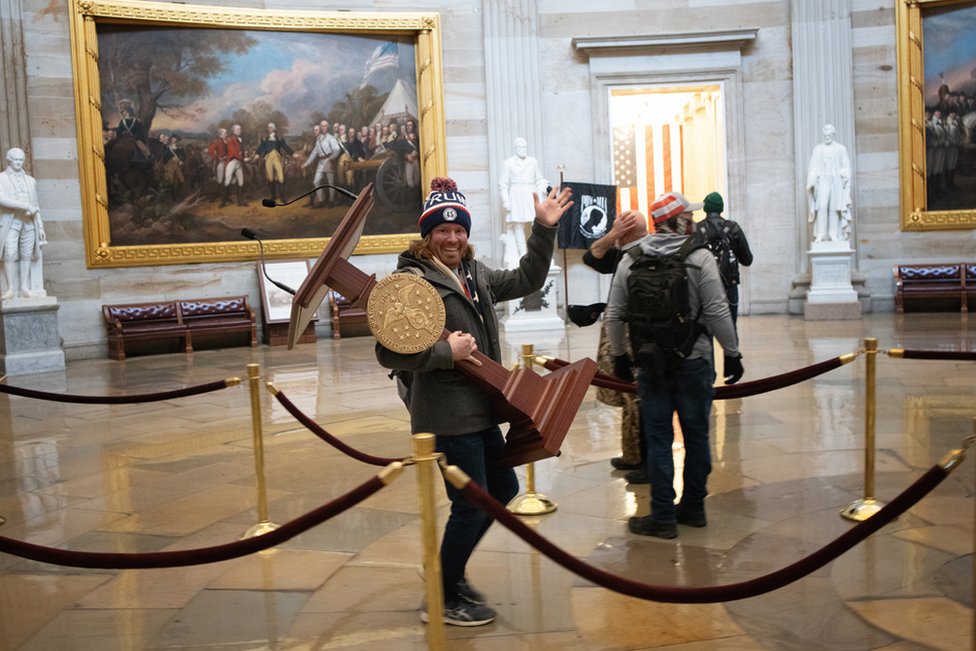
  • One last poignant note: In a photo (see below) of the January 6, 2021 U. S. Capitol violence, I noticed the large painting in the background of the Capitol Rotunda. It looked familiar. It is the painting mentioned above which includes Rufus Putnam. I was not aware of its presence in the Rotunda - and relieved that it was not damaged. Putnam’s accomplishments and character make him worthy of being present and representing Ohio in the U. S Capitol.

  • Capitol Riot: Five Startling Images from the Siege BBC News
    Creator: Win McNamee/Getty Images


Sunday, May 31, 2020

Rufus Putnam helps the “Dellaware Woman”

I came across a curious letter written by Rufus Putnam. It probably the shortest he ever wrote:

                                                                MARIETTA, May 17th, 1797.
Sir :—
Pleze to Deliver the Dellaware woman, widow of the murdered Indian Such goods as she shall chuze to wipe away her Tears to the amount of Five Dollars.
                                                                                    Rufus Putnam
To Griffin Green esq. or 
Charles Green

A notation by “S. P. H.” (presumably historian Samuel P. Hildreth) suggests that the Indian widow’s husband was killed by a white man in revenge for a previous act.

Rufus Putnam was the founder of Marietta, Ohio, and a prominent, courageous, and caring leader. Actions such this payment for the widow were characteristic of Putnam. It was attention to a “little thing” that could have been easily ignored. Author David McCullough noted in his book The Pioneers that when Putnam died he was “widely remembered” for this act of kindness. 

Putnam’s integrity set a standard in many ways. Under his leadership, the Ohio Company of Associates (the group that started the 1788 settlement at Marietta) helped the poor and sick, paid the expenses of an injured worker, and formed a militia with Company funds during the Indian unrest.  

He structured the Ohio Company so ordinary people and veterans could join. Limits on ownership prevented manipulation by speculators. The books and records of the Company were open to all. Company surveyors had to take an oath to be fair and submit full reports of their work.


Oil on canvas by James Sharples Sr., ca 1796-1797, viewed at nps.gov. Putnam was painted in uniform, though he had retired from military service in 1793


Rufus Putnam was a person of strong faith that influenced his actions and demeanor throughout his life. As a young soldier for the British in the French and Indian War he recalled that his superior Captain Ebenezer Learned “prayed regularly, night and morning with his men, and on the Sabbath read a sermon...” In 1790 Putnam brought his family and others from New England to Marietta. The trip took several weeks. The group did not travel on the sabbath and attended church. Evenings at his home in Marietta included family prayer time. He was active in establishing and supporting the First Congregational Church.

The letter about the “Dellaware woman” had another fascinating aspect: the spelling and grammar were poor for a person of his reputation. “Dellaware” is obviously misspelled. Other words were spelled phonetically - such as “pleze” and “chuze.” Capital letters appear at random. 

Putnam was embarrassed by his poor spelling and grammar. He once wrote to a friend: ....”Had I been as much engaged in learning to write, spelling, etc., as with arithmetic, geography, and history I might have been much better (prepared in life).” 

Unlike many of the well educated settlers, Putnam was largely self-taught. His step father did not allow him to attend school. He had an innate interest in learning, though, and used money from waiting tables to buy books. He was a voracious learner through life experience. His life vocations included farmer, millwright, military engineer, surveyor, civil administrator, and politician.  

The words of the letter about the Indian widow were few, but the action revealed much about the character of a remarkable man.


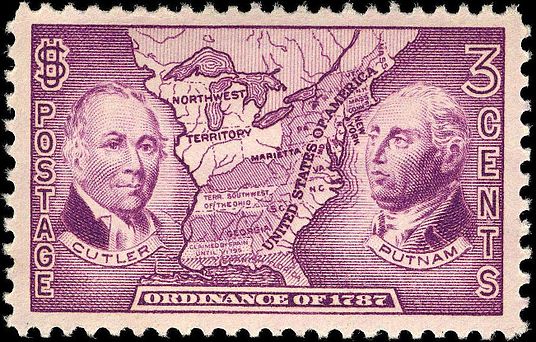
Rufus Putnam is depicted (right) on a commemorative postage stamp issued on July 13, 1937 by the U.S. Post Office which commemorated the 150th anniversary of the North West Ordinance of 1787. The engraving on the stamp depicts a map of the United States at the time with the North West Territory between the figures of Putnam (right) and Manesseh Cutler (left).


Sources:

Buell, Rowena, Editor, The Memoirs of Rufus Putnam and Certain Papers and Correspondence, Published by the National Society of the Colonial Dames of America in Ohio, Boston and New York, Houghton Mifflin, 1903

Cone, Mary, Life of Rufus Putnam with Extracts from His Journal, Cleveland, William W. Williams, 1886

Crawford, Sidney, Rev. Rufus Putnam and His Pioneer Life in the Northwest, Worcester, Mass., Press of Charles Hamilton, 1899, viewed at Archive.org

McCullough, David, The Pioneers, New York, Simon and Schuster, 2019

Hildreth, Samuel, Biographical and Historical Memoirs of the Early Pioneer Settlers of Ohio, Cincinnati, H. W. Derby & Co., 1852


Tuesday, September 3, 2019

Rufus Putnam: the early years

Rufus Putnam, one of Marietta’s founders, a millwright, surveyor, veteran of two wars, pioneer leader, civil servant - faced many hardships in his early life. But those hardships in life and military service formed the foundation for decades of leadership and accomplishment. 

Note: Words in bold are your author’s emphasis of Putnam’s traits.

Profile portrait from Wikipedia. Portraits of Rufus Putnam are mostly from middle age or older, and he preferred to be viewed from the left side.

At age seven his father died. Life with his stepfather, Captain John Stadler, after his mother remarried was harsh. He was not allowed to attend school. Stadler believed intellectual pursuits were a waste of time. Biographer Samuel Hildreth noted that Rufus “craved...instruction and would not be appeased without it. He persisted and largely taught himself.  Rufus used scant earnings from waiting tables at Stadler’s public house to buy powder and shot. With that, he shot game birds, sold them for cash, and bought reading and arithmetic books.

As a young adult he took on the obligations of military service. Below are notes from Rufus Putnam’s Journal (quotes are from The Life of Rufus Putnam with Extracts from His Journal unless noted).

The French and Indian War between Great Britain and France, began in 1754. On March 15, 1757, at age nineteen, he enlisted as a “provincial” soldier (volunteer from the American colonies) with the British forces. It was not easy duty.

July 8, 1757: He and two other rangers were sent forward to scout an area near Lake Champlain. They were stranded without adequate clothing or bedding for 2 days when their unit withdrew without them.

July 23: At 8:00 am, Indians attacked his unit near Fort William Henry. There were thirteen dead and one missing. “This was the first sight I had of the Indian butcherings and it was not very agreeable to the feelings of a young soldier.” 

August 3: A French Army laid siege to Fort William Henry; on August 9 the garrison of outnumbered British soldiers surrendered. While Putnam’s group of Provincial soldiers were marching to surrender at Fort Edward, Indians attacked “and a most horrid butchery ensued.”  The terms of surrender allowed the British to leave peacefully. Indians on their own began wantonly attacking British soldiers and civilians, including women and children.


CLICK TO ENLARGE
Fort William Henry image. For more detail about the fort, click here.

CLICK TO ENLARGE
Engraving of Louis-Joseph de Montcalm trying to stop Native Americans from attacking British 
soldiers and civilians. Viewed at  https://www.loc.gov/pictures/item/98505902/Wood engraving by Alfred Bobbett, ca. 1824-1888 or 9, engraver, based on painting by Felix Octavius Carr Darley, 1822-1888

October 8: Most men in his ranger unit were discharged. He was drafted into a group of carpenters until November 8 to finish building fortifications at Fort Edward. 

November 18: “Three Hundred and Sixty of us were drafted into....winter quarters. This was a great and unexpected disappointment.” They expected to be discharged earlier when the fighting was over.

February 3: His unit’s official enlistment expired, but the commanding officer insisted they remain and threatened them with death if they left. They set out anyway for Fort Hoosac at 3:00 am. Knee deep snow. Their provisions were barely enough for 2-3 days. 

February 4: Snowy, stormy day. Disappointed that they did not reach the fort that evening. 

February 5: Started early expecting to reach the fort by noon. “Noon and night came but no fort...Provisions nearly exhausted...several men froze their feet.”

February 6: Realized they had taken a wrong turn along the river. Changed course. Camped on a mountain top. Snow five feet deep.

February 7: Thirty men breakfasted on a small turkey. Followed a small stream which grew into a river by days end - an encouraging sign. Nothing to eat but beech nuts and a few cranberries. “Night found us very faint and much fatigued,” but hopeful.

February 8: Rough terrain. “Men...feeble and lame with frozen feet.” In their desperate need for food, they killed the dog that had accompanied them and ate it. “It was carefully butchered and divided” so that each man received the same amount.     

February 9: Better conditions for walking. Spirits bolstered by signs of human activity and familiar landmarks. 

February 10: Arrived at the fort by 10 am where they were cared for and fed. Rufus Putnam stated that for the entire march he had carried the pack (in addition to his own) of Ichabod Dexter, who had severe frost bite. 

February 15, 1758: Arrived home at Brookfield, Mass.

April 10, 1758: Rufus re-enlisted:  “Notwithstanding my late sufferings (in the previous campaign), I again engaged for another campaign in the Provincial service.”

June 12: He was assigned to a unit of engineers who were sent to Lake George to build defenses in advance of the army’s campaign to take Fort Ticonderoga (then “Fort Carillon”).

July 5: 17,000 British troops advanced in boats along Lake George towards the fort. On July 6, General George Howe, second-in command of the army and beloved by the troops, was killed in an initial skirmish. This was a major blow to troop morale. 
July 8: Putnam’s regiment was building a breastwork (temporary earthen fortification). There was a constant barrage of cannon and musket fire. In the late afternoon he volunteered to carry ammunition forward to the front lines. The army had retreated to a breastwork. He was shocked to see “so many of our men killed and wounded.”

CLICK TO ENLARGE
Fort Ticonderoga ("Fort Carillon" at the time - from fortticonderoga.org, photo by Carl Heilman II


British troops had suffered a humiliating loss at Fort Ticonderoga. Rufus returned to his regiment of Provincial engineers. At midnight they began a march in retreat to Fort William Henry.

Howe’s death prompted a poignant reaction at the time from Rufus, “...I was so panic struck that I remain(ed) with the boat guard (away from the fighting);..... however, I recovered, at least in a measure, (and rejoined) the regiment.” He admitted accepting the risky assignment to carry ammunition to the front lines on July 8 “lest my reputation should suffer” for having shown cowardice after Howe’s death.

His reflection continued: “I have heard that some men say that...they like to fight as well as they like to eat. I never had any such feelings; so far as I am able to judge for myself, it was pride and a wish to excel, ...that influenced me, at that period of life....”

July 22: Putnam’s unit was employed repairing roads from Fort Edward to Albany until October 29 when they were discharged.

November 9, 1758: He returned to Sutton, Mass., his hometown. “Thus I carried through a second campaign, enjoying uninterrupted health, the friendship of my officers, and never charged with any crime. But alas! On my journal I cannot find any acknowledgment to my Divine Benefactor and Preserver.”

April 2, 1759:  He enlisted again: “I this day engaged the Provincial service for the third campaign.”

July 22: A new campaign for taking Fort Ticonderoga was underway. British forces advanced. At 1:00 am on July 27, there was a spectacular explosion which lit up the night. The French had blown up the fort’s munitions and retreated.

August 4: Regular provincial soldiers were discharged. Rufus agreed to continue work building saw mills for a promised dollar a day. 

November 30: After four months of work, he was discharged, but the engineer in charge did not honor the dollar a day agreement. Rufus was paid only 15 cents per day for his hard work. “I was cheated,” his journal notes with exasperation.

December 1: Embarked with eleven others in two bateaux (large boats) to cross Lake George bound for Fort George. Another ordeal lay ahead. Weather good but worsened. Had to stay the night on a small island. Became very windy and cold.

December 2: Too windy to proceed; “it was never colder since my remembrance.”

December 3: Provisions all gone; “...the cold continuing and hunger increasing.” Luckily they found some old provisions left by others and ate a meal of salt pork and flour.

December 4: One of boats leaked. To lighten its load, baggage was transferred to the other boat which became severely over-loaded. With any wave action they would have perished. “But Providence ordained it so there was a perfect calm the whole day.” Arrived at Fort George just after sunset.

March, 1760: Rufus enlisted yet again and was ordered to recruit others into the Provincial service. It was frustrating duty; he found only a handful of recruits.

June 2: Joined his unit of engineers stationed at south outlet of Lake George. They did not participate in the siege and surrender of French forces at Isle au Noix which paved the way for the British to capture Montreal on September 8, 1760. 

The French and Indian War was over. Rufus returned to his primary trade of building mills.

His journal has a curious entry on June 27, 1760: Rufus Putnam reported having a dream that he was attending a wedding in the home of his future father-in-law William Ayers. Rufus then realized he was the one being married. In another dream a short time later he was in a room with his future wife Elizabeth Ayers. 

September 10, 1761: He married Elizabeth Ayers but she died less than a year later. Shortly after that, their infant son was also buried. “Thus was I in less than a year deprived of mother and child, and in them, as I then thought, of all earthly comfort.” He would remarry in 1765.

January 10, 1773: Agreed to help find land in the new Florida Territory for veterans of the French and Indian war. But the promised king’s order authorizing the grants was never approved. The Putnam party’s eight month exploration of the lands was for naught. He was reimbursed for only a fraction of his time and expense.

Rufus enlisted again in 1775 - this time in the Revolutionary War. Hildreth: “He buckled on his sword when the strife began, and he did not lay it down till liberty was secure and peace again smiled upon the land” - nearly six years later.


CLICK TO ENLARGE
Image of Fort Putnam at West Point NY built in 1778 by Rufus Putnam and 300 soldiers from the 5th Massachusetts Regiment.

Such was Rufus Putnam’s lifelong sense of duty, commitment, and perseverance that went into whatever endeavor he chose.


SOURCES:
Cone, Mary, Life of Rufus Putnam with Extracts from His Journal, Cleveland, William W. Williams, 1886

Dawes, Ephraim Cutler, Journal of Gen. Rufus Putnam Kept in Northern New York During Four Campaigns of the Old French and Indian War 1757-1760,  Albany, NY, Joel Munsell's Sons, 1886

Hildreth, Samuel, Biographical and Historical Memoirs of the Early Pioneer Settlers of Ohio, Cincinnati, H. W. Derby & Co., 1852

Mad Monarchist blog, "Sacrifice at Fort Carillon," November 30, 2017, madmonarchist. blogspot.com

New York State Military Museum, "Fort Putnam," at dmna.ny.gov

rogersisland.org, "History," references to Fort Edward

"Rufus Putnam," Wikipedia, viewed at wikipedia.org


Friday, July 27, 2018

A New Territory Begins: July 1788


Walking through the woods on July day recently sparked a reminder of Marietta’s earliest days as a new settlement in 1788. Our two English Sheepdogs Sophie, Tess, and I ambled down a trail near our home. It was a sunny and mild Sunday in July - a welcome break from the typical heat and humidity.

Sunlight filtered through the trees. We stepped into a cathedral of total shade at the waterfall under a canopy of towering maple, oak, and sycamore trees. It was quiet. Only the gentle patter of the waterfall and the wheezy buzz of a seasonal cicada were audible. Later that same day, the dogs explored the edge of a bluff above the creek. Suddenly there was an explosion of flapping wings and squawking as a flock of turkeys launched themselves down the valley. 

The towering trees, turkeys, and the quiet reminded me of Marietta’s earliest period 230 years ago in July of 1788. The tall trees hid the sun needed to grow crops needed for food. Turkeys were a welcome source of food, but large flocks also damaged crops. It was quiet then: there were just a few dozen people around. Only sounds of nature, people talking, and hand tools would have been heard.

Yet it was a busy July of 1788 in the new settlement at Marietta. A year had passed since the passage of the landmark Ordinance of 1787 which created the first United States territory beyond the original thirteen states. Now it was time to bring that new territory to life.


Summary of Ordinance of 1787 from Reddit.com viewed at
CLICK ON IMAGE TO ENLARGE

July 4 featured a community celebration with fireworks. On July 9, the Territorial Governor, Arthur St. Clair, arrived at Marietta. Major Ebenezer Denny’s journal records the event: “The arrival of the Governor of the Territory was announced by the discharge of thirteen rounds from a six pounder (cannon). The garrison (at Fort Harmar) turned out, and troops received him with presented arms.” 

The government of the new territory was officially installed on July 15. Governor St. Clair was conveyed from Fort Harmar to the “Bowery” (a long covered area erected near the Muskingum River) on the east side on a barge with “Congress” written on one of the oars. He was greeted by General Rufus Putnam and two of the three territorial judges, Samuel H. Parsons and James Mitchell Varnum. Putnam gave brief welcoming remarks. Secretary Winthrop Sargent read the commissions of the governor, judges, and secretary. St. Clair gave an address. 


Major General Arthur St. Clair, first Governor of "The Territory North and West of the Ohio River"
From Wikipedia

St Clair made several points that caught my attention:
  • He praised the character of territorial leaders, mentioning their concern for religion, morality, love of liberty, willingness to sacrifice, respect for the rights of mankind. This went beyond mere rhetoric; it truly reflected the attitudes of the leaders.
  • He observed that the legislative function of the new territorial government was only a temporary one: There was no elected legislature at this early stage. The Governor and Judges formed a legislative council to enact laws and could only enact laws adopted by other states. He gave assurance that acting in the best interests of the residents under this technically undemocratic system was "...a very important part of our duty, and will be attended to with the greatest care." He further pointed out that Congress could annul territorial laws which it believed were not lawful or suitable.
  • Despite hardships in the new settlements, he encouraged patience and perseverance, along with a keeping a vision of a successful future.
  • He devoted a significant part of his comments to the relationship with Indians: "Cultivate a good understanding with the natives...., treat them on all occasions with kindness, and the strictest regard for justice, run not into their customs and habits, prevent....reproach." Such conduct, he argued, would make them less hostile and more open to a peaceful existence.


Summary and Map of the Northwest Territory - from
https://historyplex.com/northwest-ordinance-of1787-purpose-summary-significance
The map shows states which eventually were formed from the territory lands
CLICK  ON IMAGE TO ENLARGE

General Putnam gave a brief response and "three cheers closed the ceremonies of the day." The citizens of Marietta issued a written response to St. Clair's speech. A committee including Ebenezer Sproat, John May, and Paul Fearing delivered that response to Governor St. Clair on July 17.

Governor St. Clair had been engaged in governing since his appointment in late 1787. His primary focus was arranging for a treaty negotiation with Indian tribes in the Ohio country. Congress had tasked him with this daunting assignment shortly after his appointment. On the very same day of his inauguration, he had corresponded with Secretary of War Henry Knox, regarding an Indian skirmish at the Falls of the Muskingum River where treaty negotiations were to be held. Click on link to learn more about the Treaty of Fort Harmar.

The Governor and Judges issued their first Territorial law on July 25, 1788,  "A Law for regulating and establishing a militia of the United States northwest of the river Ohio.... "  A few weeks later, Washington County, Ohio was created. In September, the “Court of Quarter Sessions” - what we refer to as common pleas court today - was convened with much fanfare. There was a procession from the Point to a room in the northwest blockhouse at the Campus Martius fortified enclosure led by Sheriff Colonel Ebenezer Sproat riding on horseback with saber drawn. Appointed judges Rufus Putnam and Benjamin Tupper were seated on the bench. Reverend Manasseh Cutler, visiting the settlement, offered a prayer. Colonel Sproat intoned these words: "Oh yes! A court is open for the administration of evenhanded justice , to the poor and the rich, to the guilty and innocent, without respect of persons; none to be punished without trial by their peers, and then in pursuance of the laws and evidence in the case."

The bold experiment in territorial government that would be the base for state formation and nation building in the United States was well underway in late 1788 - in Marietta, Ohio.

Further notes about Arthur St. Clair:
  • He served in the French and Indian War, Revolutionary War, and U. S. Army after the war, eventually achieving the rank of Major General. But he experienced two setbacks. One was a controversial retreat from Fort Ticonderoga which led to his court martial; he was exonerated. The other was a humiliating defeat by Indians in western Ohio in November, 1791.


A cover page of report analyzing St. Clair's humiliating defeat by Indians

From Wikipedia. CLICK TO ENLARGE

  • His oldest daughter Louisa drew superlatives from locals when he and the children lived in Marietta. She was described in The St. Clair Papers as full of life, expert equestrian - dashing around Campus Martius in full gallop, rapid skater, elegant in appearance, capable hunter, skilled with a rifle which she could load and fire as well as any backwoodsman, yet refined in manners and well educated.
  • St. Clair changed the name of Losantiville, Ohio, to Cincinnati - in recognition of the Society of the Cincinnati, a group formed to preserve the ideals and fellowship of Continental Army officers after the Revolutionary War
  • St. Clair acquired wealth but lost much of it as a result of military service in the Revolutionary War. He regained wealth later in life but suffered financial loss when a loan he co-signed defaulted. He died in poverty in 1818 at his home near Greensburg, PA.
  • He was a Federalist whose preference for a strong national government and elitist leadership left him at odds with the grassroots conservatism prevalent in the new territory. He opposed Ohio statehood. Instead he espoused dividing the Ohio land into two sections with the Scioto River as a north-south dividing line - regions that he thought could generate a Federalist majority.

Sources: All of these were viewed on line unless noted.

Denny, Ebenezer, Military Journal of Ebenezer Denny, Historical Society of Pennsylvania, Philadelphia, J. J. Lippincott and Company, 1859

Hildreth, Samuel, Pioneer History: Being an Account of the First Examinations of the Ohio Valley and the Early Settlement of the Northwest Territory, Cincinnati, H. W. Derby & Co., 1848

The St. Clair Papers Volumes I and II, William Henry Smith editor, Cincinnati, Robert Clarke and Co., 1882, page 107, viewed at archive.org

Wikipedia, "Arthur St. Clair."

Williams, H. Z. et al, History of Washington County with Illustrations and Biographical Sketches, Cleveland, H. Z. Williams and Bro., 1888

Milligan, Fred,  Ohio’s Founding Fathers, New York, iUniverse, Inc., 2003
Pages 81-94 (viewed in paperback edition)