Join the Conversation

Join the Conversation.
I invite your comments, suggestions, and additional information about any topic mentioned.
Showing posts with label Marietta. Show all posts

Sunday, August 10, 2025

“Water, Water Everywhere, nor any drop to Drink”

     This is an oft-quoted line from Samuel Taylor Coleridge's poem "The Rime of the Ancient Mariner." A sailor is adrift at sea and runs out of drinking water. Though surrounded by water, he can't drink it because it's salt water. Williamstown WV faced a similar situation on December 3, 1921, when their water supply was shut off. Though millions of gallons of Ohio River water passed by, it was not purified and couldn't be used. Water shut off? How could that happen to a municipal water system?

     According to history book Fruitful Valley, Williamstown in the early 1900's obtained water from several sources. Two public wells were still in use from the 1800s and there were several family and neighborhood wells. Many residents had cisterns which collected rainwater. Williamstown water was "the purest in the area;" a 1903 Parkersburg newspaper reported, attributing that to the deep wells and springs. Springs on Crystal Heights supplied water to Marietta's Crystal Beverage Company in later years.

     However, the primary source of Williamstown's water in the early 1900s was from...Marietta. It had upgraded its water system in 1891. Andrews’ History of Marietta and Washington County Ohio in 1902 noted with pride, "New (equipment has) been added… additional mains laid and the service extended until it covers…the city and its flourishing suburbs." Williamstown became a "suburb" of Marietta, at least for water supply purposes. In 1902, water flowed through an underwater pipe. Later a two-inch pipe was installed along the walkway of the Williamstown Bridge which had opened in 1903.

CLICK TO ENLARGE. This bridge carried horses, trolleys, vehicles, and water from Marietta to Williamstown. Photo from Harmar Village Facebook page, courtesy Williamstown Historical Society. 


      Back to the water shut off. There had been a few minor disagreements on water bills in years prior to 1921. This time, the bills to the Williamstown Water, Light, and Power Company went unpaid for 8 months, amounting to $2,000 ($25,000 today). It's not clear why - whether there was a dispute or lack of funds. An ultimatum was issued by Mr. Watson, Marietta's Service Director, for 1:00 PM on December 3, 1921: No payment, no water.

     Water was shut off at 1:00 PM. Schools closed. American Bisque which made toys and dolls was rushing to fill Christmas orders. They suspended operations. Fenton Glass had a water storage tank which kept them going. An informal bucket brigade was set up in case of fire.

     Residents were angry at Marietta; a petition to boycott Marietta merchants circulated. 1,100 signed it. Meanwhile, people coped as best they could. Marietta Register-Leader on December 6, "Wells and cisterns...are at a premium and neighbors are getting together and sharing these. The spring water companies are making a rich harvest furnishing the people with drinking water."

     Williamstown sought relief through the WV Public Service Commission (WVPSC), hoping for some type of court action to restore the water. Oddly, WVSPC issued an order stating in part that the Williamstown Water, Light and Power Company was "hereby required to forthwith obtain an adequate supply of pure water for its patrons and consumers in Williamstown and vicinity." The order seemed at odds with the situation since compliance, at least temporarily, was not possible with the water supply shut off. Negotiations with Marietta continued.

     "Controversy Ended - Town Given Water," so read the Register-Leader on December 9, 1921, "Williamstown is no longer a veritable Sahara (Desert)..." The Farmers and Mechanics National Bank (Williamstown Bank today) stepped up and guaranteed the water bill payment to Marietta. In the 1930s, the City of Williamstown expanded its water system with Depression-era WPA funds and in 1939 decided to drill its own wells for water supply.

     The rancor against Marietta and the boycott of merchants? It faded, “water under the bridge,” so to speak.

Friday, January 24, 2025

Marietta at President Trump’s Inaugural

    There was a guy from Marietta in the Capitol Rotunda at President Trump's inaugural. You did not hear or see him in the mainstream or social media. He did not speak, but was likely listening and watching. Who was this man? Rufus Putnam, our founder. He stands watch over the proceedings in the Capitol Rotunda, along with other Revolutionary War patriots, in the  painting by John Trumbull "Surrender of General Burgoyne." Putnam is immediately to the right of the man in white, shown in the close-up photo.

“Surrender of General Burgoyne” at the Battle of Saratoga by 
John Trumbull viewed. CLICK TO ENLARGE

Close up showing Rufus Putnam

Trumbull painting in the background; President Trump speaks at bottom of photo (cropped) 
by Andrew Narvik/Pool/Reuters. CLICK TO ENLARGE

     Rufus Putnam is considered the founder of Marietta in 1788. He had a humble beginning in Massachusetts and was self-educated; his stepfather refused to let him attend school. By the time he was 20 years old, Putnam had mastered the skills of farm management, millwright, surveyor, and military engineer – the latter learned from four tours of duty in the French and Indian War. Putnam also served the full length of the Revolutionary War.

     After that, Rufus Putnam lived a comfortable life in Rutland, Massachusetts but was inspired by the opportunity for a new life in the Ohio Country. The creation of the Northwest Territory in 1787 paved the way for western U. S. expansion. Putnam was a prime mover in the purchase of land in southeast Ohio and establishment of the territory’s first settlement at Marietta in 1788. Putnam not only helped organize this new town, he moved his family from “civilized” New England to the rough conditions on the new frontier. He lived the rest of his life in Marietta, serving in many leadership roles.

   Rufus Putnam was an exceptional man. But one attribute stands out to me: his dedication to serving his country and supporting veterans. Rufus not only served in the French and Indian War but for the duration of the Revolutionary War. Historian Samuel Hildreth: “He buckled on his sword when the strife began, and he did not lay it down till liberty was secure and peace again smiled upon the land” - nearly six years later.

   He was a tireless advocate for veterans, donating countless hours and lengthy travel to make sure that veterans got what was due them. In March, 1779, Putnam made great "exertion to prevent a mutiny from breaking out in the Massachusetts line..." From January to April of 1780 he was on leave from the army to "solicit… relief for the Massachusetts line of the Continental Army and for prisoners of war on Long Island." Putnam co-authored a 1783 petition of Revolutionary War officers to Congress asking that land grants promised to soldiers be awarded on land in today’s Ohio. And Rufus Putnam made it possible for veterans to redeem their land grants awarded for military service to obtain land – and a new life - in the Marietta area.

     It is fitting that Putnam and other patriots are represented the United States Capitol rotunda. Mariettans should be proud to see him there.

Saturday, December 21, 2024

Attack at Picketed Point!

 Life in early Marietta was difficult: few amenities, flooding, epidemics, primitive (if any) shelter, and Indian threats. Early on, there were three communities in the new town. Fort Harmar was built in 1786 with its soldiers and residents was located near where Harmar School is today. Campus Martius was a fortified mini-city about one acre in size located where Campus Martius Museum is today. Picketed Point was the community on the "point" where the Ohio and Muskingum Rivers converge. It included residences along with businesses serving traffic on the Ohio River.

Caption: early drawing of Picketed Point, from Wikipedia with credit to Marietta College Special Collections. CLICK TO ENLARGE.

     The "Picketed" name was a later addition in 1791 when blockhouses and a protective enclosure of wooden posts (“pickets”) of about 4 acres was built around the community. William Stacy and Sheriff Ebenezer Sproat oversaw construction. This was after the Indian massacre at Big Bottom, along the Muskingum about 25 miles from Marietta. The blockhouses are seen in the photo at the corners of the community. They offered protection in event of attack and were occupied by sentries standing watch.

     If any one of the three communities experienced an emergency, they fired a cannon. That would be answered by a cannon firing from the other two. Help would be mobilized. Area residents could seek shelter within the closest protective enclosure.

     One historical account recounts the following Indian attack episode at Picketed Point.

     "On a very rainy, dark night, the sentinel from the bastion of the Campus Martius saw by the help of a flash of lightning an Indian skulking about almost under him; the cannon was fired, answered at "the Point," but nothing further was seen, but plenty of their tracks in the morning. Some short time after, Capt. Joseph Rogers from Pennsylvania. and one of the men with him, were killed and scalped on the hill in the Indian path leading from Mill Creek to the Campus Martius.


   Such was life in early Marietta.


Tuesday, March 26, 2024

Captain Mary B. Greene, Pioneering River Lady

History often overlooked women in early America. There were many notable women in our area. This is one such profile. 

Steamboating was a male dominated vocation in the late 1800’s.  There were no licensed female captains on the Ohio or Mississippi Rivers. Then Mary Becker Greene came along and earned those licenses before age 29. She became an iconic figure in the riverboat industry. 

Mary Catherine Becker Greene was born in 1868 along the Muskingum River near Marietta, Ohio. The river, with its constant changes, meanderings, and bustling commerce was an early draw for her. She recalled river trips to Marietta and back in a johnboat loaded with produce. She did her share of rowing. One day she met a deckhand on a Muskingum River steamboat. His name was Gordon C. Greene, a descendent of the Greene family that founded Newport, Ohio. 

In 1890 she married Gordon; they set up “house” on his steamboat H. K. BEDFORD. According to her, “When you marry a riverman, you marry the river too. That’s the code of steamboatin’.” Few women then worked outside the home. Mary both lived and worked in the home - on their steamboats. 

Image of H K Bedford steamboat with images of Gordon (L), clerk H. E. Bevan (C), Mary (R), scanned from image at Ohio River Museum, viewed at Weelunk.com. CLICK TO ENLARGE


Mary’s accomplishments were many: 
  • Only female licensed steamboat pilot and master (captain) on the Ohio River, active for 60 years until the day she died,
  • Astute business person as co-owner of the Greene Line of riverboats,
  • Only female member and officer of the American Association of Masters and Pilots, 
  • Honorary President of riverboat history group Sons and Daughters of Pioneer Rivermen, 
  • Raised three sons while living on board riverboats, 
  • Elected to National Rivers Hall of Fame, 
  • Iconic river personality who was often interviewed,
  • Named in Ripley’s Believe It or Not!
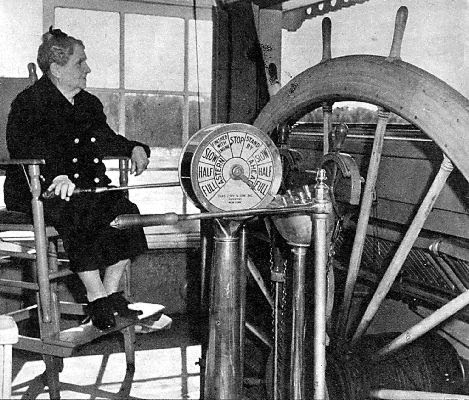
Mary was smart and determined. She learned hundreds of details about the Ohio River needed to get a pilot’s license. At only 5 feet tall, she could barely see over the pilot wheel, let alone wrestle that heavy wheel to steer. But she did it, when necessary standing on the wheel using her body weight to move it. Mary earned respect from the all-male crews and boat operators of that time.


 Mary at pilot wheel. From Delta Queen Company, viewed at allthingscruise.com

Mary was proactive, always making things happen. She stepped up to command the steamboat ARGAND to make it profitable, hosted an excursion trip (then an experimental concept in steamboat travel) in 1904 to the St. Louis World’s Fair, kept the Greene Lines company going after the sudden death of her husband Gordon in 1927, and doted endlessly on passengers.

She was a whiz at customer service, before that was a thing in business. People were attracted to “her” Greene Line boats by the good food, cleanliness, comfort, and fun. There was no drinking or gambling on her boats, creating a family-friendly setting. Mary said in an interview, “People are learning that a river trip is a fine way to spend a vacation.”

Besides navigating the river, there were difficult periods in her life to navigate. Their three children were born and mostly raised on riverboats. This was demanding and stressful. She made it work until Henry, the oldest child, died in 1907 at age 9. Grief and conflicting feelings swept over her. Probably for the first time in her life, she was forced to stop and reassess. Mary soon realized that her first priority should be her two sons. Months later she quit the river and set up the family home in Hyde Park, Cincinnati. “Being at home I can give my two boys the attention they require. On the river I couldn’t.” She eventually returned to the river as the boys grew up. 


Captain Mary B. Greene and husband Gordon, circa 1917. Photo from the collection of the 
late Frederick J. McCabe, viewed at weelunk.com.


Gordon C. Greene, Mary’s husband, died suddenly of a heart attack in 1927. Gordon had told a friend, “When I die, I want to go home on that boat ,“ referring to the TOM GREENE, his favorite boat.  It was in dry dock for repairs at the time. Crew and family worked tirelessly to ready the TOM GREENE to fulfill Gordon’s wish. Mary was with Gordon’s casket as it arrived for burial at the Greene family home in Newport, Ohio.  She with her two sons Tom and Chris continued the business, astutely guiding the company through the Great Depression and World War II.

In 1946, Greene Line Steamers acquired what became their most well known vessel, the elegant DELTA QUEEN. Mary made her home on board, serving as hostess, visiting and socializing daily. Months later in April, 1949, she passed away in her stateroom, at age 81. Only two days earlier she was dancing the Virginia Reel with passengers.  Mary Becker Greene was laid to rest in Newport, Ohio with her husband Gordon, ending a full life of leadership, dedication, and service to others. River historian Frederick Way, Jr. referred to her as …”one of the seven wonders of the river.” 

DELTA QUEEN, from steamboats.org

Forward Cabin Lounge on DELTA QUEEN viewed at deltaqueen.com


Mary may have left this earth in 1949, but her presence on the DELTA QUEEN remained. There have been numerous paranormal, ghost sightings, and odd events tied to Mary since she “left” the boat. One  event happened shortly after her death. Mary strictly opposed sale of alcohol on Greene Line boats. Her son Tom - after much soul-searching, no doubt - installed a bar on board. Days later a small towboat collided with the DELTA QUEEN on the side where the bar was located. The crew was surprised to discover the towboat was named…..CAPTAIN MARY B. Surely this could not be a coincidence, observers noted.

Numerous other “sightings” of Mary were reported over the years. An entertainer reported seeing an elderly lady walking in front of her, who when they rounded a corner “wasn’t there anymore.” 

One man reported that his parents had been moved to DELTA QUEEN cabin 109 due to a water leak. That cabin had been Mary’s. The parents were tormented by noises - the sound of furniture being moved and rattling chains. Balls of light shined in their faces. The closet door opened and closed. Crew members explained that unusual happenings were common in Mary’s former room. One night, aggravated by the activity and lack of sleep, his mother yelled SHUT UP! Noises stopped, and they enjoyed a peaceful night. 

Mary’s presence, whether through the paranormal, her words, or her many accomplishments, remains with us in many ways. 


Sources :

Abbott, Taylor, “Mary B. Greene: The Ohio River’s Leading Lady,” Part 1 and 2, weelunk.com

Barnes, Russ, “Delta Queen Stories,” steamboats.com

“Captain Mary Becker Greene,” The National Mississippi River Museum and Aquarium, 
rivermuseum.org

Espy, G. Andrew, “Mary Becker Greene and the Greene Line,” an interview with Mary B. Greene edited by R. Dale Flick, on steamboats.org

“Greene Line Steamboats,” cincinnativiews.net

Johnson, Phillip, “Remembering Capt. Mary Greene,” steamboats.org

Lamkin, Virginia, “Delta Queen: The Ghost of “Ma” Greene,” seeksghosts.blogspot.com

“Mary Becker Greene,” sites.rootsweb.com

“Mary Becker Greene,” wikipedia

Newspapers.com, numerous articles about Mary Becker Greene

Spilman, Rick, “Is Captain Mary Becker Greene Still Watching Out for the Delta Queen?”, The Old Salt Blog


Thursday, January 18, 2024

Life with Joseph at Fort Harmar

Joseph Buell, Marietta pioneer, future General of the Militia, businessman, and legislator, had a rough start at Fort Harmar: He was court-martialed. He sold liquor “without permission” when he traded a pint of liquor to buy some catfish. Fortuntately, he was acquitted. Joseph Buell was born in Killingsley CT in 1763. He arrived as a sergeant in the First American Regiment at Fort Harmar in May, 1786. His journal gives us a view of life at the fort. Quotes are from his journal unless noted otherwise.

Fort Harmar’s creation was a team effort: Congress authorized it, General Butler picked the location, Colonel Josiah Harmar (the fort was named for him) ordered its construction, Major John Doughty designed it, and soldiers built it. The Fort was built in 1785 on the west bank of the Muskingum River at the Ohio River. It had a pentagonal shape and occupied about 3/4 acre. Congress planned to sell land in eastern Ohio to new settlers and was having the land surveyed. The soldiers’ mission was to protect surveyors and settlers from Indian attacks and remove squatters living on land they didn’t own.

Initial plan for Fort Harmar, CA 1785, from University of Michigan, James McHenry Collection 
CLICK TO ENLARGE

Life at Fort Harmar was not easy. Soldiers endured primitive conditions, harsh discipline, boredom, illness, food shortages, and the constant threat of Indian attacks. Yet Joseph Buell seemed to enjoy his duty. He made friends and tolerated the hardships better than most. Likewise, Ebenezer Denny observed wistfully when he stopped at a mostly deserted Fort Harmar on April 14, 1790, “(It was) a place where I had spent….. the last two years with much satisfaction.”

Drunkenness was a constant problem. Soldiers received a daily ration of a gill (“Jill” - about 4 ounces) of liquor. Imagine that today. On a sunny May Day 1786 soldiers were given extra liquor and allowed to get “damned drunk.” On July 4th there was cannon fire and “we had liberty to drink and get drunk..” During a gloomy January stretch, they kept their spirits up by pouring spirits down, “we made ourselves pretty merry….” Buell’s St. Patrick’s Day entry is amusing: “The sons of St. Patrick kept….(the) usual custom - by getting drunk & fighting & breeding a riot etc.” Two weeks later Gregg “died in a fit of drunkenness…Soldiers have got the Devil in them - a drinking.” After that soldiers were forbidden to buy liquor from others. Joseph Buell enjoyed his spirits but exercised restraint not typical of the average soldier. When his fellow sergeants became drunk and disorderly on New Year’s Day 1787, Buell reported, “I did not think it proper to join this club (and stayed) at my own quarters.”


Painting of Fort Harmar based on early sketch by Joseph Gilman CA 1790. 
CLICK TO ENLARGE

There were six desertions during that first summer at Fort Harmar; more later on. Buell delayed reporting Corporal Weed’s desertion because he was “a very good fellow” -  a friend of Buell’s - who could have been shot if caught. Alford, Dustin, Fox were allowed to go fishing one sunny day. They didn’t return. A week later they sheepishly dragged themselves back and were given 100 lashes. 

Discipline was strict. Even petty offenses warranted confinement, whippings, or worse. “French received 25 lashes for insulting a Corporal.” “Houghmier was given 25 lashes for picking up an apron in the street.” “Brady was whipped 100 lashes for taking a coat out his serg’ts room.” Deserters could be shot on the spot without a trial. Major John Wyllys did just that, killing three deserters at Fort McIntosh. He was arrested at Fort Harmar for those killings but was exonerated and returned to the Fort. Shockley deserted and when apprehended was ordered to “run the gauntlet” 11 times. Running the gauntlet required the perpetrator to run or walk  through two rows of soldiers who struck the person with sticks, whips, or other weapons. It was a severe penalty, but at least he was still alive.

Disease took a toll. Engeham died in May; “the first due to sickness.” A month later Bamerd died.  When a death occurred all soldiers in the Fort marched with the coffin to the burial place led by an honor guard with fife and drums. Music was somber marching to the burial site, but returning they played a “jolly tune.” Question for further research: where was the burial ground for Fort Harmar?

Period drawing of Fort Harmar by Joseph Gilman CA 1790, courtesy Marietta College. 
CLICK TO ENLARGE

Accompanying surveyors was rough and dangerous duty. One company from the Fort returned from a surveying trip in November; “they had a tedious cold time of it. Some were without shoes and their feet badly frozen.”  

In June of 1789, seven soldiers accompanied John Mathews and James Backus on a surveying trip. Weather was hot; swarms of gnats and mosquitoes pestered them. Backus’s journal of the trip reported “bad hills,” storms, heavy rain, a balky compass - “plagued my soul out.” By July, Mathews’ group noticed signs of Indians. They saw moccasin tracks. Horses disappeared. Sentries were posted all through the nights. One morning well past sunrise, the group relaxed around a camp fire thinking the Indian threat had passed. They were not fully dressed. Suddenly shots rang out. Two of the soldiers and Mathews’ trusted assistant Patchen died instantly. 

A corporal, luckily sheltered from the gunfire by a tree, ran. He hid behind a log and watched while Indians explored the camp. He was surprised as their aggressive behavior changed to amusement when they discovered a compass. They laughed and gestured as the compass point moved. John Mathews escaped by outrunning the Indians. He was only partially dressed and wore no shoes. Soon his his feet and legs were painfully bloodied. Eventually the survivors reached the Ohio River and were rescued.

Troops were also charged with removing squatters living on land they didn’t own west and north of the Ohio River. Most left peacefully. In a few cases, soldiers allowed families to harvest their crops before evicting them. Levi Munsell reported a confrontation with squatters near present day Steubenville, Ohio, in 1787.  About 30 hunters were ordered to abandon their cabins. They refused. About 100 soldiers were sent to burn them out. The hunters lined up on the river bank with rifles, appearing to resist leaving. Soldiers confronted them and told them to retrieve valuables - quickly. They complied, and soon their cabins and crops were burned.

There were periods of recreation. Buell liked working in the gardens near the fort. He went to Marietta and viewed the “curiosities of the mountains,” probably referring to the earthworks (Indian mounds). In April of 1787, the weather was “warm and pleasant;” he was grateful to be out and active. A short time later, he and “all the sergeants” visited Isaac Williams who had recently moved his family to present-day Williamstown. The group enjoyed their company and “passed the day very happy.” May Day 1788 was celebrated “in the usual custom.” He added “We live pretty peaceable and happy” other than not receiving their pay on time.

Indians were a constant preoccupation - ranging from friendly curiosity to a deadly threat. Congress had sought peace with Indians, hoping to stem violence between Indians and whites in the Ohio Valley. A treaty was negotiated and signed at Fort Harmar in January, 1789. Despite elaborate efforts and good intentions, it accomplished little.  

Some Indians stayed near the Fort, trading with soldiers and entertaining with their ceremonial dancing. Joseph Buell and Fitch were amused themselves one evening watching the Indians “carry on.” Once the Indians gave a demonstration war dance inside the Fort stockade. 

One sultry August day, Captain Heart observed Indians across the Ohio River on the Virginia side. The crack of a musket echoed in the valley. He saw an Indian shoot a soldier hunting there and saw him fall down. A armed party from the Fort rushed over. They found one man target shooting and another napping on the ground. There were no Indians. 

One Indian episode was troubling for Joseph Buell. He sent one of his cooks to Kerr’s Island to get some milk. The man did not return. Buell fretted. A search party found only the man’s hat and some Indian clothing. They heard later that he had been killed and scalped. 

A friendly Indian named Captain Lunice warned in September, 1786, that Indians planned to attack the Fort Harmar. They immediately prepared for an attack by clearing brush and crops outside the fort to eliminate a potential hiding area. Soldiers were placed on full alert daily from daybreak to an hour past sunrise. There was no attack, but soldiers were on edge for months, contributing to low morale. Buell wrote: “We are out of provisions and expect the Indians every day to attack the Fort.” 

There were women at Fort Harmar. Apparently some were wives; others were employed as maids, cooks, or nurses. Buell refers to them on two occasions as “our virtuous women.” Some may not have been so virtuous. Twice Buell reports that wives had affairs with other soldiers. One of those wives…”got the Devil in her….(and) began to abuse her husband and break all her furniture” in a rage. She also “gave some insolence to Sarg’t Preatt who confined her in the guard house.” She was ordered to leave the Fort on the next boat. 

On another occasion, two soldiers came in and began to abuse “our virtuous women.” Buell removed them by force. In May 1788, a social gathering took place at Hamilton Kerr’s place on today’s Buckley’s Island. Buell and Munsell “stayed at home” because  “(it) did not seem fit to keep company with so many of our Virtuous camp women who (were there).” Why? Buell did not say.

On April 7, 1788, Buell reports: “Gen’l Putnam arrived here at this place with 50 men, who came to settle on the other side Muskingum (River) the most of them were artificiers (skilled craftsmen). They began with great spirit & there is great prospect of its being a flourishing place in a short time.” Joseph Buell himself joined that “flourishing place” (Marietta) in 1790 to operate a tavern with his friend and fellow soldier Levi Munsell. 

Soldiers at Fort Harmar helped stabilize conditions on the Ohio Valley frontier, paving the way for a settlement of Marietta and Ohio.

Monday, April 17, 2023

Abner’s Rant

The handwriting was elegant, as though written by a calligrapher. But the inscription dated January 1, 1812 was mottled, making much of it illegible. It came from a family bible1 belonging to early Marietta businessman Abner Lord. I stared at the image. What was the message and who wrote it?

As I deciphered the words, strong emotions from over 200 years ago emerged from the page. Here is an excerpt (spelling and grammar as in the original document):

Ths Jefferson…as President of the United States - proud union to a great nation of wealthy and honest inhabitants (and brought the treasury of the states into a state of bankruptcy) and myself trusting in the confidence of the nation and have become poor and declined from affluence to a state of depression - have to labour hard in order to get support for nature and all creation by that cursed policy of our government. Tho. Jefferson & Js. Madison have no doubt betrayed & sold the United States to the French Emperor Bonaparte, for their laws and policy have now almost completed the ruin & destruction of the American nation. It is impossible to lay too much against the conduct and policy of those men.
January 1, 1812

N.B. It is my request that my family should at all times and on all suitable occasions bear testimony that this cruel policy of a Jefferson, and a Madison has been our destruction as to our interest & living.
January 1, 1812                                 Abner Lord


Image of Abner Lord family bible inscription, courtesy of Bill Reynolds


Abner Lord was angry. His successful boatbuilding business in Marietta had been ruined by the Embargo Act of 1807. Lord and others were building ocean going vessels in a small town hundreds of miles from the ocean. How could that be? Simple: build the boats, float them down the Ohio River to the Mississippi River to the Gulf of Mexico and out to the world. 

Under the Embargo Act, American ships could no longer sail into European ports. Lord’s and several other boatbuilding businesses shut down. It was a major financial setback for the local economy - and for Col. Lord.

Charles Sullivan painting depicting sailing ships in the Ohio River, viewed in New York Times article, image credited to Ohio History Connection


Abner Lord was ambitious, adventurous, and entrepreneurial - big words often associated with our pioneer settlers. He loved being part of the action, wherever that was. He moved his family in the early 1790s from Connecticut to what is now Vienna/Parkersburg WV, looking for opportunity.

But how could he make money, let alone support his family, in this still primitive settlement? Abner was shrewd; he mingled with others who had influence. With his brother-in-law Spencer he bought and sold large tracts of land in the “backlands” of Wood County. The town of Vienna was created in 1795 on 100 acres owned by the two of them. 

Records show that Abner Lord was appointed as a justice of the peace (“JP”) in Wood County. The JP’s as a group decided judicial matters in the County, so he was part of the leadership structure. However, politics were rough. Abner was kicked off the panel, then reinstated. He lobbied to have the county court located in Vienna but lost out to a Parkersburg faction. Time to move on, he figured, to another community of New Englanders: Marietta. 

Early Wood County WV courthouse circa 1802, from West Virginia State Archives, built in primitive setting in present day Parkersburg on property owned by John Stokely. Abner Lord had lobbied unsuccessfully to have the courthouse located on land he and Joseph Spencer owned in present day Vienna.


Abner moved to Marietta around 1800, though he had Marietta connections before that. He was owner of 1/2 share of the Ohio Company which entitled him to several plots of land. He was a charter member of the First Church of Marietta in 1796. He began a retail business at the foot of Front Street along the Ohio River. 

He observed that boat building was a growing industry. Several others were making good money at it. So, he opened his own shipyard, located along the Muskingum River about where the Armory is now. Several ocean going ships were built there for him. The business was profitable; he built a nice home on lower Butler Street just west of Front Street. Life was good - until the Embargo.

Financial pressures forced him to sell the home and business at a loss. His home was sold at a sheriff sale in 1810 to satisfy the mortgage on it. His anger, resentment, and embarrassment were apparent in his bible message. 

He moved to Columbus in 1811 to be nearer to his daughters. He died there in 1821. A person walking through a run down Columbus cemetery in 1872 saw this grave marker: 
Sacred to the Memory of
COL. ABNER LORD
Who Departed this Life May 2, 1821

Many settlers had a positive impact on their communities, even though things did not turn out as they planned. Abner Lord was one of those. 


1Thanks to Campus Martius Museum Historian Bill Reynolds for showing me this inscription.


Monday, January 23, 2023

A Few Things I Learned About Johnny Appleseed

The question caught me off guard. A lady passenger on the river cruise boat AMERICAN QUEEN asked me about Johnny Appleseed, the frontier-era itinerant apple tree planter. Had I researched him and his activity in Washington County, Ohio? No, I told her, believing that he spent no time here. She said emphatically that he and his family had close connections in the area. I pondered that response, standing in the early morning fog at Marietta’s Ohio River landing - on the exact spot, I later learned, where Chapman and his family landed more than 200 years ago. 

Most of us have heard of John Chapman, AKA Johnny Appleseed. He was a Massachusetts native who in the early 1800's wandered from Western Pennsylvania, to Ohio, and eventually to Indiana. He planted apple tree orchards on the leading edge of settlement in those respective areas until his death in 1845. 

Here are some of my research findings:

Don’t know much about Johnny.
The “Don’t Know Much about Hist-or-y” song lyrics float through my brain. Historical facts about John Chapman are sparse; legends and stories abound. Only a handful of documents exist - a census tract here and there, property records, and a few notes payable that he signed. Most of what we “know” comes from others who knew him or heard about him.

One of dozens of children’s books written about Johnny, many of which presented romanticized or mythical versions of him and what he did. Image from amazon.com.


Below are quotes from various authors on the search for the real Johnny:
  • William Kerrigan: “I sifted through mountains of oral traditions and tall tales about the legendary apple tree planter.  What proved to be more difficult to find were concrete traces of the real John Chapman preserved in the historical record.”
  • Karen Warwick: “Chapman’s legacy stretches far beyond his trees, to the seeds he planted in storytellers imaginations.”
  • Gary S. Williams quoting Louis Bromfield. “The truth is, of course, that Johnny Appleseed has attained that legendary status where the facts are no longer of importance.”
  • David McCullough: Much would be written and said about Johnny Appleseed, including much that has little or no bearing on the truth.
Traditions
I discovered that Johnny Appleseed authors often refer to “traditions” when studying John Chapman’s life. A tradition is a body of stories or common beliefs which may be widely circulated but often not verifiable. Example from author Kerrigan: “There was a (Pennsylvania) tradition that…John may have worked as a logger.” There are dozens of traditions from many different communities - including Marietta.

Pre-Ohio life of Johnny
Knowledge of John’s first twenty years is scant. Some broad outlines can be surmised by his father’s life. Nathaniel Chapman Sr. was a carpenter and farmer; the family was poor. John’s mother Elizabeth noted later in a letter to Nathaniel that they could not afford to buy a cow. Nathaniel was gone for several years serving in the Revolutionary War. His wife, John’s mother, Elizabeth died of tuberculosis in 1776. Nathaniel was discharged from the Continental Army in 1780 and married Lucy Cooley that same year. They lived in Longmeadow, MA. John was then six years old; it is likely that he lived in that household. One source says that John was apprenticed to an orchardist, Mr. Crawford, at age 13. If this is true, it gave him invaluable knowledge of fruit trees and orchard management. 

Moving West
He left Massachusetts in the mid 1790s and moved west. Local historians have good evidence that John Chapman established orchards near present-day Warren and Franklin PA. A Judge Lansing Wetmore gave a lecture in 1853 about an interesting character in early Warren PA history. His name was John Chapman. This “tall, stalwart, Yankee” ventured west across the Allegheny Mountains to Warren in 1796 or 97. Chapman started his trek westward in November. As he approached the summit of the range, it began to snow heavily. He was stuck for three days in a crude shelter. Several feet of snow piled up. He grimly assessed his dire situation. His provisions were running out, he had inadequate clothing for winter, and was walking barefoot. Should he press on or pull back. Either way, he was 100 miles from the nearest settlement. Apparently undaunted, he pressed on, fashioning crude snowshoes from beech saplings to navigate the deep snow. He arrived in Warren in early December and planted his first orchard on Brokenstraw Creek the next spring. Quite a story - likely told by John himself. How much was true? There would be many more stories from him.

He stayed in the Warren and Franklin area for several years, tending his orchards. His half-brother Nathaniel Jr.  joined him in 1798. Author William Kerrigan discovered a note signed by a John Chapman for supplies including “brandy, whiskey, sugar, chocolate, tobacco, three pairs of ‘mockasins,’ gunpowder, and pork.” Assuming this was our John Chapman, it varies from later descriptions of a vegetarian who drank little and did not carry a firearm. 

“The areas where Johnny Appleseed traveled,” from americacomesalive.com, according to the author. This includes most of the area where he started orchards. It does not include southern Ohio and Marietta where his travel has been documented.


Washington County connections
John Chapman had probably heard of Marietta and the new Northwest Territory from his stepmother’s cousins, the Cooleys. The Ohio Country attracted many people like the Cooleys and Chapmans looking for a fresh start. The Cooleys had moved to the area in the 1790's on “Donation Land” - 100 acre lots made available for free by the Ohio Company of Associates. There were some conditions. These lands were on the fringe of settled areas. To be eligible, owners agreed to act as sentries and if necessary help defend against Indian attacks. They also had to build a dwelling, plant crops, and set out apple and peach trees on the land within five years. It was a win-win deal: incentive to attract new settlers; more protection and growing population for the new territory.

The future Johnny Appleseed (this moniker is not attached to him until decades later) visited Marietta in 1796, or 1797, or 1798 depending on the source. Author C. Burr Dawes cites 1796 based on notes from Carl Wier Ellenwood, who lectured about Johnny Appleseed based in part on knowledge passed down from Ellenwood’s relatives in Southeast Ohio. 

John’s father Nathaniel Sr., stepmother Lucy, and his ten half brothers and sisters moved to Washington County in 1805, leaving their native Massachusetts for a better life in Ohio. They settled on land near present day Dexter City, Ohio, then part of Washington County. There is no evidence that Nathaniel Sr. ever owned property there. He may have lived on unclaimed land or on property owned by the Cooley family . 

Though John Chapman never lived here, he passed through this area on the way to and from central Ohio where he conducted his orchard activities. Author Kerrigan says: “He visited his Marietta (area) family regularly and maintained close ties to some of them for the rest of his life.”  Much evidence of this comes from relatives:
  • Author Howard Means says that a tavern owner in Lowell kept a diary which noted that John passed through annually on trips to and from Pennsylvania.
  • Minnie E. Stalling of Dexter City, Ohio, quoted by C. Burr Dawes, said, “John made trips up and down Duck Creek Valley on his way from Marietta…” 
  • He visited his brother Nathaniel Jr., though his wife Ammorillah was not a fan and made John wash up in the creek before entering their house. 
  • John spent time with Davis Chapman (youngest son of Lucy and Nathaniel) and his wife in Lowell almost every year.
  • Two local historic sites, Henderson Hall, and Blennerhassett Island State Park both claim that John Chapman visited or planted at their sites.

W. M. Glines recollections
One account by W. M. Glines, a Marietta resident, in an 1870’s booklet titled Johnny Appleseed by One Who Knew Him, gives a first hand glimpse into Chapmans’ life in the Marietta area. Quotes are from his book. The narrative is fascinating, though not always accurate. Glines cited his sources: “Much that I have said about him I have gathered from his relatives who are a very respectable lot of people, and are perfectly reliable. Other incidents related are from published reports.” 

He states that John Chapman and the rest of the family arrived in Marietta from Massachusetts on April 7, 1798, having floated down from Pittsburgh in a large dugout canoe made from a poplar tree. That date, Glines points out correctly, was the tenth anniversary of Marietta’s founding. “It being the anniversary of the first landing of the Ohio Company (at Marietta)…., the citizens young and old, were engaged in a game of foot ball, an exercise they very much delighted in.” Glines does not describe this game, perhaps an early version of soccer. John himself may have visited in 1798, but the family did not arrive until 1805.

Glines mentions many of John Chapman’s traits and experiences. There was one that I had not heard from any other sources and am not able to verify its accuracy. He states that John at age 21 “received a kick from a horse that fractured his skull, which was trepaned* at the time. From that time forth he manifested that particular character attributed to him.” Glines implies that the injury changed his behavior to the eccentric, unkempt, hermit-like popular image we associate with Johnny Appleseed.

* Trepaned (or Trepanned) is an archaic phrase describing early medical procedures for cranial injuries which may have involved drilling a hole in the skull.

His first hand account of John Chapman’s final visit to see southeast Ohio relatives in 1842 is considered to be true. John stayed in his brother Nathaniel Jr.’s home. Their sister Sally who married John Whitney lived nearby. Lightning had broken apart a large tree on the Whitney property, blasting it into strangely uniform pieces. The Whitneys used those pieces to make fence rails. John Chapman was curious when he heard this story. He wanted to see this tree and the fence rails. Off they went.

Glines, who accompanied Nathaniel and Mr. Whitney, wanted to take his gun to hunt squirrel or rabbit along the way. John objected strongly, “…he read me a severe lecture upon the subject of taking life from any living creature” because of God’s sovereignty over life. They came to a creek; Glines, Whitney, and Nathaniel rock-hopped across it. John removed his shoes and waded through it, walking barefoot the rest of the way. 

He examined the fence rails, measured them, and viewed the nearby tree where the lightning generated rails came from. He then turned to Mr. Whitney and launched into “a sermon upon the wonderful Providence of God to man.” He stated that God had provided the fence rails by striking the tree at the spot where they were needed, thereby saving the family some hard work. Emphatically, he concluded, “…can’t you see it?” Whitney thought about it and wasn’t so sure. He recalled that John had once barely survived being trapped in a snow storm and asked him why God had allowed that to happen. John replied that he was foolish to put himself in such a dangerous situation, but God was merciful to provide enough snow to dig a shelter and avoid freezing.

Glines recollections were decades old when he wrote them down. Other traditions about Johnny Appleseed were often from recollections far in the past. The illustrates one challenge for researchers: those memories that seem so vivid may become less reliable over time. And stories passed down often change in the telling and retelling. 

Story teller
Stories of John Chapman’s overcoming life threatening situations abound. He often told them to rapt children eager to hear a tall tale.  One of the oft repeated stories was set in Pennsylvania. He was traveling by canoe in late winter on a river choked with ice floes. He noticed that the ice was moving as fast as he could paddle, so he dragged his canoe on to one of the floes and floated paddle-free. He fell asleep and ended up 100 miles past his intended destination. That’s a tall tale, for sure. At a brisk current of 5 miles per hour, that would have required more than 20 hours of sleep. In another adventure, he claimed to have escaped hostile Indians by submerging himself in a marsh and breathing through a reed. In this story he again fell asleep and awoke hours later, still submerged. The Indians were gone.

Dedicated Missionary
He was a missionary of the New Church which followed the teachings of Emanuel Swedenborg, distributing literature bought with money from the sale of apple trees. He preached to anyone who would listen, regaling them with “Good news fresh from heaven.” One account says he founded a church. There are many stories about his care in not harming animals or any of God’s creatures in keeping with that faith. He put out a campfire when he noticed that mosquitoes were being burned by the fire. Once a rattlesnake bit him. He reflexively killed it but soon regretted his “ungodly” action. He eschewed planting trees with grafted sections because cutting harmed the trees.

Power of oratory
John could be surprisingly eloquent for someone with such an unkempt appearance. Rosella Rice, who knew Chapman: 
On the subject of apples he was very charmingly enthusiastic. One would be astonished at his beautiful description of excellent fruit. I saw him once at the table, when I was very small, telling about some apples that were new to us. His description was poetical, the language remarkably well-chosen; it could have been no finer had the whole of Webster's "Unabridged," with all its royal vocabulary, been fresh upon his ready tongue. I stood back of my mother's chair, amazed, delighted, bewildered, and vaguely realizing the wonderful powers of true oratory. I felt more than I understood.
His oratory could be just as impressive when he talked about his faith.

Orchards were a business, Chapman a business man
I always thought of Johnny Appleseed as a haphazard planter of apple trees for other people. Wrong: Orchards were a serious business for John Chapman. His work was systematic. He planted in areas of future settlement - before settlers arrived. He found good locations, planted seeds, built fencing (often using tree branches or existing briar patches) to protect the seedlings, periodically tended them, then sold the land or trees years later when settlers arrived. Some of his later orchards contained thousands of trees. Johnny Appleseed owned or leased several hundred acres of land during his life. Author Kerrigan:  “John Chapman did not die a wealthy man, but neither was he impoverished…..”

Imagined sketch of Johnny tending his trees from the 1871 article in Harpers New Monthly Magazine which first popularized John Chapman as Johnny Appleseed.


Apples were vital for early settlers
Foxweather.com article: “At the time, apples were more than just a sweet, healthy treat. Rather, they were a versatile fruit that helped people survive and their farms thrive.” Orchards were a community asset. Apples were used to make apple cider, apple butter, and vinegar. Dried apples were stored for eating during winter. They were also fed to pigs. Apples grown from seeds were not the sweet eating kind. According to Henry David Thoreau, an apple grown from seed tastes "sour enough to set a squirrel's teeth on edge and make a jay scream."

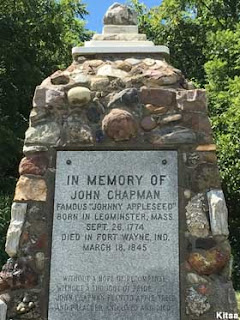
Johnny Appleseed Memorial in Noble County:
There is a monument to Johnny Appleseed near Dexter City, OH at 38345 Marietta Road (State Route 821) near the homestead where his family settled in 1805.  Parley Chapman, his half-brother and his family are buried nearby in a family cemetery on the hill above this monument. The memorial is made from small rocks donated from people all along the routes over which Johnny passed. It includes this message: “Without a hope of recompense, without a thought of pride, John Chapman planted apple trees and preached, and lived and died.”


Sources:
American Forests Magazine, author not disclosed, “From businessman to folk legend: Johnny Appleseed,” 9/26/2014
Dawes, C. Burr, “Johnny Appleseed in Marietta and Muskingum Valley,” Tallow Light, Vol 15. No. 1, 1984
Gabriel, Angeli, “How Johnny Appleseed helped establish the American frontier,” fox weather.com, 12/8/2021
Geiling, Natasha, “The Real Johnny Apppleseed Brought Apples - and Booze- to the American Frontier,” Smithsonian Magazine, 11/10/2014.
Glines, W. M., Johnny Appleseed by One Who Knew Him, The F. J. Heer Printing Co, 1922.
Howe, Henry, Historical Collection of Ohio, Vol II, C. J. Krehbiel & Co., 1904
Kelly, Kate, “Johnny Appleseed Debunked,” americacomesalive.com
Kerrigan, William, Johnny Appleseed and the American Orchard, The Johns Hopkins University Press, 2012.
Means, Howard, Johnny Appleseed The Man, The Myth, the American Story, Simon and Schuster, 2011
Smith, Brady, “The Real Johnny Appleseed,” heinzhistorycenter.org, 6/6/2017
Thompson, Jim, “Tribute to Johnny Appleseed The Tree Planter (Part I)”, Linworth Historical Newsletter, June, 2007, worthingtonmemory.org
Williams, Gary S. Gliding to a Better PlaceProfiles from Ohio’s Territorial Era, Buckeye Books, 2000