Join the Conversation

Join the Conversation.
I invite your comments, suggestions, and additional information about any topic mentioned.
Showing posts with label George Washington. Show all posts

Thursday, July 3, 2025

Rufus Putnam’s Map


The Map

CLICK TO ENLARGE
Map drawn by Rufus Putnam showing British forces discovered during his reconnaissance mission north of New York City in October 1776. Map image courtesy of Bill Reynolds, retired historian at Campus Martius Museum.

     Marietta's founder Rufus Putnam was energetic, creative, and persistent. Give him an impossible task and he'd figure out a way to "git 'er done." Early in the Revolutionary War, he served with the rank of Colonel as an engineer. Engineers built structures, fortifications, and roads to support the Army.

     After the Continental Army's disastrous defeat in the Battle of Long Island in late August 1776, Washington skillfully withdrew the Army at night across the East River to lower Manhattan Island. Morale was low; prospects against superior British forces were grim.

     The Army was forced to adopt a new strategy: win by not losing, by surviving. They began a long, fighting retreat, avoided major losses, conserved resources, and lived to fight another day, as the saying goes. The "Retreat to Victory," as historians call it, began with Rufus Putnam's help. Unless noted, quotes (including spelling and punctuation) are from Putnam’s memoir.

     Washington had wanted the Army to remain in New York City on lower Manhattan. He sent Putnam and General Mifflin out  "...to reconnoiter the country between Kingsbridge & Morrisania & eastward (today's Bronx area)..." They reported to Washington and his staff that the Army was in danger of being surrounded and cut off. General Washington ordered a retreat from New York. Putnam: "...this measure was the Selvation of the army," enabled by "the discoveries made by Miflin & my Self."

     The Army then needed a safe area to store supplies and regroup. On October 19, General Washington dispatched Putnam along with Colonel Reed and 20 soldiers to scout areas north of the City. They reached the heights at East Chester but saw little. Colonel Reed had to return to headquarters.

     Putnam continued - alone on horseback. He started towards White Plains where the Army had a large supply depot. He recalls: "I did not then know where White plains was, nor where the road I had taken would carry me." But he figured it out on his own. He disguised himself and learned of British positions by observation and from some friendly local residents. He was cautious but not deterred in his mission; if captured by the British he could have been hung as a spy.

     Enter...the map. Putnam was a skilled surveyor. He made a sketch of the area for Washington showing British units dangerously close to White Plains. Washington was surprised by Putnam’s findings - and frustrated. “He complained very feelingly of the Gentlemen from New York from whome he had never ben able to obtain a plan of the country.” He thought White Plains was a secure area. General Washington immediately ordered troops toward White Plains; they marched through the night. Putnam's observations “and an interposing providence” had saved the Army "...from a probabal total destruction." Putnam was a man of faith, acknowledging God’s  (“Providence”) favor and guidance on numerous occasions during his life.

CLICK TO ENLARGE. Close up of map showing British forces that Putnam learned about, from left to right, Hessian Grenadiers, British Regiments, British guards, 16th and 17th Light Dragoons, and Grenadiers & Light Infantry

     One Army historian: "despite Putnam's lack of (formal) training, the Commander in Chief quickly grew to regard him as his favorite engineer." Washington had appointed Rufus as Chief Engineer just a few months earlier. Putnam recognized the importance of engineers to the Continental Army. He had submitted a detailed plan to create a permanent Corps of Engineers. George Washington sent the plan with his recommendation to Congress, and complimented Putnam, “…he is indefatigable (in his work) and possesses more practicale Knowledge in the Art of Engineering than any other...”

     Rufus Putnam resigned as Chief Engineer in December but accomplished much in other roles during the War. He commanded Massachusetts units at the Battle of Saratoga victory and appears in a U. S. Capitol Rotunda painting of the British surrender, oversaw building of Fort Putnam at West Point, and spent months lobbying the Massachusetts legislature for support of their Army units. He later helped engineer (can’t resist using that term) the creation of the Northwest Territory and settlement of Marietta.

     Special thanks to local historian Bill Reynolds for showing me Putnam’s original map and the story behind it.

Tuesday, August 20, 2024

Paw Paws, America’s First Fruit

      There it was, laying next to the grass trimmer I was about to start: a paw paw, the first fruit of the season. Suzanne had found it doing yard work. It was ripe, and I took a bite. Fantastic!

     Paw paw has an Appalachian ring to it, sounding like a dog extremity or ma's husband. A paw paw is a greenish potato-sized wild fruit which grows on 20-30 foot tall trees in deep woods throughout the midwest and south. It has never been a mainstream fruit: It bruises easily, spoils quickly, messy to eat, full of seeds. And the trees are hard to find in the wild. Darn.


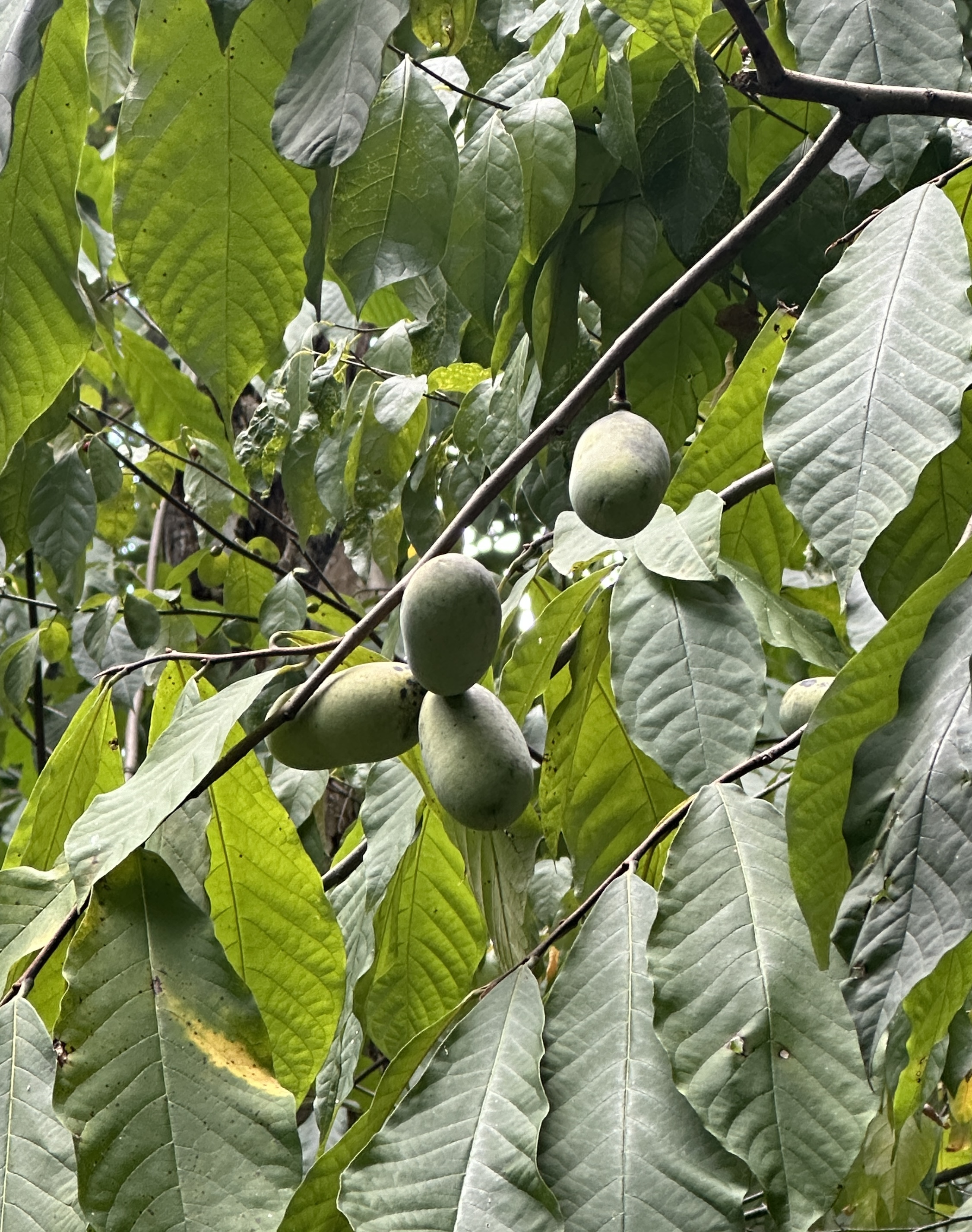
Ripening paw paws on the tree. Photo by author


      The taste is captivating to many, described by one food writer as: "...sunny, electric, and downright tropical: a riot of mango-banana-citrus flavor." The best tasting paw paws are ones picked up within a day or two after falling from the tree. I eat them like corn on the cob - munch around the outside and discard the middle where the seeds are. And I don’t eat too much - more on that later.

     Paw paws have a centuries-old history. They are considered the largest edible fruit native to North America. Indians consumed them long before white settlers arrived. The scientific name for paw paw is Asimina Triloba; Asimina is a Native American word. The name of the Natchitoches tribe is said to translate as "paw paw eater." I was surprised to learn that the Powhatan Indians not only ate wild paw paws but actually kept orchards of them. Food historian Justin Cherry wrote that George Washington expanded his orchards with paw paw trees. On March 7, 1785, he wrote: “Planted… all my papaw (trees).” Thomas Jefferson also grew paw paws; the tree appears on a list in his own handwriting.  The Lewis Clark Expedition ate paw paws, relying on them for survival toward the end of the expedition. September 18, 1806: “…our party entirely out of provisions Subsisting on poppaws”

     The 1749 French expedition in the upper Ohio Valley also saw paw paws. The priest and navigator, Father Bonnecamps, was also a trained scientist. He described the paw paw fruit in detail and called it a "delicate morsel for the (Indians) and Canadians," though he found it "unendurable." He said that paw paw in French was Testiculi Asini, roughly translated "testicle fruit," since the fruit's shape is similar to - well, you get the idea. He described that term "not very refined." Locally, paw paws did not make history headlines. But they were here, and people ate them, in one case erroneously calling them “May apples” – spring wildflowers with small inedible berry-sized “apples”.

     Today you can eat the fruit or try the many paw paw related foods and beverages. Think paw paw bread, jellies, sorbet, and beer or wine. Paw paw fruit has nutritional benefits, being rich in vitamin C, magnesium, iron, manganese, and potassium. But - remember my earlier comment not to overdo eating the paw paw fruit? Paw paw trees have a very active chemistry. Overeating may bring intestinal discomfort or worse. Paw paw extract was advertised in the late 1800s as a cathartic – you can search that word on your own.

     I have noticed that after eating a paw paw, my appetite wanes for a time. Imagine, a new appetite suppressant as an alternative to popular weight loss drugs. Opportunity awaits in the woods near you.

     So, live on the edge; explore paw paws. People may look at you strangely if you brag about paw paw knowledge. But you can feel the pride of being a paw paw cult follower.

Sunday, July 30, 2023

Rufus Putnam Ingenuity Ousts British from Boston

Rufus Putnam is considered the founder of Marietta, Ohio. He had a distinguished Revolutionary War record. His specialty was fortifications. In early March, 1776, George Washington was planning a campaign to force the British army out of Boston. Rather than a risky frontal assault, he and his staff decided upon secretly fortifying Dorchester Heights with heavy artillery. Control of those hills with would give Americans effective command of the city. Rufus Putnam was a key player in this early Revolutionary War action.

The armaments1 brought from Fort Ticonderoga were ready. Bombardments at other locations were planned to distract the British. Nearly 5,000 recently recruited and enthusiastic patriots were eager for action. There was only one problem: the cold. The ground was too frozen to build trenches, earthen walls, and timber structures needed to defend the positions once occupied.

One night Putnam, then serving as an engineer building fortifications, was invited to dine at headquarters. George Washington asked him to stay afterward. He spoke passionately about the importance of fortifying Dorchester Heights. He was anxious to start the campaign but frustrated that frozen ground was holding things up. Rufus recalled, “the General (Washington) directed me to consider the subject and if I could think of any way in which it could be done, to make report to him immediately”

Rufus Putnam was the right person for this situation. He had mastered several trades by the time he was twenty years old. He was curious and relentless in solving problems. He started back to his own quarters, his mind racing. A cold wind whipped around him, an annoying reminder of the urgent situation. He passed the quarters of General Heath. Putnam recalls vividly that “(divine) providence” prompted him to stop and visit Heath. He had no reason to do so. Heath welcomed him. Putnam noticed a large book on military fortifications sitting on a table. He coaxed a reluctant Heath into lending it to him.

The next day he perused the book. His eyes fell upon an illustration of a chandelier. It was not the light fixture of today. “What is that?, he wondered, “….it is something I never heard of before.” The next page explained how it was used. That would work!  It was a low tech solution: tightly wrapped bundles of sticks (fascines) were placed in wooden frames (chandeliers). No digging required. It would stop small arms fire and grape shot. They could be quickly assembled, transported, and mounted on the hill. He consulted with his staff, then reported to Washington who approved it. Immediately they started building the structures.

At 7:00 pm on March 4, 1776, 4,000 Continental Army troops stealthily hauled armaments, the frames, and bundled sticks up the hill in hundreds of horse and oxen carts. Thunderous cannon fire from other locations distracted the British - and terrified Boston residents. A full moon helped the patriots;  a light fog hindered British visibility. Bales of hay piled along the route stifled noise.  By 4 a.m., the operation was complete.

Image of American forces on Dorchester Heights, standing behind Putnam’s chandelier frames 
and bundled sticks

At daylight, British sentries were shocked to see the plainly visible artillery placements. British General Howe reportedly said: “The rebels have done more in one night than my whole army would have done in a month.” Days later, the British evacuated Boston and never returned. It was a major victory for the patriots, enabled by the quick thinking Rufus Putnam. Washington had tried to recruit him as Chief Engineer, though Putnam declined, believing he lacked the qualifications for the job. A decade later, Rufus Putnam started planning a new settlement in the Ohio Valley at Marietta.

Ironic fortune of war: Fort Ticonderoga, where the Dorchester Heights armaments came from, was retaken a year later with an identical strategy and outcome: The British forces hauled cannons up a nearby mountain and aimed them at the fort. Like the British at Dorchester, the Americans realized their plight and abandoned the fort. 


Henry Knox conceived and executed an expedition to recover armaments captured from the British from Fort Ticonderoga, then bring them to Boston to fortify the Dorchester Heights. He reached the fort on December 5, 1775 and departed with 8 brass mortars, 6 iron mortars, one howitzer, 13 brass cannon, 30 iron cannon, a barrel of flints, and 2,300 pounds of lead. Transporting this huge assemblage required 42 sleds, 80 teams of oxen. They had to navigate rivers, wait for ample snow and ice coverage, and drag them over the hill country of western Massachusetts. But they persevered. One historian called it the greatest logistical feat of the entire war.

Sources:

“March 4, 1776, Fortification of Dorchester Heights,” massmoments.org

Baker, David B., “Rufus Putnam the Early Years,” Early Marietta local history blog

Brooks, Noah, Henry Knox, Soldier of the Revolution

Buell, Rowena, Memoirs of Rufus Putnam
Fortification of Dorchester Heights, Wikipedia

“Fort Ticonderoga (1775),” battlefields.org
French, Allen, The Siege of Boston 

Frothingham, Richard, History of the Siege of Boston etc.

Shallot, Todd, Structures in the Stream, Water, Science, and the Rise of the U. S. Army

The Writings of George Washington, Vol 3, 1775-76


Wednesday, July 14, 2021

George Washington and the Ohio River Valley

The George Washington we know was an accomplished person in so many ways - surveyor, military and civic leader in Virginia, Commander-in-Chief in the Revolutionary War, and first President of the United States. He was also an astute businessman who owned large amounts of land, including tracts in the Ohio River valley, some within 20 miles of Marietta. His lifelong primary interest and passion was the land: surveying, farming, investment, and development.

Below are two advertisements to lease or sell the Ohio River tracts. 

The first, published in 1784, sought to lease the land. There were three Ohio River tracts with a total of 10,000 acres located below the Little Kanawha River. One of those is still referred to locally as “Washington Bottom.”

Image from Marietta College Special Collections. Click here for a more detailed view: 
https://cdm16824.contentdm.oclc.org/digital/collection/p16824coll7/id/659/rec/1


The lease advertisement offered an incentive for the lessee to build a home and farm the land. He offered three different - and unusual by today’s standards - lease terms: ten years with no renewal, ten years with renewals of ten years “for ever,” and 999 years. The lessor could specify the acreage to be leased. There was an elaborate rent schedule; the amounts varied by term. The mode of payment included a "Spanish Milled Dollar of the present coin and either gold and silver in that proportion." Payment could also be in the form of barter items such a "staple commodity....if the parties....can agree upon a medium value for it." 

George Washington or whoever wrote the ad was skilled at marketing verbiage, delivered with just the right combination of practical facts and hyperbole. His description of the land: “....the whole of (the land) is River low grounds, of the first quality...a great deal of it may be converted to the finest mowing ground imaginable, and uncommonly profitable for flock(s).”

The second advertisement is dated February 1, 1796; he was still President at the time. This ad had two sections: 

The first part was to lease parts of the Mount Vernon Estate and was the lead headline on the ad: 

TO BE LET, and Possession Given in Autumn.
The farms appertaining to the Mount Vernon Estate, in Virginia; four in number; adjoining the Mansion house farm. Leases will be given for the term of fourteen years to real farmers of goodreputation and none others need apply. 

Punctuation was exactly as it appeared in the ad, including italics. Note that the words “real” and “good” are not italicized, apparently for emphasis. He plainly wanted only good neighbors on farms adjoining his mansion farm.  

Image from Marietta College Special Collections. More a more detailed view, click here
https://marietta.contentdm.oclc.org/digital/collection/p16824coll7/id/910/

The second part of the ad, “FOR SALE; the following Lands, viz.,” listed for sale the four Ohio River tracts, plus others. The tract listed as “SECOND” was “3 or 4 miles” below the Little Kanawha River, and “about 12 or 15 miles below “Mariette (sic).” The ad invites potential purchasers to “examine them critically,” presumably for full disclosure. He also includes some beneficial attributes:
  • “...they may be considered as the cream of the country in which they lye (sic), being the richest interval lands on the two rivers......(and) are unquestionably among the most valuable on the Western waters...” 
  • “That all of (the tracts) are patented in my name, many years’ ago...and, that the titles to them are indisputable.” This was a true benefit. Land at that time often had uncertain titled ownership. A “Patent” (similar to a deed documenting ownership of land acquired by grant or claim) was the most reliable evidence of ownership. 
  • The land had been surveyed, and inquirers could see the survey reports.
Terms for the purchase: one fourth of the price up front “when the bargains are concluded,” and balance paid as a mortgage loan over 5 years “with interest, annually, and punctually paid.”

Most of these lands were never sold and ended up in his estate. A few deals fell through for lack of payment. George Washington died in 1799; his estate listed 52,195 acres of land in Virginia, Pennsylvania, Maryland, New York, Kentucky, and the Ohio Valley.  

Some background helps understand George Washington’s interest in land and land development. George Washington was educated mostly through home schooling - and life experience -  at a very young age. He did not have a formal school education; much of what he learned was from acquaintance with woodsmen and plantation foremen. 

His father died when George was eleven years old, and he became the ward of his half-brother Lawrence Washington. He likely helped his mother manage Ferry Farm where they lived. By his early teens, George Washington had learned tobacco farming, surveying, and raising farm stock. 

Lawrence’s marriage to Anne Fairfax of the well-to-do Fairfax family opened valuable contacts for young George. He accompanied George William Fairfax on a surveying party into western Virginia at age 16. The following year through the sponsorship of Lord William Fairfax he gained an appointment as the official surveyor of Culpeper County, Virginia. Biography.com noted, “This experience (as a surveyor) made him resourceful and toughened his body and mind. It also piqued his interest in western land holdings, an interest that endured throughout his life with speculative land purchases and a belief that the future of the nation lay in colonizing the West.”

Washington eventually became a wealthy man, partly from his marriage to Martha Custis, but also from land that he acquired and managed throughout his life. His half-brother Lawrence died of tuberculosis in 1752. George inherited one of Virginia’s most prominent estates, the Washington family lands which became Mount Vernon. He was 20 years old. Land holdings at Mount Vernon eventually grew to about  8,000 acres.

He made his first land purchase in 1752, 1459 acres along Bullskin Creek in Frederick County, Virginia. Over the next 50 years, he continued scouting for and buying or claiming land.  A major land opportunity for Washington was the availability of “bounty land” for military service in the French and Indian War. A 1754 proclamation issued by Virginia Governor Dinwiddie offered land as an inducement to enlist. Washington himself had served in that conflict (some say his actions actually started the war) as commander of a Virginia militia regiment. 

The war ended in 1763, but a royal proclamation prohibiting the grants west of the Appalachian mountains stalled the land grant process. Washington began a nearly 20 year campaign to have the grants issued for those who had served under him - and for himself. He began quietly scouting out potential land tracts with Colonel William Crawford , a surveyor friend of his, saying in a letter to Crawford:

I can never look upon the proclamation in any other light (but this I say between ourselves) than as a temporary expedient to quiet the minds of the Indians.....(The proclamation must be rescinded), of course, in a few years....Any person who neglects hunting out good lands, and in some measure marking and distinguishing them as his own, in order to keep others from settling it will never regain it. 

He encouraged Crawford to begin secretly exploring the land and making claims. He even gave Crawford a cover story if his actions came under suspicion: “All of this can be carried on by silent management.....under the guise of hunting game...” As opportunities were uncovered, Washington directed Crawford to “...advise me of it....and I will have the land surveyed to keep others off and leave the rest to time and my own assiduity.” The two men continued to collaborate until Crawford’s death* in 1782.

Finally, in 1769, Washington obtained approval to identify lands for granting. He conducted an exploratory trip in 1770 down the Ohio River from Pittsburgh to the Kanahwa River. For more on this expedition from another blog post, click here: “George Washington Was Here.” 

Fortunately, Washington documented this Ohio River trip in a journal. It is fascinating reading. His observations were astute and practical. He pointed out potential sites for mills (mills powered by water were an essential power source for early settlements), farming, grazing, and other activities. 

They passed the Marietta on October 26 and 27, 1770, as noted in these journal excerpts - spelling and punctuation as in the journal:
“Friday 26th......we Incampd just above the mouth of a creek (Little Muskingum River)and just above an island (Buckley Island).
Saturday 27...we came to the mouth of the Muskingham...This river is abt 150 yards wide at the Mouth; a gentle stream runs out of it, and is navigable a great way into the Country for Canoes.” Washington knew that the Muskingum River was a substantial waterway, apparently from Indian contacts. 

Washington was constantly vigilant for land grants as they were offered by the Commonwealth of Virginia. In the letter below he asks for more details about an upcoming land grant and requests that eligible veterans be given sufficient opportunity to attend the meeting and benefit from the distribution of land. He also sought to buy or trade with veterans to acquire land for himself. Here is the wording of the letter to surveyor John West who was involved with the land grant issuance, with the image of the original letter below: 
    
                                                                                    Mount Vernon Sept.12.1773 
Dear Sir: By two letters just come to hand from Col. Stephen and Capt. Hog, I conclude you are returned. These letters appear to have come by you, and refer to a copy of the Resolves entered into at Winchester, which I should be obliged to you for the perusal of; and to know what method you have adopted to give the absentees notice of your meeting on the Kanawha the 20th of October as the time, to those who live at a distance & are to get notice of it yet…to prepare, if they had any other business upon hand to engage them. The reason of my desire to be informed in this matter is on Muse’s account, who I would wish to be early advised of the meeting since he rely upon [it] for the conduct of his part. I should be glad also to know whether you propose to attend the division of the land yourself, and as near as you can guess, the time you will set off.
                                                                   I am D Sir
                                                                                    Your Most Obed. Serv.
                                                                                            G Washington

Washington was ultimately not as successful as he had hoped with the Ohio Valley land. Attempts to lease or sell it were mostly unsuccessful. Yet he remained fervent in his belief of the future potential of the Ohio River region. Author Christopher Coleman captured Washington’s fervor for western expansion, including a quote from Henry Cabot Lodge:

He had been the protagonist of western expansion long before he dreamed of independence. When the latter had been won “the thought that engaged his mind most was of the best means to give room for expansion, and to open up the unconquered  continent to  the forerunners of a mighty army of settlers. For this purpose all his projects for roads,  canals, and surveys  were formed and forced into public notice. He looked beyond the limits of the Atlantic colonies. His vision went far over the  barriers of the Alleghanies; and where others saw thirteen infant  States backed by the wilderness, he beheld the germs of a great empire.”

He supported the efforts of Rufus Putnam and others to settle the Ohio Country and expand the United States westward. About the settlement at Marietta in 1788, Washington said: 

No colony in America was ever settled under such favorable auspices as that which has just commenced at the Muskingum (River). ... If I was a young man, just preparing to begin the world, or if advanced in life and had a family to make provision for, I know of no country where I should rather fix my habitation...


*Colonel William Crawford was brutally tortured and killed in 1782. He was captured after leading a failed expedition against Wyandot and Delaware Indians near Upper Sandusky, Ohio. Delaware chief Captain Pipe helped defeat the “Crawford Expedition” and was present at Crawford’s torture and death. Pipe later became more cordial in dealings with white settlers, including those at Marietta. He was often present at Fort Harmar and was reportedly a dinner guest in Rufus Putnam’s home. Putnam, who knew of Pipe’s connection to the Crawford execution, remained wary of Captain Pipe.


Sources:
Abbott, W. W., “The Young George Washington and His Papers,” February 11, 1999, at Washingtonpapers.org
Cleland, Hugh, George Washington in the Ohio Valley, Pittsburgh, University of Pittsburgh Press, 1955, viewed at archive.org
Coleman, Christopher, “George Washington and the West,” Indiana Magazine of History, Vol 28, No 3, September, 1932
DiSarno, Nicole, George Washington University, “The Kanawha Tracts,” mount Vernon.org
“George Washington,” Wikipedia.org
George Washington Estate, Enclosure: Schedule of Property July 9, 1799, viewed at:
Gardner, Andrew G., “How Washington Made His Millions,” CW Journal, Winter 2013, viewed at 
Hart, Lorna, “Washington in the Ohio Valley,” Pomeroy OH Daily Sentinel, October 28, 2020. 
National Archives, Founders Online, “From George Washington to Samuel Lewis 1 February 1784,” viewed at https://founders.archives.gov/documents/Washington/04-01-02-0066
Redmond, Edward, Senior Reference Librarian, Geography and Map Division, “Washington as Land Speculator, “ George Washington Papers Collection, Library of Congress, Washington, DC, viewed at loc.gov. 
“William Crawford (soldier),” Wikipedia.


Tuesday, December 3, 2019

The Royal Visitors


In July, 1839, King Louis Philippe I of France received an American visitor, a Mr. Hughes, the American charge d’affaires in Stockholm. After introductions, conversation turned to the King’s visit to America in the late 1790’s.

King: “Have you ever been at Marietta?”
Mr. Hughes responded yes, that he had lived there for several years. 
King: “Did you know a French baker there, named Thierry?” Francis Thierry was a French immigrant who arrived in Marietta in 1790 with his wife and two children.
Mr. Hughes answered that indeed he knew Thierry.
King: Explaining with amusement, “Well, I once carried him away from his family,” referring to a decades-earlier incident during Louis Philippe’s visit to Marietta in 1797. More about this episode later. 

Louis Philippe De’Orleans, later King Louis Philippe I, “King of the French” visited the United States in 1796 and 1797. The King often amazed visitors with his memory of minute details of his American tour decades earlier. 

King Louis Philippe I, Getty image -  Portrait by Franz Xaver Winterhalter, 1841

Marietta Connection - Ephraim Cutler
There were two Louis Philippe encounters with a Marietta connection. The first was a chance meeting with pioneer leader Ephraim Cutler who recorded the event in his journal. He met two Frenchmen while boiling salt at the "Salt Works"1 on Salt Creek in Muskingum County, Ohio. He was working there with a friend, Peter Noblaise, a Frenchman who had emigrated to Gallipolis,Ohio.

The two visitors asked to stay with Cutler and Noblaise that night. At the cabin Cutler noted that the three Frenchmen became "quite loquacious in their native language." Noblaise was a good singer and sang the Marseilles hymn and several French airs. Cutler reported that one of the men asked him detailed questions about the Ohio Company, and the settlements at Marietta and Gallipolis. After midnight they retired. Ephraim gave the man his bunk and bear skin. As they left the next day, Louis’ companion explained to Noblaise that the other man was Louis Philippe, Duke of Orleans. He would later be King of France

Louis Philippe was born into royalty in the House of Orleans in 1773. He and his family supported the French Revolution. At age eighteen he was given a command in the French army. He performed well but was forced to flee when he was implicated in an ill-fated attempt to overthrow the French government. He spent the next twenty years in exile from France.


 Young Louis Philippe, Duke of Chartres in 1792 by Léon Cogniet wikipedia. 

Louis Philippe and his two brothers, Antoine Philippe, the Duke de Montpensier,  and Louis Charles, Duke De Beaujolais, toured the United States. Louis Philippe was anxious to see natural wonders, Indians, and the backwoods of the new country. The introduction to Louis Philippe's Diary of My Travels to America, observed: "What is amazing is the breadth of his experiences and the distances he covered when most of the Eastern half of the United States remained unknown and unexplored.“ 

Marietta visit
Louis’ other local visit was a stop at Marietta in December of 1797 toward the end of their American tour. They were on a keelboat trip down the Ohio River, headed  to New Orleans and a return trip to Europe. It was December. River travel was treacherous with the ice, swift currents, and snags. They pressed on anyway. 

At Marietta they stopped for supplies. Louis Philippe wanted fresh bread and was directed to Francis Thierry, the baker whom King Louis Philippe recalled. He had no bread available at that moment and fired up his oven to begin baking. The group obtained their supplies and toured Marietta. They were fascinated by the Indian mound earthworks ("interesting ancient remains") and made a sketch of them. 

As they prepared to leave Marietta, Mr. Thierry rushed the fresh bread to the group's boat on the Muskingum River. But ice on the river was breaking up at that exact moment. The boat lurched away from the shore - with Thierry still on board - to avoid the ice. He was frightened but soon was deposited on dry land by canoe when the ice danger passed. The future King and his party continued down the Ohio River grateful for the fresh bread. He would later amuse listeners, such as Mr. Hughes, in retelling the adventure of "kidnapping" a French baker at Marietta.

The American Tour
Louis Philippe had arrived from Europe in October 1796 at Philadelphia, then the U. S. Capital. He met many prominent people while there and made a good impression. He was described as “modest, amiable, unpretending, cheerful, forgetful of his lost rank." Louis Philippe witnessed the inauguration of John Adams and heard Washington's last speech as President. He reportedly proposed marriage to a young lady. She apparently was willing, but her father was not: "As an exile, destitute of means, you are not a suitable match for my daughter." 

Louis Philippe was not a typical prince in demeanor or lifestyle. He and his brothers had been educated by a governess, Madame De Genlis. They learned by doing through games and role playing. They learned other languages. They spoke only English at lunch; Italian at dinner; German when working with a German gardener. They were toughened by sports, long walks, and sleeping on the floor. He also developed medical skills working with a surgeon. It was an education for adversity as well as for the royal life. Louis Philippe recalled later that his governess "brought us up with ferocity."


Lithograph after the painting by David showing him in Switzerland circa 1793 teaching geography and mathematics under an assumed name at the college at Reichenau during his 21 years of exile from France. (Photo by Universal History Archive/Getty Images). A few years after this he visited America.

His two brothers joined him in America after a long sea voyage in February of 1797. Soon the trio was off to explore. One of the the first stops was Mount Vernon. They visited with George Washington for four days. Washington gave them a recent Abraham Bradley map of the United States and traced a recommended itinerary in red ink. The future king impressed visitors by showing them the "George Washington" map years later.


Abraham Bradley map approx 1796; similar to the map George Washington gave Louis Philippe. Viewed at Tennessee Virtual Archive.  
CLICK TO ENLARGE 


They next wound their way through Virginia, Tennessee, Kentucky, and southern Ohio. Often they lodged with locals, sleeping on the floor surrounded by the occupants, sounds, and smells of a cramped cabin. They stayed one night with a Captain Chapman in Tennessee who wondered out loud why they would “endure all the fatigues of a hard journey to see wilderness, savages, and other (unworthy things).” 

At Chillicothe, Ohio, Louis Philippe stopped a barroom brawl, rescuing the landlord. They endured bedbugs, coarse manners, indifferent workers, excess drinking by the settlers, and periods of rough travel. Antoine Philippe wrote to his sister in August 1797 after a rugged two weeks in New York State: “We have spent fourteen nights in the woods, devoured by all kinds of insects, soaked to the bone, unable to get dry, eating pork and sometimes a little salt beef and corn-bread.” 

There were also delightful visits and excellent hospitality. They met prominent people in cities like Pittsburgh, Boston, and Philadelphia. There were surprise encounters with emigrants from France. One of these, Chavelier Dubac, ran a sweet shop in Pittsburgh. His pet monkey, Sultan, entertained guests. 

They spent time with Indians to learn more about them. Louis coaxed Cherokees in Tennessee to play a lacrosse-type game. At a Seneca Indian Reservation in New York state, he successfully treated a tribal chief by bleeding him. The chief granted Louis the high honor of sleeping on the family mat - between the grandmother and great aunt. 

The brothers departed the U.S. from New Orleans in August of 1798 bound for Cuba. They finally reached England in February of 1800, after a series of harrowing delays. Louis Philippe eventually ascended the French throne as Louis Philippe I, “King of the French” in 1830. He wrote to  historian François Guizot in 1839: “My three years’ residence in America have had a great influence on my political opinions and on my judgment of the course of human affairs.” 

His reign promised to be middle-of-the-road. He was called “citizen king.” Attempts at reforms were frustrated by political and economic unrest. There were seven assassination attempts on the King's life. He was deposed in the French Revolution of 1848. That ended the monarchy for good. Louis Philippe I was the last King of France. He died in 1850.


Notes:
  1. The Salt Works was a salt deposit along Salt Creek in Muskingum County. Surrounding communities formed the "Salt Springs Company" to make salt. Volunteers worked long, tedious hours boiling the salt water to produce salt crystals for community needs. They sold the surplus. Ephraim Cutler was among the volunteers working that day.

Sources:
Abbott, Jacob, Louis Philippe, New York and London, Harper and Brothers Publishers, 1901
Bishop, Morris, “Louis Philippe in America,“ American Heritage Magazine, Volume 20, Issue 3, 1969, viewed at americanheritage.com 
Cutler, Julia Perkins, Life and Times of Ephraim Cutler, Cincinnati, Robert Clarke & Co, 1890
“Louis Philippe,” NNDB tracking the entire world, nndb.com 
“Louis-Philippe Biography,” , Biography.com editors, Biography.com
“Louis Philippe I,” Wikipedia.org
Perley Poore, Ben, Rise and Fall of Louis Philippe, Ex-King of the French, Boston, William D. Ticknor & Company, 1848 
Wright, Rev. G. N.  Life and Times of Louis Philippe, Ex-King of the French,
London, Peter Jackson, Late Fisher, and Son



Monday, October 21, 2019

Smallpox, pioneer scourge

Smallpox. Among the many hardships that the early Washington County pioneers endured was illness, often severe and sometimes fatal. There was bilious fever, scarlet fever, malaria, yellow fever, cholera, and .....smallpox. I read about smallpox often in stories of early settlers. It was only when I saw this photo that the devastation of the disease sank in. 

Young girl in Bangladesh with smallpox, from Wikipedia.

Smallpox has been around for centuries. The first evidence of the disease was from Egyptian mummies dating from the third century BCE. Smallpox occurred in outbreaks all over the world. An estimated 200 million died in the twentieth century alone; many survivors suffered blindness and severe scarring.

Your author was surprised to learn that immunization techniques for smallpox were developed several centuries ago, likely in Asia. Tissue from smallpox sufferers was rubbed or inserted into a scratch in the skin of the person to be immunized. That person would contract smallpox, usually in a less severe form, and thereafter would be immune. This treatment, referred to as variolization, was imported into Europe around 1720. It was a crude and not always successful form of immunization which preceded more modern vaccination techniques. It was widely used in the 1700’s, including at Marietta. 

Yet smallpox remained a scourge which impacted pioneer settlers. Many contracted the disease. Dozens died. Survivors could be blind or disfigured by scars. Courageous doctors and caregivers risked their lives to treat those infected.

Reverend Manasseh Cutler treated smallpox patients in his native Massachusetts. There was an outbreak of the disease in 1772 at Marblehead, MA. Patients were to be admitted to a hospital at Cat Island where Cutler visited. Local residents panicked fearing that the influx of infected patients would spread the disease. They burned down the hospital. The specter of smallpox appeared again in early 1779. Cutler by then had become a physician after training during the previous year. He inoculated and treated 40 or more patients during that period.

The original work party headed to Marietta in 1788 was slowed by smallpox. A group under Major White struggled west from Massachusetts over rough Pennsylvania terrain. In February 1788 they arrived at Simrill’s Ferry on the Youghiogheny River to build boats for the trip down the Ohio River to Marietta. The boat building was delayed by, among other things, smallpox which afflicted five of the party.

The initial outbreak of smallpox at Marietta began in January, 1790. A boat bound for Kentucky stopped at Marietta with a sick passenger, a Mr. Welch, and his family. He was taken to the home of James and Mary Gardner Owen. His disease was the dreaded smallpox. Residents met and decided to build a “pest house” (a building for quarantine and treatment of contagious disease patients, including smallpox) near where Marietta College is now. Mr. Welch was moved there but died a few days later. Mrs. Owen became ill with the disease but later recovered. 

London Pest House image, from Wikipedia. Pest houses originated for epidemics in Europe, such as bubonic plague. Some buildings were quite large. Burial grounds (the “plague pit” in this image caption) were often near the pest house, away from public areas.


Residents were concerned about contagion because of living in close quarters at Campus Martius. There was a town meeting at the northwest blockhouse at Campus Martius. They decided to build more pest houses and to have everyone “inoculated” (using the variolization technique described above). Several of these houses were built “on the plain,” probably in area where Fifth Street and Marietta College are now. One house held 23 patients; another occupied by Colonel Stacy and his family had 20 people. Of the hundred plus people inoculated, only two died. Six people died who became sick by contagion. Doctors Jabez True and Thomas Farley cared for the sick.

Apparently some pest houses were quite small and the quarters cramped. Master builder Joseph Barker stayed in one for a while. He and his wife Elizabeth Dana Barker moved to Marietta in 1789. When the January 1790 smallpox outbreak occurred, Mrs. Barker moved to Belpre to live with her parents until the danger passed. Joseph Barker remained in Marietta and was inoculated with smallpox and moved into a pest house. He rather cheerily described it in a letter to his wife: “I am living in a little clean log cabin that is six feet wide, seven feet long and four and a half high.” He could sit up but not stand up. “We lodge very well.” He survived the sickness and was reunited with his wife and infant son Joseph Jr. a few weeks later.

Mary Bird Lake provided invaluable assistance in this smallpox outbreak. She was a native of England who married Archibald Lake and emigrated to the colonies. She served as a matron of two hospitals caring for wounded and sick Revolutionary War soldiers, including those with smallpox. She received personal thanks from George Washington for her work. Washington commented in 1777 that smallpox was a potentially greater threat than “the sword....of the enemy.”

The Lakes moved to Marietta in 1789 with their eight children. Williams’ History of Washington County Ohio (hereafter, “William History”): "The spring after their arrival the small pox broke out, and during the terrible pestilence Mrs. Lake served a crucial role as nurse." She was familiar with the inoculation technique and guided the physicians who had no experience with smallpox treatment. 

1793 brought an extensive smallpox outbreak in Washington County. In August, scarlet fever and then smallpox appeared in Marietta at Picketed Point, spread from militia soldiers in Colonel Haskell’s command. The Court of Quarter Sessions met on August 7 and ordered removal of the infected persons to Mixer’s spring. The Court met again August 9 and ordered the sick relocated to Devol’s Island, presumably a more isolated location, on the Muskingum River.

Smallpox broke out in September 1793 at the beleaguered Belpre community, which had endured famine, Indian threats, and scarlet fever in recent times. A scout named Benjamin Patterson brought the disease; he had been inoculated in Marietta. The Belpre community initiated “heroic measures,” knowing of the contagion risk of living in close quarters. They sent for Dr. Jabez True from Marietta to inoculate the entire community at Farmer’s Castle (the fortified enclosure at Belpre), which became “one great hospital.” Dr. Samuel Barnes also cared for smallpox patients at Belpre. 

The immunization effort protected the community from devastation. About a hundred were inoculated. Most survived the resulting mild form of smallpox. Five people died, though, testimony to the imperfect inoculation method. 

The family of Simon Deming moved to Rainbow on a donation tract in 1796. They erected a cabin there and cleared an area for farming. Williams’ History has a curious commentary: “During the following season an epidemic of smallpox spread across the county, and the young men of the neighborhood made the Deming cabin a pest house.” Several families of the Deming clan were “confined within this one cabin, where they were waited on by a physician from Virginia.” Who were the “young men”? Were they providing a needed community service or enforcing a quarantine vigilante style? And were the Demings forced to stay in this cabin?

Early physicians were often called on to minister to smallpox patients, in addition to other illnesses. Dr. Jabez True “was many times exposed to the attacks of the Indians, as he passed up and down the Ohio (River) in his visits to Belpre and still lower on the river, to minister to the sick...., numerous trips were made in a canoe, accompanied, generally, by two men.” 

Settlers in Washington County endured much the first few years. Williams’ History captured the essence of what they suffered: ...the terrible scourge had been prevented from doing its worst. Though sorely tried, (they) were destined to neither succumb to the Indian, to famine, to fever, nor to pestilence.”

In 1796 English surgeon Edward Jenner developed an improved vaccine using cowpox virus. Persons vaccinated could be immunized from smallpox without being sickened by it. Jenner had noticed during his surgeon apprenticeship that milk maids and dairy farmers who had suffered from the less virulent cowpox were immune from smallpox. Dr. Jenner devised a vaccine and inoculated an eight year old boy who proved immune from smallpox. Jenner presented his findings; years of suspicion and controversy followed. Finally, in 1800, his method was widely adopted.


Dr Edward Jenner performing his first vaccination on James Phipps, a boy of age 8. 14 May 1796. Painting by Ernest Board (early 20th century). He noticed that milk maids who had been sick with cowpox were immune from smallpox and developed a vaccination
 process using cowpox.

Millions of people were saved from smallpox, yet millions of the unvaccinated died into the twentieth century. With improved vaccine and wider distribution, smallpox was finally eliminated as a health hazard. The last reported case was in 1977.


SOURCES:

Andrews, Martin R., History of Marietta and Washington County and Representative Citizens, Chicago, Biographical Publishing Company, 1902

Cutler, William Parker and Julia Perkins, Life, Journals, and Correspondence of Rev. Manasseh Cutler, L.L.D. Cincinnati, Robert Clarke & Co, 1888

Hildreth, Samuel P., Pioneer History: Being an Account of the First Examinations of the Ohio Valley and the Early Settlement of the Northwest Territory, Cincinnati, H. W. Derby & Co., 1848,

Hildreth, Samuel, Biographical and Historical Memoirs of the Early Pioneer Settlers of Ohio, Cincinnati, H. W. Derby & Co., 1852

Ridiel, Stefan, M.D., Ph D., “Edward Jenner and the History of Smallpox Vaccination,” Baylor University Medical Center Proceedings, National Center for Biothechnology Information, viewed at https://www.ncbi.nlm.nih.gov/pmc/articles/PMC1200696/

Waller, A. E., “Dr. Samuel P. Hildreth 1783-1863,” Ohio History Journal, Vol 53

Wikipedia.com, Smallpox, Smallpox Vaccination, Smallpox Variolization

Williams, H. Z., History of Washington County Ohio, Cleveland, H. Z. Williams and Bro, 1881