Join the Conversation

Join the Conversation.
I invite your comments, suggestions, and additional information about any topic mentioned.
Showing posts with label Revolutionary War. Show all posts

Thursday, July 3, 2025

Rufus Putnam’s Map


The Map

CLICK TO ENLARGE
Map drawn by Rufus Putnam showing British forces discovered during his reconnaissance mission north of New York City in October 1776. Map image courtesy of Bill Reynolds, retired historian at Campus Martius Museum.

     Marietta's founder Rufus Putnam was energetic, creative, and persistent. Give him an impossible task and he'd figure out a way to "git 'er done." Early in the Revolutionary War, he served with the rank of Colonel as an engineer. Engineers built structures, fortifications, and roads to support the Army.

     After the Continental Army's disastrous defeat in the Battle of Long Island in late August 1776, Washington skillfully withdrew the Army at night across the East River to lower Manhattan Island. Morale was low; prospects against superior British forces were grim.

     The Army was forced to adopt a new strategy: win by not losing, by surviving. They began a long, fighting retreat, avoided major losses, conserved resources, and lived to fight another day, as the saying goes. The "Retreat to Victory," as historians call it, began with Rufus Putnam's help. Unless noted, quotes (including spelling and punctuation) are from Putnam’s memoir.

     Washington had wanted the Army to remain in New York City on lower Manhattan. He sent Putnam and General Mifflin out  "...to reconnoiter the country between Kingsbridge & Morrisania & eastward (today's Bronx area)..." They reported to Washington and his staff that the Army was in danger of being surrounded and cut off. General Washington ordered a retreat from New York. Putnam: "...this measure was the Selvation of the army," enabled by "the discoveries made by Miflin & my Self."

     The Army then needed a safe area to store supplies and regroup. On October 19, General Washington dispatched Putnam along with Colonel Reed and 20 soldiers to scout areas north of the City. They reached the heights at East Chester but saw little. Colonel Reed had to return to headquarters.

     Putnam continued - alone on horseback. He started towards White Plains where the Army had a large supply depot. He recalls: "I did not then know where White plains was, nor where the road I had taken would carry me." But he figured it out on his own. He disguised himself and learned of British positions by observation and from some friendly local residents. He was cautious but not deterred in his mission; if captured by the British he could have been hung as a spy.

     Enter...the map. Putnam was a skilled surveyor. He made a sketch of the area for Washington showing British units dangerously close to White Plains. Washington was surprised by Putnam’s findings - and frustrated. “He complained very feelingly of the Gentlemen from New York from whome he had never ben able to obtain a plan of the country.” He thought White Plains was a secure area. General Washington immediately ordered troops toward White Plains; they marched through the night. Putnam's observations “and an interposing providence” had saved the Army "...from a probabal total destruction." Putnam was a man of faith, acknowledging God’s  (“Providence”) favor and guidance on numerous occasions during his life.

CLICK TO ENLARGE. Close up of map showing British forces that Putnam learned about, from left to right, Hessian Grenadiers, British Regiments, British guards, 16th and 17th Light Dragoons, and Grenadiers & Light Infantry

     One Army historian: "despite Putnam's lack of (formal) training, the Commander in Chief quickly grew to regard him as his favorite engineer." Washington had appointed Rufus as Chief Engineer just a few months earlier. Putnam recognized the importance of engineers to the Continental Army. He had submitted a detailed plan to create a permanent Corps of Engineers. George Washington sent the plan with his recommendation to Congress, and complimented Putnam, “…he is indefatigable (in his work) and possesses more practicale Knowledge in the Art of Engineering than any other...”

     Rufus Putnam resigned as Chief Engineer in December but accomplished much in other roles during the War. He commanded Massachusetts units at the Battle of Saratoga victory and appears in a U. S. Capitol Rotunda painting of the British surrender, oversaw building of Fort Putnam at West Point, and spent months lobbying the Massachusetts legislature for support of their Army units. He later helped engineer (can’t resist using that term) the creation of the Northwest Territory and settlement of Marietta.

     Special thanks to local historian Bill Reynolds for showing me Putnam’s original map and the story behind it.

Sunday, July 30, 2023

Rufus Putnam Ingenuity Ousts British from Boston

Rufus Putnam is considered the founder of Marietta, Ohio. He had a distinguished Revolutionary War record. His specialty was fortifications. In early March, 1776, George Washington was planning a campaign to force the British army out of Boston. Rather than a risky frontal assault, he and his staff decided upon secretly fortifying Dorchester Heights with heavy artillery. Control of those hills with would give Americans effective command of the city. Rufus Putnam was a key player in this early Revolutionary War action.

The armaments1 brought from Fort Ticonderoga were ready. Bombardments at other locations were planned to distract the British. Nearly 5,000 recently recruited and enthusiastic patriots were eager for action. There was only one problem: the cold. The ground was too frozen to build trenches, earthen walls, and timber structures needed to defend the positions once occupied.

One night Putnam, then serving as an engineer building fortifications, was invited to dine at headquarters. George Washington asked him to stay afterward. He spoke passionately about the importance of fortifying Dorchester Heights. He was anxious to start the campaign but frustrated that frozen ground was holding things up. Rufus recalled, “the General (Washington) directed me to consider the subject and if I could think of any way in which it could be done, to make report to him immediately”

Rufus Putnam was the right person for this situation. He had mastered several trades by the time he was twenty years old. He was curious and relentless in solving problems. He started back to his own quarters, his mind racing. A cold wind whipped around him, an annoying reminder of the urgent situation. He passed the quarters of General Heath. Putnam recalls vividly that “(divine) providence” prompted him to stop and visit Heath. He had no reason to do so. Heath welcomed him. Putnam noticed a large book on military fortifications sitting on a table. He coaxed a reluctant Heath into lending it to him.

The next day he perused the book. His eyes fell upon an illustration of a chandelier. It was not the light fixture of today. “What is that?, he wondered, “….it is something I never heard of before.” The next page explained how it was used. That would work!  It was a low tech solution: tightly wrapped bundles of sticks (fascines) were placed in wooden frames (chandeliers). No digging required. It would stop small arms fire and grape shot. They could be quickly assembled, transported, and mounted on the hill. He consulted with his staff, then reported to Washington who approved it. Immediately they started building the structures.

At 7:00 pm on March 4, 1776, 4,000 Continental Army troops stealthily hauled armaments, the frames, and bundled sticks up the hill in hundreds of horse and oxen carts. Thunderous cannon fire from other locations distracted the British - and terrified Boston residents. A full moon helped the patriots;  a light fog hindered British visibility. Bales of hay piled along the route stifled noise.  By 4 a.m., the operation was complete.

Image of American forces on Dorchester Heights, standing behind Putnam’s chandelier frames 
and bundled sticks

At daylight, British sentries were shocked to see the plainly visible artillery placements. British General Howe reportedly said: “The rebels have done more in one night than my whole army would have done in a month.” Days later, the British evacuated Boston and never returned. It was a major victory for the patriots, enabled by the quick thinking Rufus Putnam. Washington had tried to recruit him as Chief Engineer, though Putnam declined, believing he lacked the qualifications for the job. A decade later, Rufus Putnam started planning a new settlement in the Ohio Valley at Marietta.

Ironic fortune of war: Fort Ticonderoga, where the Dorchester Heights armaments came from, was retaken a year later with an identical strategy and outcome: The British forces hauled cannons up a nearby mountain and aimed them at the fort. Like the British at Dorchester, the Americans realized their plight and abandoned the fort. 


Henry Knox conceived and executed an expedition to recover armaments captured from the British from Fort Ticonderoga, then bring them to Boston to fortify the Dorchester Heights. He reached the fort on December 5, 1775 and departed with 8 brass mortars, 6 iron mortars, one howitzer, 13 brass cannon, 30 iron cannon, a barrel of flints, and 2,300 pounds of lead. Transporting this huge assemblage required 42 sleds, 80 teams of oxen. They had to navigate rivers, wait for ample snow and ice coverage, and drag them over the hill country of western Massachusetts. But they persevered. One historian called it the greatest logistical feat of the entire war.

Sources:

“March 4, 1776, Fortification of Dorchester Heights,” massmoments.org

Baker, David B., “Rufus Putnam the Early Years,” Early Marietta local history blog

Brooks, Noah, Henry Knox, Soldier of the Revolution

Buell, Rowena, Memoirs of Rufus Putnam
Fortification of Dorchester Heights, Wikipedia

“Fort Ticonderoga (1775),” battlefields.org
French, Allen, The Siege of Boston 

Frothingham, Richard, History of the Siege of Boston etc.

Shallot, Todd, Structures in the Stream, Water, Science, and the Rise of the U. S. Army

The Writings of George Washington, Vol 3, 1775-76


Saturday, February 20, 2021

Black History Month: 3 African American Pioneers

These are profiles of three African American men from our early history. Each distinguished himself with a life of courage and perseverance. Each had the opportunity to live as a free man in the Northwest Territory or Ohio where foresighted leaders had adopted laws to prohibit slavery.

Christopher Malbone aka “Kitt Putnam”
Kitt Putnam panicked as the flatboat started to sink crossing the Ohio River in 1793. He was helping Aaron Waldo Putnam and Major Robert Bradford move cattle from Belpre, Ohio to Virginia. Drowning was a common risk on the early frontier because waterways were often used for transportation. Kitt was an African American servant in the household of Israel Putnam Jr. of Belpre.

He was frightened because he could not swim. The canoe sent to rescue the men could only take one at a time. One version of the incident said that the two white men with him insisted on being rescued first. Israel Putnam Jr., in whose home Kitt served, encouraged him to bounce on his tip toes to stay above water. He also admonished Kitt to not to disgrace the family name by showing any fear. There was no context with the latter comments, but the impression is one showing little empathy or encouragement.

Kitt Putnam's given name was Christopher Malbone. He was one of the first Blacks to live most of his life in Washington County. He was a servant of General Israel Putnam, then his son Colonel Israel Putnam Jr. Kitt came to Washington County from Connecticut with Israel Putnam Jr. in 1789 and lived at The Farmer’s Castle stockade in Belpre as a teen. He was described as friendly, athletic, a hard worker, and kind. He was an excellent worker and sentry, standing watch to warn those working in the fields of danger.

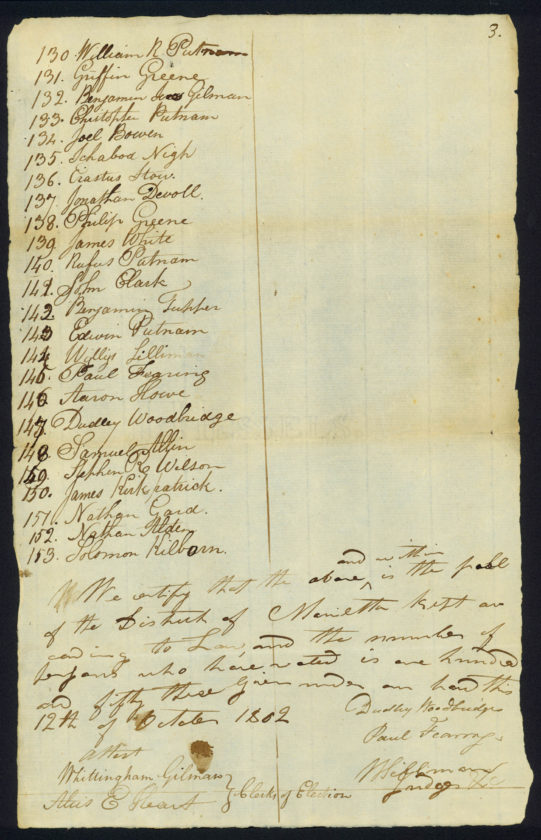
Kitt achieved distinction as the first Black person to vote in Ohio and maybe the Unites States. He voted in the 1802 selection of delegates from Washington County to the Ohio constitutional convention. Ironically, the Constitution, while it prohibited slavery, denied Blacks the right to vote in the State of Ohio.

This image shows a list of voters for delegates to the Territorial Convention, District of Marietta, dated second Tuesday of October, 1802. Christopher Malbone, a.k.a. Kitt Putnam, the first person of color, to vote in the new territory, is listed on line 133 (fourth from the top) as Christopher Putnam. Photo courtesy of Marietta College’s Local Government Records and Legal Documents collection. 
CLICK TO ENLARGE


This actor portrayal of Christopher Malbone voting, from the documentary film “Opening the Door West,” can be seen as part of the “Pathways to Freedom” exhibit at the Campus Martius Museum. (Photo by Erin O'Neill). Copied from Marietta Times article February 7, 2018.
CLICK TO ENLARGE


At age 21, Kitt Putnam became a free man* and could seek other employment. He started working for Captain Devol who lived near the Muskingum River helping clear fields and tend the floating mill. He died unexpectedly in 1802; there was great sadness at his passing. The cause of death is unknown. It is also not known if he had a family or where he is buried.


*The nature of his servant status is not clear. He was not a slave but may have been an indentured servant under a contract which expired on becoming an adult at age 21.


Bazaleel** Norman
This man was a veteran of the Revolutionary War. Blacks served in the war, starting in 1777. There were reservations at first about their bravery and whether military training and access to weapons might tempt them to rebel. Blacks were also fighting for their own independence. Some also had to decide which side, America or Britain, would give them the best chance for freedom. Blacks in the Continental Army served with distinction. They also provided needed manpower, especially at crucial times of low enlistments in general. The Black soldiers served for an average of 4.5 years, more than 8 times the average white soldier.

Bazaleel joined the Continental Army in 1777. Most Army units then were integrated. Bazaleel Norman likely fought alongside white soldiers to gain freedom for country - and for African Americans. He served in Captain Richard Anderson’s company in seventh regiment of the Continental Army Maryland line. His service included the battles of Monmouth, Camden, Cowpens, Gilford Court House, and Eutaw Springs. He served the entire war until the Maryland line of the Continental Army was disbanded in 1781.

After the war, in 1782 he married Fortune Stephens in Frederick County, Maryland. They had six children. Sometime before 1819, they moved to Roxbury Township*** in Washington County, Ohio. There he farmed.

Bazaleel was granted a pension in 1818. An affidavit required to continue his pension was filed in 1820 with the Washington County Common Pleas Court. It listed his war service and also included a list of his assets and debts. Many veterans, especially African American, were poor and relied on the pension for survival. Here is a partial list of his assets: 

100 acres of land third rate, two old Horses the one 14 & the other 17 years old. One Cow 14 years old one spring calf, one two years old Heifer, two yearling calves, two sheep & two Lambs, one Sow & Eight Pigs. Three old Kitchen chairs without bottoms, one old Crock. 4 Pewter plates, 4 old Knives & Forks one old Bucket one shovel Plough. 1 old broken Pot 1 Log chain. One 7 gallon Kettle one small broken Bake Pan 4 old pewter spoons. an old drawing Knife. and old handsaw. two old Chissels. One small fire Shovel. one old axe. one old hoe. one worn wedge

Some of the debts included: “One Hundred & Twenty five dollars to Joel Adams. Thirty Six dollars to Dudley Woodbridge. Fourteen dollars & Seventy dollars to Augustus Stone...” Woodbridge and Stone were merchants in Marietta, quite a distance by horse or on foot from where Bazaleel lived in western Washington County. 

Pension certificate for Bazabeel Norman - image from National Archives viewed at
https://catalog.archives.gov/id/196314602
CLICK TO ENLARGE


Bazaleel’s 1820 affidavit plaintively stated: “I am by occupation a farmer, but owing to age and infirmity I am unable to do very little toward supporting myself.” His signature appeared as “Bazaleel his X mark Norman.” He was signing with an “X” likely indicating that he was illiterate.

Bazaleel Norman died in 1830. His wife Fortune applied for the survivor pension benefit in 1832. It listed Bazaleel’s cause of death as “falling from a rock...his family found him dead at the foot of a precipice” after he had been missing for a day. Another application was made in 1837, and the pension was finally granted - only four years before she died. For some reason, the pension had been delayed or denied for nearly five years. Fortune Norman died on February 3, 1841.


**His name also appears elsewhere as Bezael, Basil, and Bazabeel

***Roxbury Township was an early township that was dissolved in 1851. Parts of it went to Palmer Township, Morgan County, and Noble County.


William Peyton
Washington County resident William Peyton, “Uncle Billy,” was proclaimed the oldest person in the United States in 1912 at age 120. He lived until 1919, dying at age 128, still thought to be the oldest person in the country. He was born as a slave in 1792 in Prince William County. William was bought for $333 as a child by George Creel, an early settler in Wood County, Virginia. He remained with the Creel family for generation after generation. He left them in 1868 and moved to Decatur Township in Washington County where he lived for the rest of his life - another nearly fifty years.

Uncle Billy was one-of-a-kind in many ways. He was described as a “large man with a splendid physique” who loved work. On his eightieth birthday he set a local record by splitting 320 fence rails in a single day. His long life was remarkable because “he used liquor, chewed, and smoked tobacco.” He had an excellent memory and could recall events when Thomas Jefferson was president. His fitness was legendary; he would often walk to Marietta or to Wood County to visit the family of his former masters. Emancipation Day on September 22, 1916 was the fifty- third anniversary of the Emancipation Proclamation freeing slaves. There was a county-wide celebration - said to be the largest in the State of Ohio. The Marietta Register-Leader newspaper reported that William Peyton was the parade honoree.

Collage of information about “Uncle Billy” Peyton from Facebook post 2/21/2021 on Harmar Village - Marietta, Ohio page. CLICK TO ENLARGE

“Uncle Billy” died on December 26, 1919. Peyton’s headstone is at the Decatur United Methodist Church, reading: “William Payton, Sept. 2, 1792, Dec. 26, 1919, 127 Y. 3 M. 24 D.”  His wife was forty years his junior and died in 1900. He was survived by one son and a granddaughter. Judge L. N. Tavenner of Parkersburg reviewed his birth records and substantiated his year of birth as 1791, a year earlier than the date on his gravestone. He had lived through the administrations of twenty-eight presidents from George Washington to Woodrow Wilson.


Sources:
Burke, Henry Robert, “Lest We Forget” website, “William ‘Uncle Billy’ Peyton 1792-1919” viewed at lestweforget.Hamptonu.edu

Dennis, James L., “Washington’s Darker Brother, 100 years of Black History in Washington County, Ohio 1788-1888,” published 1967 by the author

Hildreth, Samuel, Biographical and Historical Memoirs of the Early Pioneer Settlers of Ohio, Cincinnati, H. W. Derby & Co., 1852

Historical Marietta blogpost, August 6, 2016, “53 Years of Freedom to be Celebrated” article from the Register-Leader, August 19, 2016

Marietta Times article, “Black History Month: First to Vote,” February 6, 2018, article by Erin O’Neill

National Archives, Revolutionary War Pension and Bounty Land Warrant Application File W. 5429, for Bazabeel Norman, Maryland, viewed at catalog.archives.gov 


Thursday, November 7, 2019

Marietta and the Queen


What do the names Castrapolis, Protepolis, Urania, Tempe, Genesis, and Adelphia have in common? They were discussed as possible names for the new settlement at Marietta. Adelphia was the strongest contender; it was advocated by pioneer leader/lobbyist Manasseh Cutler. In a December 3, 1787 letter to Rufus Putnam, he stated, ”I feel a partiality for the name proposed at Boston, and think it preferable to any that has yet been mentioned. I think that Adelphia will, upon the whole, be the most eligible. It strictly means brethren, and I wish it may ever be characteristic of the Ohio Company.”

The city was ultimately named Marietta, in honor of Marie Antoinette, then the flamboyant Queen of France. The French had played an important role in support of the colonies during the Revolutionary War. Many of the pioneers had a personal acquaintance with the French nobleman Marquis de Lafayette who had served with distinction as a soldier, commander, and diplomat for the American side. The Queen herself was said to be an ardent supporter of the colonies. 

This story was brought to mind by a newspaper report on October 16 this year. My wife noticed it and said to me, “Did you know that Marie Antoinette was beheaded on this date in 1793?” I looked up blankly from my iPad. Synapses slowly began to fire; dots were connecting.....Marie Antoinette....Queen of France during the French Revolution....yes! - Marietta’s namesake. Now I had to know more. 

The Ohio Company Directors passed a resolution on July 2, 1788 as follows:  “Resolved, that the City near the confluence of the Muskingum and Ohio (Rivers), be called MARIETTA (and) That the Directors write to his Excellency the Compte Moustiers, informing him of their motives in naming the city and requesting his opinion, whether it will be adviseable to present to her majesty of France, a public square-“ Moustiers was the French ambassador to the United States at the time. 

There was no record of a response from the Queen or French officials to the naming of the city and the offer of land. A report circulated that the Queen had sent a commemorative bell to Marietta which was lost at sea. But that has never been verified. 

Ohio Company Directors designated Square Number 1 (where Mound Cemetery is now) as Marie Antoinette Square. It was leased to Rufus Putnam on March 7, 1791 for a period of ten years for maintenance and beautification.  By that time, the Queen’s name was no longer attached to the square. 

Mound Cemetery, Illustration from Squier and Davis Ancient Monuments of the Mississippi, viewed at touringohio.com. This was named Marie Antoinette Square for a period of time before it became a cemetery. 


Queen Marie Antoinette lived a life of extremes: from the pinnacle of royal power and wealth to imprisonment, disgrace, and public execution. She was born an Austrian princess and given in marriage at age 14 to Louis Auguste de Bourbon, heir apparent to the French throne. For her May 1770 wedding, she was escorted to France with an entourage that included 57 carriages, 117 footmen and 376 horses.


Marie Antoinette at age 13 by Joseph Ducreux. Viewed at Wikipedia. This portrait was sent to her future husband in France so he could see what she looked like.

In 1774, the couple became king and queen - he at age 19, she at 18. Early in her reign, she was famous for profligate spending, flamboyant dress, and wild socializing. Tabloid-type gossip exaggerated her public image. She was vilified for shameless opulence while many in France - and the national treasury - were impoverished. Later in her reign, she focused more on her children, political issues, and cultural interests. She is credited with influencing policy leading to French support of the American cause in the Revolutionary War.

This 1787 State Portrait of Marie Antoinette and her three surviving children, Marie Thérèse, Louis Charles (on her lap), and Louis Joseph holding up the drape of an empty bassinet signifying the recent death of Marie's fourth child, Sophie, was meant to improve her reputation by depicting her as a mother in simple, yet stately attire (by Vigée-Lebrun, 1787). From wikipedia.com

But the royal couple were resistant to the teeming social and political changes in France. The French Revolution forced her and King Louis VI from power. She was convicted of treason on trumped up charges and publicly beheaded, as her husband had been earlier that year, on October 16, 1793. Her body was placed in an unmarked grave.

Marie Antoinette's execution on 16 October 1793: Sanson, the executioner(left, on platform), shows Marie Antoinette's head to the people (anonymous, 1793). CLICK TO ENLARGE. 

Read  "10 Things You May Not Know About Marie Antoinette" at History.com at this link:
Number 10 on that list says: “A U.S. city is named in honor of Marie Antoinette.” That city is Marietta, Ohio.

Tuesday, April 10, 2018

Three Brave Men


The Grave
I overheard the trail crew talking about it: a grave site along the new trail. A Buckeye Trail work party was building a new hiking trail in June, 2015, through the Edge of Appalachia Preserve in Adams County, Ohio. One day after trail work was done I hiked out to see the grave.

It was a poignant sight, a simple grave stone with a crisp American flag and Revolutionary War veteran marker, located near the trail. It was shaded by a canopy of tall trees. I took a picture. The cryptic inscription: 
Wm Flood
Morgan's Va
(illegible) Rev War


Grave of William Flood, Adams County, OH, Photo by Author


Ted Cox, a volunteer tour guide at Campus Martius Museum, sent me some information he found on line about William Flood. I learned that Flood had been part of Daniel Morgan's Virginia Riflemen on Benedict Arnold's campaign to capture Quebec in late 1775. Instantly I made the connection: Flood was in the same campaign as two other prominent men with Marietta connections: Return Jonathan Meigs and Aaron Burr.

What follows is a story of three remarkable men, very different in their backgrounds and stations in life, but united in their zeal for the Revolutionary cause. And each was heroic in their courage and perseverance during the Quebec campaign. 

Background: The Quebec Campaign
Invading Canada was thought to make strategic sense. French speaking inhabitants were believed sympathetic to the American cause. It would deny the British a base for operations down the Hudson Valley. General Philip Schuyler was dispatched into Canada via Lake Champlain. George Washington approved a separate expedition led by Benedict Arnold to Quebec. This group would combine with Schuyler's force to take Quebec.

Washington wrote to Congress: 

“I am now to inform the honorable congress that, encouraged by the repeated declarations of the Canadians and Indians, and urged by their requests, I have detached Col. (Benedict) Arnold, with one thousand men, to penetrate into Canada by way of the Kennebec River....I made all possible inquiry as to the distance, the safety of the route, and the danger of the season being too far advanced, but found nothing in either to deter me from proceeding..."  

There was some political spin in the first sentence. The last sentence, though spoken honestly, would turn out to be tragically misleading. 

He also wrote a glowing letter to Canadian citizens inviting their cooperation which included this plea: "Come then, my brethren, unite with us in an indissoluble union; let us run together to the same goal." 

The Quebec expedition turned out to be grueling struggle which ultimately failed in its objective. Everything that could go wrong did. Boats provided for river transport were poorly made and leaked. The map of the route was inaccurate. The distance was estimated at 180 miles; it was actually twice that. The men - and many of their leaders - lacked proper training, conditioning, and discipline. Illness and exertion put many out of service. 

Boats and supplies had to be portaged many times. Image viewed at  https://www.britishbattles.com/war-of-the-revolution-1775-to-1783/battle-of-quebec-1775/

Working against the flood on Dead River viewed at http://www.americaslibrary.gov/jb/revolut/jb_revolut_canada_2_e.html

Boats and supplies had to be portaged over long distances. River rapids sank many of the boats with some loss of life. Days were spent slogging through swamps and dangerous stream crossings. Food ran short. Men in many units were reduced to eating - on various occasions - shoe leather, candle wax, a dog, and a horse. One whole unit under Roger Enos gave up and turned back with 450 men. Those who completed the harrowing journey exhibited incredible courage and perseverance. The battle itself was lost when part of the force withdrew, leaving the other outnumbered and 
surrounded. 

William Flood
Little detail is known of Flood’s activity in the Quebec expedition. He enlisted in a company of 96 riflemen recruited in June 1775 by Daniel Morgan near Winchester VA. They became known as “Morgan’s Virginia Riflemen.” The nature of Flood’s experience can be discerned from Morgan’s activity. John Henry’s journal of the Quebec expedition described Morgan as “a large, strong bodied personage..., a strict disciplinarian,...was of an impetuous temper, yet withal, prudent in war, as he was fearless of personal danger. His severity, at times, has made me shudder, yet it was necessary...”


Daniel Morgan led Morgan's Virginia Riflemen. He was a cousin of Daniel Boone. Image from Wikipedia.com

Service in Morgan's company required immense physical and mental stamina. To start, Morgan marched them 600 miles from Winchester to Boston in just 21 days. That is an average of 30 miles per day.

Morgan attacked the extreme difficulties of the Quebec march head on, as indicated by these events: 
On October 28, boats had to be portaged over the 2500’ Height of Land. Other units carried over just a single boat; Morgan ordered his men to carry all of their boats. Henry’s journal: “It would have made your heart ache, to view the intolerable labors (Morgan's) fine fellows underwent. Some of them, it was said, had the flesh worn from their shoulders.”

On November 1, Morgan lost all of his boats in the rapids of the Chaudiere River along with their food, supplies, and the doctor’s medical kit. One of his men drowned; Morgan himself barely survived. 

The expedition forces crossed the St. Lawrence River undetected to Quebec City on the night of November 13. Morgan was in the lead canoe with expedition leader Benedict Arnold. Morgan boldly suggested attacking the city immediately with the element of surprise - even though some of their force had not crossed the river yet. Arnold thought about it but decided to wait.

The attack was finally mounted on December 31 at 5 am in a blinding snow storm. There were two main attack groups: one lead by General Richard Montgomery and another led by Benedict Arnold. Daniel Morgan's unit was with Benedict Arnold. Morgan took command of that force when Arnold was wounded. His men pressed on, withstanding withering fire, to overcome blockades and enter the Lower City. Henry's journal: Morgan, "brave to temerity, stormed and raged,....though under tremendous fire." 

British and Canadian forces attacking
Arnold's column in the Sault-au-Matelot
painting by C. W. Jefferys


Map showing American forces attacking Quebec, viewed at 


Montgomery's force withdrew after General Montgomery and senior officers were killed by a single cannon shot - ironically, a shot fired off by a drunken British sailor as he fled his station. With Montgomery’s force out of the fight, British troops were able to concentrate men and fire on Morgan's unit. By 10 that morning, they were surrounded and forced to surrender. William Flood was fully engaged in all of this dangerous action - and was taken captive along with Morgan's force. 

Prisoners were crowded into a former seminary building. Life in captivity was grim, though the men were treated with respect by the British. In early January, General Montgomery and other senior officers were given dignified burials. The next day the prisoners witnessed bodies being transported to a makeshift morgue called the "dead house." There “the bodies were stacked in monstrous piles.”

Captivity brought on new misery. Prisoners received only limited food, due in part to a general food shortage in Quebec. Some played games to kill the monotony. All Fours, a card game, was was a favorite for some - played not for money but for biscuits and other necessities. 

Poor nutrition afflicted the men. Diarrhea and scurvy became rampant. Scurvy caused weakness, severe joint pain, bruising in the legs, and mood swings. A doctor prescribed cleansing of the stomach with cathartics - and exercise. The men tried to stay active and often played Fives - a game similar to handball. The activity did temporarily ease the joint pain. Later in April, green plants - even grass, dandelion, and onion tops - helped relieve the scurvy.

William Flood escaped from captivity in Quebec and returned to Staten Island. He re-enlisted in Morgan's Virginia Riflemen after the men had been returned in a prisoner exchange. He continued in Morgan's company until the end of the war - five long years after the Quebec campaign. After the war, he moved to Adams County, Ohio, perhaps on a land grant. An affidavit required for his pension in 1818 poignantly states "...from unforeseen events I am in great need of aid to render me more comfortable in my old age." 

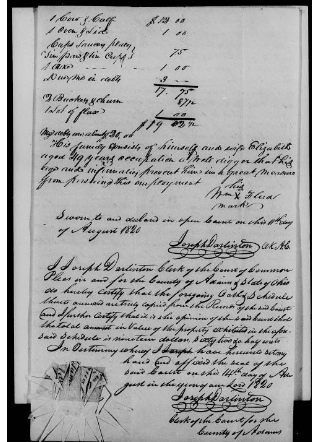
A similar affidavit in 1828 listed his occupation as well digger and that "his age (80) and infirmities prevent him in great measure from pursuing his employment." His meager statement of assets included "1 cow & calf $12.00, 1 oven and lid $1.00, Cups saucers tin pan and tin cups $.75, among a few others. His total assets were listed at $19.62 with debts of $20.00. He signed the affidavit "William hisXmark Flood." He was likely illiterate.

William Flood Pension Certificate - this and the document below are from the National Archives

William Flood - portion of affidavit required (to prevent fraudulent claims) after 1818 to continue pension payments. This part includes a list at top of document of his meager assets.


Return Jonathan Meigs emerged from British captivity in early January, 1776. He had been captured with others in Morgan's forces. British Commander Guy Carleton allowed him to retrieve belongings of the officers at the Americans’ camp. He returned to his captors the same day. 

Return Jonathan Meigs, from 
Appletons' Cyclopædia of American Biography, 4, p. 288, viewed at Wikisource.org


He had joined the Quebec expedition as a Major in September, 1775, from the 6th Connecticut Regiment. Find out how he acquired the name "Return" by clicking here. He kept a journal, writing in "ink" made of gun powder and water. 

On the journey to Quebec Meigs was constantly on the move, helping his men, guiding their passage, clearing portaging areas, and distributing supplies and ammuntion. Despite the hardships he remained positive and steady in leadership. November 1 was an especially difficult day, as many were on the Quebec expedition. His journal records “...the marching this day exceedingly bad. I passed a number of soldiers who had no provisions and some that were sick, and not in my power to help or relieve them except to encourage them.” 

He greatly lamented the death of General Richard Montgomery. Meigs journal on December 31, 1775 records his thoughts: ...”He had the voluntary love, confidence, and esteem of the whole army. His death, though honorable, is lamented, not only as the death as an amiable, worthy friend, but as an experienced, brave General, whose country suffers greatly by such a loss at this time...”

Meigs was chagrined at having to surrender. His journal entry on January 1, 1776, included this comment: “The first day I knew confinement. I hope I shall bear it with becoming fortitude.”

Major Return Jonathan Meigs was given an early release from captivity in May of 1776 by General Carleton and returned home. He continued his service in the Continental Army with distinguished action at Sag Harbor, Stony Point, and in suppressing a mutiny. 

Meigs joined the Ohio Company of Associates as a surveyor and moved to the new settlement at Marietta in 1788. He served as a territorial judge, justice of the peace, and clerk of the Court of Quarter Sessions. In 1801, he went to Tennessee to serve as agent to the Cherokee Nation where he remained until his death in 1823.

Aaron Burr
The battles at Lexington and Bunker Hill had electrified the thirteen colonies - and Aaron Burr, later a prominent lawyer, politician and Vice President of the United States. He was 19 at the time. One of his biographers noted that "this young student-at-law threw aside his books, and seized the sword, on fire to join the patriot forces." Burr was excited by the military life. He had studied it since childhood. His was a quick learner, natural leader, self promoter, fearless and steady under stress. Though slight in stature, he was able to endure intense physical exertion and privation. 

Aaron Burr portrait, viewed at http://www.nndb.com/people/184/000022118/


He joined the army at Cambridge MA near Boston. He leaped at the chance to join Benedict Arnold's campaign to capture Quebec. His family and friends tried to dissuade him but he was resolute. 

On the arduous trip to Quebec, Burr quickly gained the respect of his fellow soldiers for his bravery, willingness to help others, and wilderness skills. His biographer noted that "His hardihood and quick helpfulness attracted general admiration among the troops." 

He soon attracted the attention of senior officers. Benedict Arnold entrusted Burr to deliver a message to General Montgomery at Montreal. This required traveling alone across 128 miles of enemy territory. Burr gave a striking example of his tact and creativity by disguising himself as a priest, to gain more cooperation and minimize suspicion of the local population. His knowledge of Latin allowed him to elicit help of with a religious order to guide him along his route to General Montgomery. At Montreal, the latter was so impressed with Burr that he made him an aide-de-camp with the rank of Captain. He participated in discussions about planning the attack.

Aaron Burr was at the front of the attack on Quebec with General Montgomery when the General and others were cut down by the cannon shot. The attack faltered. Burr stayed cool and was vehement in urging the attack to continue. Captain Richard Platt who commanded a company in the attack testified that Burr "animated the troops, and made many efforts to lead them on...and might have succeeded, but for the positive order of the commanding officer to retreat."  Burr also braved heavy fire to attempt, unsuccessfully, the retrieval of General Montgomery's body from the snow. 

He stayed with the Arnold's diminished forces near Quebec for a time but disagreed vocally with Arnold's ideas and bearing. He left against Arnold's wishes, an act of insubordination which Arnold ultimately overlooked. Burr served on the staff of other Generals, including George Washington (with whom he developed a long standing feud) and Israel Putnam. His service was exemplary. For decades after, many would recall his performance during the War, particularly the Quebec campaign, in glowing terms. In 1779 he resigned due to poor health. He began the practice of law and entered politics.

Some 25 years later, Aaron Burr began planning an expedition (often referred to as "The Burr Conspiracy") to the United States western territories. That brought him to Marietta through contacts with Harman Blennerhassett, Dudley Woodbridge, Joseph Barker, and others. For more detail, click here.


Appendix: 
Journals' excerpts from Meigs and Henry recorded the ordeals in wilderness on the way to Quebec:
Oct 3: (Meigs) In the evening....my battoe (boat) filled with water...I lost my kettle, butter, and sugar, a loss not to be replaced here.
October 8 Henry:..a twig, perhaps, caught the buckle of my shoe: tripped , I came down head foremost, (down an incline) about 20 or 30 feet.
October 11 Henry: ...we observed a great smoke before us, (hoping it would be a camp of fellow soldiers). ...at the great smoke there was no army, no friends, no food, only a friendly fire, kindled by ourselves...; it had been our camp as we ascended the river."
Oct 13 Henry: ...we arrived at our first encamping ground on the Dead River...pallid and weak, for want of substantial food in due quantity."
Oct 14: Meigs. Last night a tree, blown down by the wind, fell upon one of our men and bruised him in such a manner, that his life is despaired of.”
Oct 16 Henry: "Melancholy of the desperate kind oppressed me. (I feared) that we should die of mere debility in these wilds." 
Oct 22 Meigs: The river rose 8 ft overnight, flooding the area, impeding passage of those marching on land.
Oct 23 Henry: The boat (was) borne under, in spite of all our force, by the fury of the stream. (Going into the water), I yelled “Simpson we are going to heaven.”
Oct 23 Meigs: River current upset six of the boats, “...by which we lost several barrels of provisions, a number of guns, and some cash.”
Nov 1 Meigs: “...the marching this day exceedingly bad. I passed a number of soldiers who had no provisions and some that were sick, and not in my power to help or relieve them except to encourage them.” 


Sources:
Army and Navy Pension Laws, and Bounty Land Laws of the United States, compiled by Robert Mayo, M.D. and Ferdinand Moulton, Counsellor at Law, Baltimore, Lucas Brothers, 1854, page 135-36  

Britishbattles.com, Battle of Quebec

Henry, John Joseph, Account of Arnold’s Campaign Against Quebec, Albany, Joel Munsell, 1877.

Hickman, Kennedy, “American Revolution Arnold Expedition,” thoughtco.com

Johnston, Henry P., “Colonel Return Jonathan Meigs, Connecticut Line,” The Journal of American History, Vol IV,  New York, A. S. Barnes & Co., 1880

Meigs, Return Jonathan, Journal of the Expedition Against Quebec, Under the Command of Benedict Arnold, New York, Privately Printed, 1864,

Parton, James, The Life and Times of Aaron Burr, Vol 1., Mason Brothers, 1857, p 66-84

Revolutionary War Pension and Bounty Land Warrant Application File S. 42,728, William Flood, Va., National Archives, https://catalog.archives.gov/id/54581415

Wikipedia.org, Battle of Quebec; Benedict Arnold’s Expedition to Quebec