Join the Conversation

Join the Conversation.
I invite your comments, suggestions, and additional information about any topic mentioned.
Showing posts with label indians. Show all posts

Thursday, January 18, 2024

Life with Joseph at Fort Harmar

Joseph Buell, Marietta pioneer, future General of the Militia, businessman, and legislator, had a rough start at Fort Harmar: He was court-martialed. He sold liquor “without permission” when he traded a pint of liquor to buy some catfish. Fortuntately, he was acquitted. Joseph Buell was born in Killingsley CT in 1763. He arrived as a sergeant in the First American Regiment at Fort Harmar in May, 1786. His journal gives us a view of life at the fort. Quotes are from his journal unless noted otherwise.

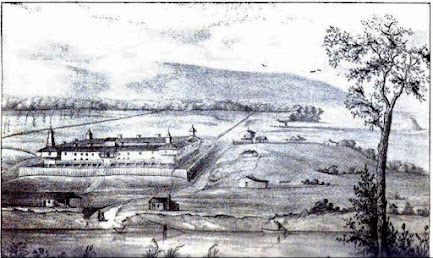
Fort Harmar’s creation was a team effort: Congress authorized it, General Butler picked the location, Colonel Josiah Harmar (the fort was named for him) ordered its construction, Major John Doughty designed it, and soldiers built it. The Fort was built in 1785 on the west bank of the Muskingum River at the Ohio River. It had a pentagonal shape and occupied about 3/4 acre. Congress planned to sell land in eastern Ohio to new settlers and was having the land surveyed. The soldiers’ mission was to protect surveyors and settlers from Indian attacks and remove squatters living on land they didn’t own.

Initial plan for Fort Harmar, CA 1785, from University of Michigan, James McHenry Collection 
CLICK TO ENLARGE

Life at Fort Harmar was not easy. Soldiers endured primitive conditions, harsh discipline, boredom, illness, food shortages, and the constant threat of Indian attacks. Yet Joseph Buell seemed to enjoy his duty. He made friends and tolerated the hardships better than most. Likewise, Ebenezer Denny observed wistfully when he stopped at a mostly deserted Fort Harmar on April 14, 1790, “(It was) a place where I had spent….. the last two years with much satisfaction.”

Drunkenness was a constant problem. Soldiers received a daily ration of a gill (“Jill” - about 4 ounces) of liquor. Imagine that today. On a sunny May Day 1786 soldiers were given extra liquor and allowed to get “damned drunk.” On July 4th there was cannon fire and “we had liberty to drink and get drunk..” During a gloomy January stretch, they kept their spirits up by pouring spirits down, “we made ourselves pretty merry….” Buell’s St. Patrick’s Day entry is amusing: “The sons of St. Patrick kept….(the) usual custom - by getting drunk & fighting & breeding a riot etc.” Two weeks later Gregg “died in a fit of drunkenness…Soldiers have got the Devil in them - a drinking.” After that soldiers were forbidden to buy liquor from others. Joseph Buell enjoyed his spirits but exercised restraint not typical of the average soldier. When his fellow sergeants became drunk and disorderly on New Year’s Day 1787, Buell reported, “I did not think it proper to join this club (and stayed) at my own quarters.”


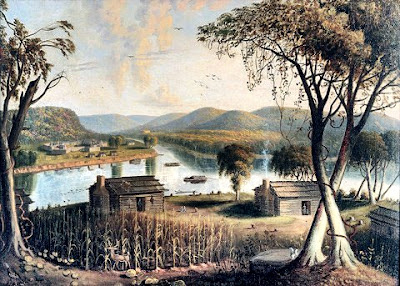
Painting of Fort Harmar based on early sketch by Joseph Gilman CA 1790. 
CLICK TO ENLARGE

There were six desertions during that first summer at Fort Harmar; more later on. Buell delayed reporting Corporal Weed’s desertion because he was “a very good fellow” -  a friend of Buell’s - who could have been shot if caught. Alford, Dustin, Fox were allowed to go fishing one sunny day. They didn’t return. A week later they sheepishly dragged themselves back and were given 100 lashes. 

Discipline was strict. Even petty offenses warranted confinement, whippings, or worse. “French received 25 lashes for insulting a Corporal.” “Houghmier was given 25 lashes for picking up an apron in the street.” “Brady was whipped 100 lashes for taking a coat out his serg’ts room.” Deserters could be shot on the spot without a trial. Major John Wyllys did just that, killing three deserters at Fort McIntosh. He was arrested at Fort Harmar for those killings but was exonerated and returned to the Fort. Shockley deserted and when apprehended was ordered to “run the gauntlet” 11 times. Running the gauntlet required the perpetrator to run or walk  through two rows of soldiers who struck the person with sticks, whips, or other weapons. It was a severe penalty, but at least he was still alive.

Disease took a toll. Engeham died in May; “the first due to sickness.” A month later Bamerd died.  When a death occurred all soldiers in the Fort marched with the coffin to the burial place led by an honor guard with fife and drums. Music was somber marching to the burial site, but returning they played a “jolly tune.” Question for further research: where was the burial ground for Fort Harmar?

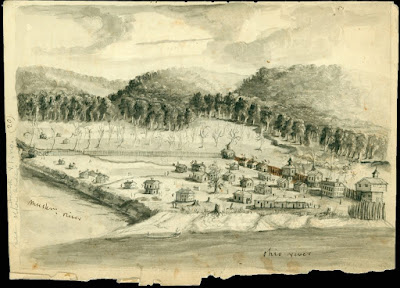
Period drawing of Fort Harmar by Joseph Gilman CA 1790, courtesy Marietta College. 
CLICK TO ENLARGE

Accompanying surveyors was rough and dangerous duty. One company from the Fort returned from a surveying trip in November; “they had a tedious cold time of it. Some were without shoes and their feet badly frozen.”  

In June of 1789, seven soldiers accompanied John Mathews and James Backus on a surveying trip. Weather was hot; swarms of gnats and mosquitoes pestered them. Backus’s journal of the trip reported “bad hills,” storms, heavy rain, a balky compass - “plagued my soul out.” By July, Mathews’ group noticed signs of Indians. They saw moccasin tracks. Horses disappeared. Sentries were posted all through the nights. One morning well past sunrise, the group relaxed around a camp fire thinking the Indian threat had passed. They were not fully dressed. Suddenly shots rang out. Two of the soldiers and Mathews’ trusted assistant Patchen died instantly. 

A corporal, luckily sheltered from the gunfire by a tree, ran. He hid behind a log and watched while Indians explored the camp. He was surprised as their aggressive behavior changed to amusement when they discovered a compass. They laughed and gestured as the compass point moved. John Mathews escaped by outrunning the Indians. He was only partially dressed and wore no shoes. Soon his his feet and legs were painfully bloodied. Eventually the survivors reached the Ohio River and were rescued.

Troops were also charged with removing squatters living on land they didn’t own west and north of the Ohio River. Most left peacefully. In a few cases, soldiers allowed families to harvest their crops before evicting them. Levi Munsell reported a confrontation with squatters near present day Steubenville, Ohio, in 1787.  About 30 hunters were ordered to abandon their cabins. They refused. About 100 soldiers were sent to burn them out. The hunters lined up on the river bank with rifles, appearing to resist leaving. Soldiers confronted them and told them to retrieve valuables - quickly. They complied, and soon their cabins and crops were burned.

There were periods of recreation. Buell liked working in the gardens near the fort. He went to Marietta and viewed the “curiosities of the mountains,” probably referring to the earthworks (Indian mounds). In April of 1787, the weather was “warm and pleasant;” he was grateful to be out and active. A short time later, he and “all the sergeants” visited Isaac Williams who had recently moved his family to present-day Williamstown. The group enjoyed their company and “passed the day very happy.” May Day 1788 was celebrated “in the usual custom.” He added “We live pretty peaceable and happy” other than not receiving their pay on time.

Indians were a constant preoccupation - ranging from friendly curiosity to a deadly threat. Congress had sought peace with Indians, hoping to stem violence between Indians and whites in the Ohio Valley. A treaty was negotiated and signed at Fort Harmar in January, 1789. Despite elaborate efforts and good intentions, it accomplished little.  

Some Indians stayed near the Fort, trading with soldiers and entertaining with their ceremonial dancing. Joseph Buell and Fitch were amused themselves one evening watching the Indians “carry on.” Once the Indians gave a demonstration war dance inside the Fort stockade. 

One sultry August day, Captain Heart observed Indians across the Ohio River on the Virginia side. The crack of a musket echoed in the valley. He saw an Indian shoot a soldier hunting there and saw him fall down. A armed party from the Fort rushed over. They found one man target shooting and another napping on the ground. There were no Indians. 

One Indian episode was troubling for Joseph Buell. He sent one of his cooks to Kerr’s Island to get some milk. The man did not return. Buell fretted. A search party found only the man’s hat and some Indian clothing. They heard later that he had been killed and scalped. 

A friendly Indian named Captain Lunice warned in September, 1786, that Indians planned to attack the Fort Harmar. They immediately prepared for an attack by clearing brush and crops outside the fort to eliminate a potential hiding area. Soldiers were placed on full alert daily from daybreak to an hour past sunrise. There was no attack, but soldiers were on edge for months, contributing to low morale. Buell wrote: “We are out of provisions and expect the Indians every day to attack the Fort.” 

There were women at Fort Harmar. Apparently some were wives; others were employed as maids, cooks, or nurses. Buell refers to them on two occasions as “our virtuous women.” Some may not have been so virtuous. Twice Buell reports that wives had affairs with other soldiers. One of those wives…”got the Devil in her….(and) began to abuse her husband and break all her furniture” in a rage. She also “gave some insolence to Sarg’t Preatt who confined her in the guard house.” She was ordered to leave the Fort on the next boat. 

On another occasion, two soldiers came in and began to abuse “our virtuous women.” Buell removed them by force. In May 1788, a social gathering took place at Hamilton Kerr’s place on today’s Buckley’s Island. Buell and Munsell “stayed at home” because  “(it) did not seem fit to keep company with so many of our Virtuous camp women who (were there).” Why? Buell did not say.

On April 7, 1788, Buell reports: “Gen’l Putnam arrived here at this place with 50 men, who came to settle on the other side Muskingum (River) the most of them were artificiers (skilled craftsmen). They began with great spirit & there is great prospect of its being a flourishing place in a short time.” Joseph Buell himself joined that “flourishing place” (Marietta) in 1790 to operate a tavern with his friend and fellow soldier Levi Munsell. 

Soldiers at Fort Harmar helped stabilize conditions on the Ohio Valley frontier, paving the way for a settlement of Marietta and Ohio.

Saturday, March 5, 2022

Future Ohio Governor Survives Indian Attack

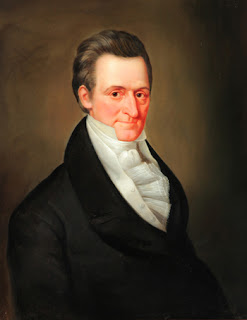
In June, 1792, future Governor of Ohio Return Jonathan Meigs, Jr. encountered a large snake as he was walking near Marietta. He shot it but didn’t reload his rifle - a careless oversight that nearly cost him his life. Meigs was twenty-something at the time, a Yale College graduate and lawyer who had followed his father to the new settlement at Marietta in 1788. 

Return Jonathan Meigs, Jr. portrait. From ohiostatehouse.org. Ohio governor 1810-1814. Artist unknown.

It was a warm, humid, breezy day. Meigs, a hired man named Joseph Symonds, and black (mulatto?) servant boy Jim had been working in a field near Fort Harmar. At dusk, they started for home at the Campus Martius stockade. They were soaked with perspiration, waving away pesky mosquitoes as they trudged the narrow path along the Muskingum River to their canoe. A large snake crawled in front of them. Meigs shot the snake with his musket. No need to reload, he thought; no Indian in their right mind would be this close to the well defended Fort Harmar and Campus Martius stockades.


Campus Martius, a fortified residential community, viewed from across the Muskingum River near where Meigs was attacked. The river appears at the bottom of the image. Areas behind and to the right of Campus Martius were farming areas. Source: Wikipedia. CLICK TO ENLARGE.


Joseph Symonds was instantly on alert, though, as he said,  “We should be in a poor state of defense if Indians came upon us.” Jim was in the rear; he heard something and turned around. Two Indians were just a few paces back! “There is two now!” he shouted in a panic. As Symonds turned to look, a rifle shot boomed and struck him in the shoulder. His movement in turning around probably saved him from a more serious wound. He instantly ran for the river and jumped in. Adrenaline blocked out the pain and shock. A jumble of thoughts about his family swam though his head. Fortunately he was a good swimmer, managing to stay afloat despite his injury.

The Indian gave up pursuit of Symonds and started after young Jim who had also jumped in the water. He could not swim and was soon dragged back by the Indian. His captor tried to communicate that he would take Jim prisoner, not kill him. But Jim resisted so strongly that the Indian struck him with a tomahawk and scalped him.

This incident illustrates a curious paradox about life on the early frontier. Why would a Yale educated lawyer from an established family in Connecticut move to the wilderness in Ohio? Author David McCullough in his book The Pioneers described conditions grimly: “There were no roads as yet anywhere in all this wilderness, no bridges, no towns, churches, schools, stores, or wayside taverns.” There as also the threat of disease, food shortages, and Indian hostility. The latter left Meigs at this moment in fear of his life. Fortunately, Meigs and many others endured the hardships to start a new life in the new territory.

Imagined view of Fort Harmar and the future site of Marietta from the Williams settlement in Virginia (today West Virginia) ca 1787. The farming area where Meigs was working when attacked is near the fort (across the river in left center of the image). Other than Fort Harmar, the area on the Ohio side was undeveloped wilderness. Charles Sullivan, View of Fort Harmar from the Virginia Side, Marietta, Ohio, ca. 1835. Oil on canvas. 20" x 28". (Courtesy, Peter Tillou Works of Art.), viewed at Chipstone.org. CLICK TO ENLARGE

As Meigs turned to face the Indian who had shot Symonds, his eyes widened in disbelief. He recognized the Indian as “Charley,” who acted as a guide in 1790 when Meigs was dispatched with a message to the British at Detroit. Meigs shouted “Is that you, Charley?” No response. Charley, who had shot Symonds, did not fire at Meigs - perhaps because he too had not yet reloaded. Future governor Meigs raised his musket to fire at Charley. The Indian stood his ground, knowing that the gun was not loaded. Meigs suddenly swung at him using his rifle as a club and took off running. Charley deflected the blow with his own rifle, drew his tomahawk, and charged after Meigs. He gained ground on Charley as they approached a fairly wide stream. Meigs managed to leap across. Charley hesitated, probably realizing the chase was now futile, and turned back to join the other Indian. Settlers hearing the gunfire had gathered on the other side of the river and now fired at the two Indians, one of whom fell. But whether he was hit or just slipped on the muddy bank, he got up, waved Jim’s scalp to taunt the settlers, and vanished.

Picketed Point, another fortified residential community at the junction of the Muskingum and Ohio Rivers. From Wikipedia with credit to Marietta College Special Collections. Buildings are numbered; Return Jonathan Meigs’ residence and store is identified in one source as being Number 6, which is the second building to the left of the large building on the point next to the tree stumps. CLICK TO ENLARGE.


Return Jonathan Meigs, Jr. had been sent to Detroit in September of 1790 to deliver a letter to the British. The letter explained that a planned American expedition against the Indians under General Harmar was not directed against British interests. It also asked that they refrain from supporting Indians’ resistance. Meigs was accompanied by John Whipple (son of Naval hero Commodore Abraham Whipple) and an Indian guide…..Charley. He was described in Hildreth’s Pioneer History as “a sprightly Indian who had loitered in Marietta since the treaty (in early 1789). He could speak some English and a little French.” 

The trip to Detroit was fraught with danger. Whatever their brave intentions in volunteering for this mission, Meigs and Whipple quickly wondered what they were in for. The entire area beyond the Waterford settlement was total wilderness. Bushwhacking was exhausting and their progress frustratingly slow. Late summer heat alternating with chilly nights wore them down. Indians stole their pack horse; they had to carry their provisions. At last they came to a friendly Delaware village on the Sandusky River. 

But hostile Miami Indians arrived at the same time exhorting the Delawares to join them in resisting the American soldiers. It was a perilous situation. The Miamis heard that the two white emissaries were near and threatened to kill them. Meigs and Whipple laid low and considered their options. 

Luckily, they were blessed with good fortune which saved them on several occasions. That night, friendly Delaware Indians spirited them from the camp and out of danger. Their guide Charley was forced to leave them at this point, because he too was targeted for death if found with Meigs and Whipple. 

The British governor at Detroit received them coldly but finally answered the letter. More good fortune: the governor warned them not to return through Ohio because the Indians “would certainly put him to death, without any regard for the flag of truce which he had (carried to Detroit)” (Hildreth, Pioneer History). And he offered them passage to Presque Isle (on Lake Erie near present day Erie, PA) on a schooner which was about to leave. From Presque Isle, they journeyed down through Pennsylvania to the Allegheny River, to the Ohio River, to home at Marietta. Their effort was courageous but unsuccessful. The British continued to supply Indians with arms and encouraged them to fight against the Americans.

The attack on Meigs had unnerved the families at Campus Martius. Melzer Nye, who was only six at the time, recalled in his Memoirs: “The women were frightened. Some cried, 'Lord have Mercy. What shall we do.' (His) mother said, ‘go home, bolt up your doors and windows and prepare for them.’ And two or three (of them) fainted and Mother threw water in their faces – which scared me for I did not know what it meant.”

Joseph Symonds was carried back to Campus Martius where his wound was dressed and he eventually recovered. Jim’s body was retrieved by E. W. Tupper, “a brave and fearless man, (who) in spite of the remonstrances of the bystanders, sprang into a canoe with one other person and pushed over to the body of the black boy, hoping that he might yet have life in him, but…..he could not be restored.” (Quote from Hildreth’s Pioneer History).

A sidebar story to the Meigs episode played out just minutes before the attack started. Horace Nye, then a young boy, accompanied a Frenchman named Mr. Bureau, to visit a friend near Fort Harmar. They were returning to Campus Martius. Bureau carried a musket, but was inexperienced in using it. He saw a pigeon and took aim. The gun did not fire - a "flash in pan." Young Nye noticed that Bureau had loaded the gun incorrectly - he had inserted the ball first, then the powder. Nye explained that to Bureau, but he persisted in trying to fire the gun. Same result each time. As they approached the entrance to the Campus Martius stockade, the attack on Meigs' party started. Bureau and Nye were lucky the gun misfired. From Pioneer History: “The (misfiring of Mr. Bureau’s gun), which vexed and fretted him so much at the time, no doubt saved both their lives, for the report of the gun would have called the Indians to the spot.” 

Return Jonathan Meigs was apparently undaunted by this and similar experiences in early Marietta. He went on to achieve a distinguished career in public service, including serving as the first Chief Justice of the Ohio Supreme Court, Governor of Ohio, and Postmaster General of the United States. He died in 1825.


Sources:
Barker, Joseph, Recollections of the First Settlement of Ohio, Marietta, Ohio, Marietta College, 1958
Hildreth, Samuel P., Pioneer History: Being an Account of the First Examinations of the Ohio Valley and the Early Settlement of the Northwest Territory, Cincinnati, H. W. Derby & Co., 1848
Meigs Family History and Geneaology, “Return Jonathan Meigs 2nd,” viewed at Meigs.org.
Ohio Genealogical Society, Washington County Chapter, “Melzer Nye Memoir.” Viewed at washogs.org
Wikipedia, “Return Jonathan Meigs, Jr.”
Williams, H. Z., History of Washington County Ohio, Cleveland, H. Z. Williams and Bro, 1881

Monday, March 30, 2020

The French Celeron Plates Expedition

Perhaps you've heard of the so-called "Celeron Plates." Or, maybe not. It's not headline material for most of us. But it has been endlessly fascinating for history scholars.

Pierre Joseph Celeron De Blainville*, a French military leader, led an expedition down the Ohio River Valley in 1749. The expedition buried lead plates at major tributaries, including the Muskingum River, to establish French claim to land in the Ohio River Valley. It was a curious enterprise built on the dubious premise that burying plates could establish a land claim. Who was this Celeron guy and why were they burying lead plates? First, some background.

The French and English were vying for control of America’s interior lands in the mid 1700's. The French pursued their claim to Ohio Valley lands based on earlier explorations by LaSalle in 1669 and 1682. The British had other ideas. They fought King George’s War from 1743-1748. The British were able to disrupt the French fur trade and undermine French influence with Native Americans in the upper Ohio River Valley. Also, Virginia colonists set up The Ohio Land Company (unrelated to the Ohio Company of Associates which later settled Marietta) intended to acquire land in the upper Ohio Valley.

CLICK TO ENLARGE. Map of colonial interests in 1750. New France was the blue area, British in red, Spanish brown. The border of red and blue lands in western PA and the upper Ohio Valley were being contested.


British inroads jolted the French into action. The governor of Canada commissioned Pierre Joseph Celeron De Blainville (“Celeron”) to lead an expedition down the Ohio Valley in 1749. Its purpose was to reassert French claims in the area, renew friendship with Indians, and chase out British traders.

Celeron was a French Canadian soldier born December 29, 1693, in Montreal. His father Jean-Baptiste Celeron was granted a lordship over Blainville, which accounts for the suffix “de Blainville.” Celeron became a cadet in the French colonial army at age 13. He was commissioned as ensign at age 20 and was a nearly a 40 year veteran when he began the Ohio River expedition. Celeron was selected in part for his “cool but tough” attitude towards the Indians in previous commands.

The expedition began near Montreal, Canada on June 15, 1749. It was an eclectic group, about 250 strong. There were French soldiers, Canadian militia, and a few dozen Indians. Randall and Ryan’s History of Ohio Volume I offers a colorful imagined description: “The flotilla ....formed a bizarre but picturesque outfit, the French soldiers and Canadians, in their gay costumes and semi-medieval armour, the half naked, copper-skinned savages (Indians) with their barbarian weapons, the flying banners of France, all crowded in frail white birch canoes, that floated on the blue waters of the river like tiny paper shells; it must have seemed like a tableau vivant (a static, posed group of actors) rather than an army...”


CLICK TO ENLARGE. Map of the route followed by Pierre Joseph Céloron de Blainville along the Ohio River in 1749, drawn by Father Joseph Pierre de Bonnecamps, viewed at Wikipedia.com.


A priest, Father Jean Pierre de Bonnechamps, was chaplain and also the dutiful navigator for the expedition. He used a sextant, drew maps, and made notes on the expedition. Their Indian diplomat/envoy was Phillips Thomas Joncaire, a French officer of Seneca Indian ancestry. He was often sent ahead to assuage Indians, who were predictably alarmed by such a large force of mostly white men.

It was a strenuous journey at the start for the expedition’s canoe flotilla. They had to paddle the length of Lake Ontario, portage around Niagara Falls, paddle further on Lake Erie, and portage again to Lake Chautauqua. A portage - moving men, canoes, and supplies across dry land to the next waterway - is an exhausting and time consuming task. From there they followed Conewango Creek to the Allegheny River and eventually to the Ohio River. 

Their primary mission was to bury lead plates designating French land claims. They did this at major tributaries of the Allegheny and Ohio Rivers. Each plate burial was accompanied by a ceremony. Soldiers lined up in formation. King Louis XV was proclaimed lord of that region. There were songs, cheers, and musket volleys fired. A tin plate erected on a tree gave notice of each buried plate which was placed near that tree.


CLICK TO ENLARGE.
12 x 20 foot mural at the Wheeling Civic Center - “French exploration of the Ohio Valley,” by Mark Missman. This painting illustrates the ceremony that accompanied the burial of each lead plate. The mural was designed to commemorate the presence of the French explorers and their Jesuit companions in the Upper Ohio Valley. One of the lead plates was buried at the confluence of the Ohio River and Wheeling Creek.


The burying of plates seems today like a curious way to make a land claim. This technique was a common method used in medieval Europe for land claims. But realistically, who would ever see them - after all, they were buried? And if the plates were found, their purpose and validity would surely be questioned. But the French were committed their mission.

One of the plates was buried at the mouth of the Muskingum River on August 15, 1749. A metal sign was posted on a tree to mark the location of the buried plate. The narrative on the sign was very formal; brevity was not part of the French communication style:

The 15th of August, 1749, we, Celoron, Knight of the Royal and Military Order of St. Louis, Captain commanding a detachment sent by the orders of Monsieur the Marquis de la Galissoniere, Governor-General of Canada, upon the Beautiful River, otherwise called the River Oyo, accompanied by the principal officers of our detachment, have buried at the foot of a maple tree, which forms a triangle with a red oak and an elm tree, at the entrance of the river Jenuanguekouan (Muskingum), at the western bank of that river, a leaden plate, and have attached to a tree on the same spot, the arms of the King. In testimony whereof we have drawn up and signed the present official statement, along with the Messrs. the officers at our camp, the 15th of August, 1749.

In 1798 a flood had washed away part of the Muskingum River bank, exposing the plate. It was discovered by boys swimming there. Not realizing its importance, they melted much of the lead plate for musket balls. Paul Fearing became aware of it. William Woodbridge, then of Marietta, had recently been to Gallipolis and knew some French. He was able to decipher enough of the plate to realize that it was deposited by the French as a land claim. The probable inscription, reconstructed based on other plates, is given below:

In the year 1749, in the reign of Louis the XV, King of France, we Celoron, commander of the detachment sent by the Marquis de la Galissoniere, Governor-General of New France, to reestablish peace in some villages of these Cantons, have buried this plate at the confluence of the Ohio and the river Yenanguekouan (Muskingum), the 15th of August, for a monument of the renewal of possession which we have taken of the said river Ohio, and of all those which fall into it, and of all the territories on both sides as far as the source of the said rivers, as the preceding Kings of France have possessed or should possess them, and as they are maintained therein by arms and by treaties, and especially by those of Riswick, Utrecht and of Aix la Chapelle


CLICK TO ENLARGE.
Image of the Celeron plate buried at the Muskingum River. Over half of the original plate was destroyed to make musket balls. From the American Antiquarian Society where the plate resides. About halfway down, note the word “Yenangue”, part of the hyphenated Yenanguekouan, an early Indian name for Muskingum. In the next line down, see “Rivière Oyo,” French for Ohio River.


The wording on the plates was somewhat confusing to historians and not always consistent. Charles B. Galbreath, an editor of the journal kept by Celeron, wryly observed that "The artist (who engraved the plates), Paul De Brosse, like Celeron himself, had evidently not taken first prize in spelling words of his native tongue and was somewhat careless..." Another author noted that “the French (wording) is none of the purest and the accents, apostrophes, and punctuation are wanting...”

Celeron’s expedition also sought to placate the region’s Indians and remove British traders. Neither goal was realistic and ultimately failed. On August 6, at the Indian village called Logstown northwest of Pittsburgh, Celeron found six English colonial traders present with large bundles of furs bound for Philadelphia. He ordered them out of the area and wrote a note to Governor Hamilton of Pennsylvania asking that he keep traders from trespassing on French land. Other British traders near Indian villages at the mouth of the Scioto River were asked to leave. Those requests and other actions to dislodge the British were largely ignored.

The expedition held numerous discussions with tribes in Pennsylvania and Ohio. Each exchange had an elaborate protocol, typical of communication between Indians and whites in that time period. A speech by one party was preceded by a gift of wampum belts to convey the importance, sincerity, or urgency of the topic. A similar speech was made when the other party responded, often on the day following. 

CLICK TO ENLARGE.
Robert Griffing painting of imagined expedition stop near Logstown in western Pennsylvania. Notice Indians present; there were Iroquois Indians in the expedition. The large tree was a cottonwood tree. From the diary of Father Joseph Pierre Bonnecamp: “We dined in a hollow cottonwood tree in which twenty-nine men could be ranged side by side.” 

Language used was flattering, deferential, and endlessly courteous, though often insincere. The speeches followed a common pattern. Celeron alternately scolded and cajoled the Indians to reject the British and embrace the French. The Indians usually demurred, sometimes feigned compliance, occasionally disagreed with him. 

Celeron invested hours and hours in communicating with the Indians - listening, composing speeches, enduring tedious ceremonies - mostly for naught. The Indians viewed Celeron’s intentions with contempt. They were too closely tied in with the British who offered them cheaper goods, trusted friendship, and rum - which Indians thought offered a quicker high than the whiskey supplied by the French.

The expedition continued down the Ohio River to the Great Miami, then northward to Lake Erie and eventually back to Montreal. Celeron Pierre Joseph DeBlainville was awarded a command in Detroit. The French and British continued as adversaries. The French and Indian War (1756-1763) eventually resolved the issue in favor of the British. The Treaty of Paris in 1763 awarded land from the Mississippi River east to the Appalachian mountains (which included the Ohio Valley) area to the British.

One of the expedition’s lead plates was buried at the Kanawha River near present day Point Pleasant WV. A boy discovered that plate in 1846, a curious reminder of the futile French claim made nearly 100 years earlier.


*His name also appears as “Celoron” and the title part of his name as “De Bienville.”


SOURCES:

Bumgardner, Stan, “Celeron de Blainville,” wvencyclopedia.org

Biography – CÉLORON DE BLAINVILLE, PIERRE-JOSEPH – Volume III (1741-1770) – Dictionary of Canadian Biography, viewed at http://www.biographi.ca/en/bio/celoron_de_blainville_pierre_joseph_3E.html 

Galbreath, C. B., Expedition of Celeron to the Ohio Country in 1749, Columbus, Ohio, F. J. Herr Publishing Company, 1921

Hulbert, Archer Butler, The Ohio River, a Course of Empire, New York, G. P. Putnam’s Sons, 1906

Howe, Henry, Historical Collections of Ohio, an Encyclopedia of the State, Volume 2, 1907

Ohio History Journal Vol 29, “Celeron’s Journal, edited by A. A. Lambing” and
"Account of the Voyage on the Beautiful River in 1749 Under the Direction of Monsieur de Celeron, by Father Bonnecamps.”

Vanderwerth, W. C., and Carmack, William R., Indian Oratory, Famous Speeches by Noted Indian Chiefs, University of Oklahoma Press, 1979.


Saturday, September 24, 2016

Council House and the Treaty of Fort Harmar

It must have been a startling sight: 200 Indians marching towards Fort Harmar in December of 1788 with an American flag. There was musket fire - a friendly salute from the Indians, followed by several minutes of a cannon and musket fire salute from Fort Harmar. The troops escorted the Indians into the fort with music playing. So began treaty negotiations at Fort Harmar. The few dozen settlers of the fledgling Marietta community were on edge.

This topic came up recently when Bill Reynolds, Historian at Campus Martius Museum in Marietta, showed me the undated photo below. The sign claims that the Treaty of Fort Harmar was signed in this building. Could this have been the original "council house" (a meeting place for Indians) built for
the treaty negotiations? 

Sign says: Log House in which Gov. St. Clair signed Treaty with Indians 1788. The photo is undated; location uncertain; probably somewhere in Harmar village. Photo courtesy of  Bill Reynolds.


In this early drawing of Fort Harmar, the council house appears at the bottom left.
Source: Wikipedia:

This photo triggered my interest in the council house. I have pored over historical texts, journals, and letters. But I have found nothing yet mentioning its construction or when it was built. 

Maybe it doesn't matter. The council house symbolizes a year-long drama on the early Ohio frontier culminating in the Treaty of Fort Harmar. Here are some of the issues and highlights of the story.

The issues and timeline
Late 1780's: There were long standing tensions between Indians and white settlers:
  • Indians sought guaranteed lands, protection against harassment, and equality with whites.
  • Settlers wanted land, room to expand, and freedom from raids.
  • The U. S. Government wanted peace and the ability to sell "Indianless" land to white settlers for expansion - and to reduce government debt.
A treaty seemed like the most practical solution to bring lasting peace. The Indians were first to express an interest in a broad treaty.

November/December, 1786: Multiple Indian tribes held a council at Brownstown, near Detroit. They sought to form a united confederation to negotiate with the Americans. Charismatic Mohawk chief Joseph Brant advised his peers that "the interests of any one nation should be the welfare of all others." The Indians asserted that the United States should consider Indians as equals and negotiate treaties with the entire confederation rather than separate tribes. After the council, Brant wrote a letter to Congress requesting negotiations.

Portrait of Chief Joseph Brant from wikipedia.com

July 13, 1787: The Ordinance of 1787 created the Northwest Territory, the first U.S. territory outside the original 13 states. The Ordinance had language foreshadowing the Bill of Rights for its citizens: trial by jury, prohibition of slavery, religious freedom, encouragement of education, and more. There was also effusive language calling for the civilized treatment of Indians. But there were no rights given Indians nor territory set aside for them.

October 22, 1787: Congress directed Arthur St. Clair, the Governor of the newly established Northwest Territory, to pursue a general treaty with all of the tribes. "The objects of such a treaty are, the removing all causes of controversy, regulating trade, and settling boundaries." It was quite a responsibility to be thrust upon the new governor of a new territory.

Arthur St. Clair  portrait from Wikipedia.com

October 27, 1787: Congress agreed to sell 1,500,000 acres of land in the new territory to The Ohio Company for settlement. This and other land sales would bring a major influx of white settlers into areas that Indians considered their own. 

January 27, 1788. St. Clair responded to the Congressional directive in a letter to Secretary of War Henry Knox. He recommended a treaty, though he doubted that it would resolve the conflicts.  A date for a treaty meeting was set for May 1, 1788 at the Falls of the Muskingum River - about 70 miles north of Fort Harmar. Invitations were sent to Indian tribes.

Preparing for the treaty gathering was a major logistical effort. Congress set aside $20,000 ($540,000 in today's dollars) for "goods" needed. Goods included supplies to build a council house, huts for temporary lodging, food, equipment, and gifts as "incentives" (bribes, some said) for Indian cooperation.

March 1788. St. Clair writes to the United States Treasury Board, frustrated at the refusal of the State of Pennsylvania to honor a warrant for $1,000 to help pay for treaty supplies. The U.S. Treasury had no money; states were asked to provide funds when needed. Sometimes they didn't. St Clair admonishes the Board to find the money some other way, stating emphatically that "the money is absolutely necessary" to complete the treaty. 

March 9, 1788. Some treaty supplies had to be transported by boat from an outpost at the Falls of the Ohio (near Louisville KY). Ensign Spear was assigned this task, along with a complement of "one serg't, one corp'l, and 16 privates." As they approached the Falls of Ohio, Indians attacked them. Two of the soldiers were killed, and they retreated down the river 18 miles. They built a temporary blockhouse as a defense and sent a friendly trapper as a messenger requesting help from Major John Wyllys at the Falls outpost.

No help arrived. Several days later their provisions ran out. Fortunately, by chance, they met a supply boat headed downriver which was able to resupply them. They continued to the Falls of the Ohio, loaded the provisions, and returned upriver to Fort Harmar. Imagine rowing a loaded keelboat - powered only by oars or poles - upriver against the current for 400+ miles. They arrived back at Fort Harmar  in late April, nearly seven weeks after they left.

Spring 1788: The Indians were not ready for a treaty meeting in May. There was internal dissention. Wyandots wanted a separate treaty with Americans. Delawares, Potowatomies, and Hurons wanted a set boundary line. Shawnees and Miamis wanted no land give-up and opposed negotiations with Americans. A council meeting near Sandusky was planned to resolve their differences. But the date was uncertain. 

June 13. The treaty gathering at last seemed imminent. General Josiah Harmar dispatched Lt. McDowell and 22 soldiers with the treaty provisions from Fort Harmar to the Falls of the Muskingum (near present day Duncan Falls, Ohio). The party included a sub-sergeant, corporal, and 20 privates. The group began work building a council house and huts for the treaty attendees. Meanwhile a large group of Indians gathered there for the anticipated meetings.

General Josiah Harmar image from Wikipedia.com


July 12. Unexpected trouble. Some Indians raided the treaty supplies, apparently trying to steal some of the contents. The raid was repulsed, though with the loss of two soldiers killed, others wounded. One Indian was killed, another wounded. The dead Indian was found to be a Chippewa. The next morning Delawares, disclaiming any involvement in the raid, brought in six Chippewas accused of being in the raiding party. They were taken prisoner. A servant of Major Duncan, an Indian trader and future namesake of the Falls treaty location, also died in the attack.

July 14. St. Clair's reaction to the raid was immediate. He cancelled the meeting. In a letter to Secretary of War Knox, he stated that "After such an insult, to meet the Indians at that place,...I thought inconsistent with the dignity of the United States." He ordered troops from Fort Harmar to retrieve Lt. McDowell's party and the provisions at the Falls. He sent a stern, derisive message demanding an apology to the Indians who were holding a council at Detroit. It effectively blamed the Indian tribes for the raid, though it seemed more likely that the perpetrators were a few Indians acting on their own. The St. Clair letter was taken by the Shawnees and Miamis as a clear signal that Americans would not negotiate in good faith. They increased their attacks against soldiers and settlers in Ohio country.

July 20. The Indian prisoners from the raid arrived at Fort Harmar. A few days later, two of them escaped as they were being escorted to the "necessary" (Major Ebenezer Denny's term for outhouse) outside the Fort. Four soldiers guarded the group as they walked past a corn patch. The Indians had figured out that their shackles could be slipped off. Two of them waited for the right moment, slipped off the shackles, disappeared into the corn. The guards were flogged, though ill fitting shackles were likely not their fault.

Early August. The Indians held a council at the Falls but could not reach agreement on a response to St. Clair. Delaware Chief Captain Pipe visited St. Clair seeking the release of the Chippewa prisoners, claiming that Ottawas were the real culprits. St. Clair said no way. Captain Pipe was an effective diplomat: He had conferred with General Harmar on several occasions, visited Fort Pitt, greeted the settlers at Marietta on their arrival, traded with the Fort Harmar Indian contractor, and dined at the home of Rufus Putnam. He then countered with an offer to take a single prisoner with him to Detroit to counter the inflammatory statements of the escapees. St. Clair thought that was a good idea and accepted the offer.

September 9. Seneca Chiefs Cornplanter and Halftown, along with 51 other Indians, arrived at Fort Harmar for the treaty. Historian H. Z. Williams describes Cornplanter as a "civilized savage" who was friendly to US and tried to promote good will on both sides. The Ohio Company later awarded him some land because of his efforts to promote harmony.

Portrait of Cornplanter from wikipedia.com

Mid September. St. Clair received a message saying that "a large body of Indians may be expected here (for the treaty)," and they will be armed. He worried about a possible attack. Even if extra troops were available, it would be too little, too late, from too far away. He thought war with the western tribes (who would likely skip the treaty talks) was inevitable and even suggested a preemptive military strike to Secretary of War Knox.   

October 20. Major Denny heard of rumors being circulated to discourage Indians from attending the treaty talks. One such rumor was that the whiskey intended for the Indians was poisoned and that blankets were infected with smallpox.

November 7. A delegation of Six Nations tribes arrived unexpectedly at Fort Harmar. Chief Captain David presented a friendly message authored by Joseph Brant - who was on his way to Fort Harmar - to St. Clair. The Indian confederation offered territorial concessions and requested that the treaty meetings be reconvened at Falls of the Muskingum. St Clair refused, stating that he would negotiate only at Fort Harmar where there was protection from possible Indian attacks. This was a stinging reference to the July attack at the Falls of the Muskingum. Brant was angered and turned back. He was suspected of influencing Shawnees, Miamis, and others to also boycott the treaty meetings. Realization that the United States would not even consider Indian proposals alienated many tribes. It became apparent that a truly comprehensive treaty agreement would be impossible.

December 13. Finally - a large group of Indians arrived to the pomp described above. But it was far from a representative group of all tribes. St. Clair wrote to Secretary of Foreign Affairs John Jay that the treaty would begin soon but "would....not be a very general meeting," since many tribes would not attend.

Day to day proceedings, mostly from Major Ebenezer Denny's journal:

December 14. Indian leaders, Governor Arthur St. Clair, Indian Commissioner General Richard Butler, and officers at Fort Harmar met in the Council House just outside Fort Harmar. The symbolic "council fire" was kindled there. John Heckewelder, a Moravian missionary who had lived among the Delaware and Tuscarawas, acted as a facilitator during the talks.
December 15. Treaty discussion opened.
Deember 15-20. Extremely cold weather; river jammed with ice. Frequent meetings in the council house.
December 29. Wyandot Chief Shandotto gave a long speech on behalf of the Indians. He spoke of past betrayals by the Americans and asserted that the Ohio River must stand as the boundary for Indian lands. Governor St. Clair said that was impossible. There could be no deviation from previous treaty agreements. 
December 30-January 5, 1789. No treaty meetings. Indians met among themselves.
January 5. Secretary Knox pressed St. Clair to pursue the treaty agreement. "I am persuaded that every thing will be done on your part that can be with propriety to avoid a war, and if that event should be inevitable, the evils of it can be justly charged to the Indians."  In other words, war could be blamed on the Indians and provide an excuse to use force against them.
January 6. Governor St. Clair gave an accusatory and intimidating speech to the Indians. He explained how the defeat of the British (with whom the Indians sided) effectively ceded Indian lands to the United States. He said that America wanted peace but "if the Indians wanted war, they would have war."  He proposed renewing the previous treaty at Fort McIntosh and with a provision allowing Indians the right to hunt anywhere in American territory. He also offered gifts of money and merchandise (the "incentives" for Indian cooperation).
January 9. The Indians capitulated and accepted the terms. They no other option. There were also other provisions, including prohibitions of white settlement in Indian territories and opening of trade with certain tribes.
January 12. The treaty was agreed to and signed. Denny noted cynically: "This was the last act of the farce; the articles (treaty) were signed." Technically there were two treaties with slightly different provisions for certain tribes.
January 13 The goods were given out to the various tribes.
A few days later, the main chiefs were given a celebration feast at Campus Martius, the fortified residential enclosure at Marietta. The Indians then departed.

The Legacy of the Treaty of Fort Harmar:
Marietta residents were grateful for the peace promised by the treaty and forwarded a letter of congratulations to Governor St. Clair for his effort. But success short lived. Indian hostilities soon broke out and continued for several years, ended finally by the Treaty of Greenville in 1795.

Denny's assessment that the treaty was "a farce" was harsh but not far from the truth. Historians agree that despite good intentions the treaty resolved nothing new for some of these reasons:

  • Most of the treaty language was a restatement of earlier treaties. 
  • Many tribes were absent and did not accept the treaty as valid. Some cited an earlier 1788 Indian council decision that no agreement would be valid unless all tribes agreed.
  • Others said that their representatives who signed the treaty were not authorized to act for the tribe.
  • As with earlier treaties, some claimed they did not understand what they signed. A Chippewa    who signed at Fort Harmar later said that interpreters did not adequately explain the provisions.
There was a council house at Fort Harmar. But like the treaty and the Fort itself, it is largely lost in time. But I still want to find out what happened to it.

Sources:
Bond, Beverley Bond Jr, The Foundations of Ohio, A History of the State of Ohio Volume 1, Ohio State Archaeological and Historical Society, Columbus, Ohio, 1941, pages 312-16  viewed at https://archive.org/stream/historyofstateof01witt#page/n9/mode/2up
"A Description of Fort Harmar" (author not identified), The National Magazine, A Monthly Journal of American History, Volume 1, page 26-31, viewed 9/29/2016 at https://books.google.com/books?id=y0RIAQAAIAAJ&printsec=frontcover#v=onepage&q&f=false
Hurt, R. Douglas. The Ohio Frontier: Crucible of the Old Northwest, 1720-1830. Bloomington, IN: Indiana University Press, 1996., pages 101-104    
Military Journal of Major Ebenezer Denny, Historical Society of Pennsylvania, Philadelphia, J. J. Lippincott and Company, 1859, pages 109+, accessed 9/29/16 at https://archive.org/stream/militaryjournalo00denn#page/n11/mode/2up
O'Donnell, James H., Ohio's First Peoples, Athens OH, Ohio University Press, 2004, pages 74-84      
Outpost on the Wabash, 1787-1791. Edited by Gayle Thornbrough. Indiana Historical Society Publications, Volume 19. (Indianapolis: Indiana Historical Society, 1957., pages 32-147
The St. Clair Papers, The Life and Public Services of Arthur St. Clair, William Henry Smith, editor, Cincinnati, Robert Clarke and Co., 1882, pages 36-104, viewed 9/29/2016 at https://archive.org/details/stclairpaperslif02smituoft
Treaty of Fort Harmar (1789), Ohio History Central, http://www.ohiohistorycentral.org/w/Treaty_of_Fort_Harmar_(1789), accessed 9/29/16
Williams, H. Z., History of Washington County Ohio, H. Z. Williams and Bro., Cleveland OH, 1881, pages 59-62, accessed 9/29/16 at https://babel.hathitrust.org/cgi/pt?id=chi.20284997;view=1up;seq=7


Monday, September 1, 2014

Williamstown and the Tomahawk Claim

When the first Marietta settlers landed on a dreary 7th of April in 1788, Isaac and Rebecca Williams were already settled across the Ohio River in what was then Virginia. Their settlement, which would become Williamstown, is a story of two fascinating people whose families who explored this area separately as early as 1770.

The initial settlement land was set aside by a tomahawk claim. At the time, a person could claim 400 acres of land on the frontier by girdling a few trees to create a clearing and placing their initials on a prominent tree. That’s what Samuel Tomlinson did in 1773. He also claimed an additional 1,000 acres adjacent to the tomahawk claim through what was called a preemption claim. We’ll see how this claim became a town as we learn more about Isaac and Rebecca.

Isaac Williams was born in West Chester, PA on July 16, 1737. His family moved to Winchester VA, then a frontier town, while he was a boy. He acquired hunting and frontier skills as he grew up. At age 18 he was employed by the colonial government as a ranger to monitor the movements of Indians. He served briefly in the army of General Braddock and in the party that delivered the first provisions to Fort Duquesne after its capture by the British. Isaac was a very proficient hunter and trapper and made several expeditions to the Ohio River region. Wild game on the frontier of those days was extremely plentiful – a hunter’s dream.

On returning from one of these trips, he and two companions were trapped by a huge snow storm and extreme cold. They were confined to camp and soon depleted their food rations. The snow made hunting impossible and difficult to find enough fuel for fires to keep warm. One of their party died from illness compounded by the cold and starvation. Isaac’s other companion lost toes and parts of his feet from frostbite. He was unable to walk for about a month. Isaac courageously stayed with him until he was able to walk well enough to get home. Their only “food” was a broth of boiled skins from the pelts they had mixed with melted snow. It took Isaac months to regain his strength from this ordeal. But it did not diminish his zeal for the life of a hunter.

Isaac settled along Buffalo Creek in 1769 near present day West Liberty WV in Brooke County. Further hunting expeditions took him clear to the mouth of the Ohio River and along the Mississippi River north to the Missouri River. He brought back a wealth of beaver pelts on these ventures.

While hunting and trapping, he made numerous tomahawk land claims along the Ohio and tributaries. This was opportunistic – almost none of this vast area was settled, so he could be the first to claim the best land parcels as he came upon them. He was then able to sell them to later settlers who wanted prime lands but were too late to make claims of their own.

In 1774 Isaac returned to military service and was with Lord Dunmore as he sailed down the Ohio River on his expedition against the Shawnees. Williams was present when Chief Cornstalk signed the peace treaty at Chillicothe.

It was during this period that he met Rebecca Tomlinson Martin, a young widow at Grave Creek. Her husband was a trader who had been killed by Indians on the Hocking River in 1770. She was born at Will's Creek on the Potomac in Maryland on February 14, 1754. She moved with her two brothers to a cabin on Grave Creek (near Moundsville WV) in 1771 and was their housekeeper. She lived for weeks at a time alone while the brothers were out on hunting tours.

Historian Samuel Hildreth described her as "full of life and activity and as fearless of danger as the man who chose her to be his companion." Her fearlessness was particularly evident on one trip as she struck out alone from their home at Grave Creek (near Moundsville WV) to visit her sister who lived some 50 miles north near Yellow Creek. She planned the return trip by canoe on the Ohio River. Her trip began in the afternoon. At dark she stopped and waited until the moon came up to continue the trip at night. As the moon rose, she retrieved the canoe and pushed it out into deeper water. Her bare foot recoiled as she stepped on the dead, cold body of an Indian, lying in the shallow water. He had been killed a short time before she came on shore. She coolly stepped into the canoe and began paddling, thinking to herself how lucky she was that he was dead. She arrived home without further incident.

Rebecca also was skilled at treating wounds with home remedies. Hildreth recounts one episode where she assisted in caring for a Thomas Mills who had been wounded by rifle fire in fourteen places. One arm and one leg were broken. Using her remedies, including slippery elm bark, they nursed Mills back to health. That he lived - and did not require amputations - was considered miraculous at the time.

Rebecca’s brothers made the tomahawk claim of 400 acres of land opposite the Muskingum River for her. They cleared a small plot of land, planted corn, and built a cabin in 1773. Joseph Tomlinson a few years later worked to legally validate this initial tomahawk claim. There was an extensive process of application to the Virginia Commonwealth, payment of a fee, completion of surveys, along with patience and sometimes luck. In 1781 the 400 acres were finally deeded to Isaac Williams on Rebecca’s behalf. Continued Indian raids near their home at Grave Creek prompted them to consider moving to the Williamstown property. Isaac made two additional trips to clear the land again and prepare it for settlement.

Joseph Buell, a soldier at Fort Harmar, recorded an entry in his journal dated March 24, 1787: “Isaac Williams arrived with his family to settle on the opposite (Virginia/West Virginia) side of the river. Several others have joined him which makes our situation in the wilderness more agreeable.” There were about 10 families which comprised the initial settlement at what was then called Williams Station or Williamsport.


Painting of Williamstown circa 1840 by Christopher Busta-Peck. From Williamstown WV History Facebook page

Isaac and Rebecca settled into their new home on the Ohio. Shortly after that, Rebecca gave birth to their only child, Drusilla. Isaac gave up hunting full time but still made occasional hunting trips - especially for beaver trapping, a favorite activity of his. He became involved in managing his plantation and civic affairs.

During this time, his remarkable combination of personality traits, skills, and interests became evident. He was a proficient and courageous hunter, yet mild mannered and not given to the crude behavior of typical frontiersmen. He was charitable, enjoyed social interaction, possessed a strong business sense, and became active in civic affairs. Isaac was involved in the formation of a new county in Virginia - Wood County, necessitated by the growing population in the area. Later he became the long time operator of the ferry service which operated between Marietta and Williamstown.

Rebecca was occupied with raising Drusilla and an orphan niece. She continued using her self-taught nursing skills, as described in the Williamstown history book Fruitful Valley, “Mrs. Williams made salves and lotions for weary bruised pioneers…and nursed the sick and put in place the broken bones of unfortunate woodsmen.” She was also enjoyed reading.

Isaac and Rebecca were charitable. He provided food to the settlers in Belpre and Marietta when they experienced a critical food shortage in 1789. They also opened their home to river travelers who became ill. They eventually emancipated their slaves; Isaac left tokens of his appreciation to them in his will.

Isaac and Rebecca’s latter years also brought challenges. There were numerous law suits regarding the land claims. Those were costly to defend and a stressful distraction to them. Drusilla married John Henderson in 1805. But she bore two or three children but each died in infancy. She herself died prematurely a few years later in 1810, leaving a lasting void in the Williams' lives.

Isaac died in 1820. Rebecca passed away a few years later in 1825. They left behind an admirable legacy and thriving community - that began with a humble tomahawk claim.

Monday, July 28, 2014

Hunting and Fishing in Early Marietta

Marietta’s first settlers had to provide their own food. There were no convenience stores, supermarkets, or vending machines – only what the trees, soil, and rivers could provide. Some foodstuffs could be brought in from the east but not enough to survive on. Fortunately, there was a wealth of fish and wild game in the new territory. Compared to today, it was a hunting and fishing paradise.

Colonel Joseph Barker’s journals provide fascinating details regarding fishing and hunting. Colonel Barker was a native of New Hampshire who moved to Marietta in 1789 with his wife and father-in-law Captain William Dana. Col. Barker was an accomplished carpenter, boat builder, militia member, and judge. He kept detailed journals about life in Marietta in the early days.

There were ample fish in the rivers – catfish, pike, salmon, sturgeon, buffalo, perch, and sucker. Barker reports that Judge Gilbert Devol of Waterford fished with gig poles. The rivers then were not dredged and had shallows and pools. He found deep pools of water in the river and by randomly striking downward with the gig pole could soon fill his canoe with fish.

Barker declared the pike “the king of fish in our waters.” Judge Devol caught a pike weighing 96 pounds using his gig pole. The fish dragged on the ground when hung from the shoulder high gig pole. It was cooked for the Fourth of July community dinner which featured an oration by Judge Varnum for local residents, including General Harmar and the garrison at Fort Harmar. The pike was caught by a practice which was common on area rivers. Large fish were attracted by chum (chopped up bait and fish refuse) dumped in the water. Once spotted, the fishermen chased the target fish in a canoe up and down the river, maneuvering to keep it in the shallows, until it tired. They then landed it with gig poles or a spear. This pike was pursued by Judge Devol and his son from the mouth of the Muskingum upriver past Campus Martius then back down river where it was caught.

In 1790 James Patterson, who fished for a living, caught a 96 lb catfish. He had set out a trotline in the evening, then anchored the canoe and slept. The fish hooked itself and managed to drag the anchored canoe into deep water near an island – where Patterson found himself upon waking.

Wild game was unbelievably plentiful in the early years – until Indians and overhunting reduced the game population. Deer, turkeys, squirrels, and buffaloes were seen in large numbers. Bears, wolves, and panther were present, though in smaller numbers away from the settlements. Large numbers of game were killed to supply food for locals and trapped for pelts which were in demand in the east.

Hamilton Kerr, who hunted to provide wild meat for the garrison at Fort Harmar, would often kill 15 deer in a single day. One hunting party in 1792-3 brought in 45 deer. Kerr was a fascinating character – an accomplished backwoodsman, hunter, trapper, and fisherman – and a fearsome Indian fighter. In one encounter during a night fishing outing, he effectively brandished his barbed fishing spear to keep attacking Indians at bay. Kerr had no formal education but acquired formidable physical skills. He was considered by his peers to possess superior intellect and reasoning ability and was often a natural leader in emergency situations. He earned considerable income from hunting and trapping. In a single hunting season alone, he earned enough to by a share in the Ohio Company.

Joseph Buell, a soldier stationed at Fort Harmar, reported a buffalo kill in his journal. On March 27, 1787, he reported that hunters brought in a buffalo that was “eighteen hands high (about 6 feet) and weighed one thousand pounds.”

Some of the wildlife was too plentiful and became pests which threatened crops and livestock. A prevalence of beech trees attracted turkeys in such large numbers that they damaged corn, wheat, and oats. To protect their crops, locals killed so many turkeys that their market value as a food source became worthless. One man killed 40 in a day.

Barker was surprised at the multitude of squirrels and their ferocity in attacking crops. He reports that squirrels swarmed “by the millions…like the locust of Africa” and attacked crops of corn and hemp. Often the crops had to be harvested early to protect them from the squirrels.

Yet in an ironic twist, Samuel Hildreth reports in “Pioneer History” that the wild game “pests” helped break a food shortage experienced by settlers. Despite the abundance of fish and game, food became scarce in the spring of 1790. The weather and delays in planting meant meager harvests from crops that year. Indians chased off or killed much of the wild game in the area. The settlers had few other sources of food. There were plenty of fish but few knew how to fish.

That summer one family in Belpre had been without meat for several days. The man in the family, not a hunter and using a weapon normally used in New England for bird hunting, went into the woods not expecting success. He happened upon a fawn which he killed. At that moment he was struck with a overwhelming sense gratitude for God’s providing food for his family. That fall, an excellent crop harvest brought back deer and turkey in such numbers that this family was gratefully reminded of God’s provision of quail to the Israelites. Thereafter the supply of food for area residents was not a problem. Wild game and fish in great abundance continued to supplement crops and livestock raised by the settlers.