Join the Conversation

Join the Conversation.
I invite your comments, suggestions, and additional information about any topic mentioned.
Showing posts with label Muskingum River. Show all posts

Tuesday, March 31, 2026

Harmar Beach and the Old River

      A Marietta Daily Times writer in 1917 referred to a Marietta bathing spot on the Muskingum River as "Our Coney Island," referring to the iconic amusement parks on Coney Island in Brooklyn. That comparison was a stretch; there were no carnival rides. But rivers were a major source of recreation: fishing, swimming, boating, or just enjoying the scenery. The river levels were a few feet lower, leaving more dry land for beach area than we see today.

     Harmar Beach was located near where Harmar School is today. A series of 1916 newspaper articles from the “Historical Marietta, Ohio” blog paint the picture. Quotes are from that blog. 

      The Register Leader, July 31, 1916: "Hundreds of young people in Marietta...found relief from the heat wave in the cool waters of the Ohio and Muskingum rivers, the most favored spot being the newly discovered bathing beach at the mouth of the Muskingum river on the West Side... Several hundred people (swam), while an even larger crowd (watched)...To add to the excitement of things on the river front, George Whiting, a local baseball player, jumped from the railroad bridge into the river, others following his lead."

        Countering this enthusiasm was a stark reality: rivers were dirty and unhealthy. Sewage ran untreated into the water. Marietta Daily Times on August 3, 1916: "Sewers Too Close to Bathing Beach." A Dr. Ballard, chair of the bathing beach committee of the Chamber of Commerce, recommended against swimming at Harmar Beach because of a sewer discharge just above the beach area. Undeterrred, West Side residents had started a fund to build bath houses and a boardwalk to access the beach.

CLICK TO ENLARGE. 
Postcard 1930 Muskingum River Lock and Dam No 1 at Marietta. From getluckyvintage.com


     City Council was monitoring the situation, too. The Register Leader on August 18, 1916 reported that Council debated the beach and sewer situation in Harmar "at considerable length." Should sewer outflows from area homes be moved? A Council Sewer Committee had estimated that relocating the sewer might cost $5,000 ($100,000 today). No action was taken. Council President Crawford stated dismissively that the sewer discussion "was of too petty a nature to occupy the attention of council."

     Swimming in the rivers was nothing new. John L. Harrison, raised in Harmar, remembered fondly warm summers in the 1880s spent swimming with friends. Harmar boys "had a monopoly on good swimming places on the Muskingum River, and we jealously guarded them against any encroachments by ‘Marietta Rats.’" That term reflected the "enmity" between Harmar boys and Marietta boys. "We passed up all the shallow beaches and used only the jumping off places" - such as the railroad bridge, lock walls, and dam apron. Another favorite was a spot near the Marietta College boathouse that Harrison called "the logs." Here they skinny dipped from a raft of logs, but only after dark - a requirement imposed by the Harmar town marshall:"You kids stay outa there until (dark) or I'll throw you in the can."

     Remember the Coney Island reference earlier? The writer was talking about the beach at Devol’s dam, depicted in Michael Dickenson’s painting. I remember swimming, fishing, other antics there - such as sliding down the dam itself into the boiling cauldron of water at the bottom. It’s still a pleasant place today.

CLICK TO ENLARGE.  
Michael Dickenson painting (cropped) of Devol’s Dam beach circa 1960. From artistmichaeldickenson.com


      On a visit to Marietta decades later, John Harrison noticed “one unchanged thing…the voice of the old river…an old friend which remained eternally young.” That was the mesmerizing roar of water rushing over the Muskingum dam at Marietta. That same dam was my go-to place during several summers growing up. I remember smoking cheap cigars while fishing with friends from the outer lock wall, reveling in that voice of the river and feeling the mist from the falling water. What river memories to you have?

Thursday, January 9, 2025

Cliff Crane - Man Overboard!

 This is an abbreviated version for newspaper of an earlier post titled “Man Overboard on the Steamboat Carrie Brooks.” To see the entire article, click here.

     The steamboat CARRIE BROOKS chugged along down the icy Muskingum River one frigid winter day in the 1870's. Engineer Cliff Crane was on duty in the engine room. Near Malta-McConnelsville, Ohio, Crane stepped out on the stern to oil the bearings of the paddlewheel shaft. Spray from the paddlewheel had left a coating of solid ice. He slipped and fell overboard. A potential disaster was unfolding.

     Crane floundered in shock from the freezing water, struggling to stay afloat in his heavy clothing. The CARRIE BROOKS steamed on without slowing, unaware he was overboard. Crane began shouting frantically for help as he struggled toward shore. He wondered who could possibly hear him in the middle of January when farm fields were deserted. Miraculously, James Loughridge heard Crane and found him clinging to willows along the shore.

     Loughridge helped the shivering Crane to his house. Most people would have been relieved to be rescued and in a warm house. But Crane was babbling, panicked that his absence placed the CARRIE BROOKS in danger. Loughridge tried to calm him. Crane asked if there was a horse available. He had to catch up with his boat before it was too late.


Image of CARRIE BROOKS from a postcard. Viewed at https://historical.ha.com/itm/transportation/nautical/real-photo-postcards-nine-ohio-river-steamers-total-9-items-/a/6092-39099.s# CLICK TO ENLARGE

     Danger? Before it was too late? Crane knew his absence was a danger. As the engineer, he played a critical a role. The steamboat pilot steered but relied on the engineer in the engine room below to change speed or direction. Steamboat pilots communicated with the engine room using a system of bells. The on-duty engineer upon hearing a bell, rang back an acknowledgement to the pilot and made the changes requested. But without Crane, there was no one to slow the boat for the stop at Hooksburg, just upriver of Windsor (now Stockport). Imagine the peril of a vehicle cruising at full speed with the accelerator to the floor - and no brakes.

     The CARRIE BROOKS pilot steered around a bend in the icy river towards the dock at Hooksburg. He rang a bell to slow for docking. No answer. What? Anxiously he rang the stopping bell to stop the engines. No answer. For the first time, he realized no one was in the engine room. Heart pounding, he lunged at the pilot wheel, steering the boat out into the river to avoid the dock and yelled for another crew member to slow the boat. The CARRIE BROOKS swung slowly around, barely missing the dock.

     The crew now knew engineer Cliff Crane was missing. The boat turned back upriver to search for him. All eyes scanned the water and shorelines for hours. They found nothing. With heavy hearts, they called off the search and continued down river.

     Meanwhile, Crane was given dry clothes and a horse drawn carriage. The race was on to catch the CARRIE BROOKS at Windsor lock. The CARRIE BROOKS approached the lock. The crew saw the lock tender cranking open the lock chamber. And there was another man standing there. It was Cliff, the missing-and-presumed-dead engineer! The crew were amazed and overjoyed at seeing Cliff Crane whom they had given up for lost. 

Stockport (formerly Windsor) Lock today looking downriver. CARRIE BROOKS would have entered the area between the two walls to continue her trip after finding Cliff Crane.


     Steamboat travel could be hazardous to boats, crew, and passengers. Boiler explosions, mechanical breakdowns, damage from obstructions ("snags") in the river, and collisions were all too common. The CARRIE BROOKS once experienced mechanical failure and was damaged on the Ohio River when she struck a barge.

     But that day on the CARRIE BROOKS, it was a happy ending. Tragedy was averted. There was no damage to the boat. Like the biblical story of the prodigal son, Cliff Crane was "lost but was found."


Wednesday, September 25, 2024

Shipbuilding in Marietta

They built ocean-going vessels here, 300 miles away from any ocean. How could that be? It's what I call a Marietta-ism: a combination of amazing skills, creativity, entrepreneurial spirit, and river access. Ships were built here, floated down to the Gulf of Mexico, and sailed out into the world. People in European ports knew of Marietta before some in the Eastern U.S. did. A history marker at Front and Greene Streets, tells the story:

“One of the first industries in Marietta was shipbuilding. Due to the abundance of trees and the shipbuilding talent of the New England settlers, twenty-nine ocean-going vessels were built in eight shipyards from 1800 to 1812. In 1845 shipbuilding resumed and seven more vessels were constructed. The last ship left dry dock in 1847. The first vessel built was the 110-ton brig St. Clair, captained by Commodore Abraham Whipple.... a noted Revolutionary War naval officer..."


Charles Sullivan painting depiction sailing ships on the Ohio River in early 1800s at Marietta. Ohio History Connection. 


The Muskingum River waterfront became a bustling industrial area. There were several shipyards between Muskingum Park and the Ohio River, employing dozens and creating wealth for many. Three rope works provided needed rigging for sails. David McCullough in The Pioneers: "The summer of 1807 saw two ships, three brigs, and two schooners being built at one time."


Many prominent names were active in shipbuilding including Charles Greene, Jonathan Devol, Abner Lord, and Joseph Barker. Benjamin Ives Gilman and master builder James Whitney ran a facility in Harmar; Whitney's home still stands on Fort Street.


Future growth seemed assured, but it wasn't. The industry received a devastating blow when President Jefferson convinced Congress to pass the Embargo Act in 1807 which shut down exports from U.S. ports. The Act was intended to punish Britain and France for interference with U.S. merchant ships.


Shipbuilding here and elsewhere stopped abruptly. The local economy went into a years long slump. Yards closed; some left the business. Builder Abner Lord was embittered by losses and finally moved away. He made a rant-like inscription in a family bible which concluded: "...my family should at all times...bear testimony that this cruel policy of Jefferson...has been destructive to our interest & living." 


Abner was mostly right; the Embargo Act failed to change British and French behavior and stunted the national economy. Congress repealed it in 1809. But the damage was done.


One chapter of shipbuilding closed in 1807; that same year a new type of boat made a pioneering voyage. That ushered in a new chapter of Marietta shipbuilding that would last for decades: steamboats. Steamboats were a transformational innovation – the first truly self-propelled vessel. The Navigator publication 1811 edition glowingly described this new type of boat: “There is a new mode of…boats propelled by the power of steam…a novel sight…seeing a huge boat without the appearance of sail, oar, pole…propelled by unseen power!”


               Knox Boat Yard, from Gypsy Roadtrip

Marietta became a steamboat construction juggernaut. More than 100 steamboats were built here, many more were repaired  or renovated. The Knox Boatyard was sold in 1903 and closed a few years later, ending an amazing run of 70 years. 


Tuesday, March 26, 2024

Captain Mary B. Greene, Pioneering River Lady

History often overlooked women in early America. There were many notable women in our area. This is one such profile. 

Steamboating was a male dominated vocation in the late 1800’s.  There were no licensed female captains on the Ohio or Mississippi Rivers. Then Mary Becker Greene came along and earned those licenses before age 29. She became an iconic figure in the riverboat industry. 

Mary Catherine Becker Greene was born in 1868 along the Muskingum River near Marietta, Ohio. The river, with its constant changes, meanderings, and bustling commerce was an early draw for her. She recalled river trips to Marietta and back in a johnboat loaded with produce. She did her share of rowing. One day she met a deckhand on a Muskingum River steamboat. His name was Gordon C. Greene, a descendent of the Greene family that founded Newport, Ohio. 

In 1890 she married Gordon; they set up “house” on his steamboat H. K. BEDFORD. According to her, “When you marry a riverman, you marry the river too. That’s the code of steamboatin’.” Few women then worked outside the home. Mary both lived and worked in the home - on their steamboats. 

Image of H K Bedford steamboat with images of Gordon (L), clerk H. E. Bevan (C), Mary (R), scanned from image at Ohio River Museum, viewed at Weelunk.com. CLICK TO ENLARGE


Mary’s accomplishments were many: 
  • Only female licensed steamboat pilot and master (captain) on the Ohio River, active for 60 years until the day she died,
  • Astute business person as co-owner of the Greene Line of riverboats,
  • Only female member and officer of the American Association of Masters and Pilots, 
  • Honorary President of riverboat history group Sons and Daughters of Pioneer Rivermen, 
  • Raised three sons while living on board riverboats, 
  • Elected to National Rivers Hall of Fame, 
  • Iconic river personality who was often interviewed,
  • Named in Ripley’s Believe It or Not!
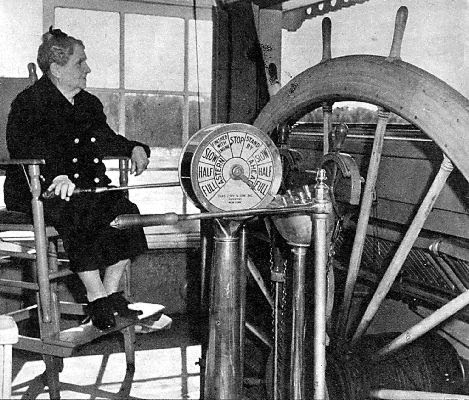
Mary was smart and determined. She learned hundreds of details about the Ohio River needed to get a pilot’s license. At only 5 feet tall, she could barely see over the pilot wheel, let alone wrestle that heavy wheel to steer. But she did it, when necessary standing on the wheel using her body weight to move it. Mary earned respect from the all-male crews and boat operators of that time.


 Mary at pilot wheel. From Delta Queen Company, viewed at allthingscruise.com

Mary was proactive, always making things happen. She stepped up to command the steamboat ARGAND to make it profitable, hosted an excursion trip (then an experimental concept in steamboat travel) in 1904 to the St. Louis World’s Fair, kept the Greene Lines company going after the sudden death of her husband Gordon in 1927, and doted endlessly on passengers.

She was a whiz at customer service, before that was a thing in business. People were attracted to “her” Greene Line boats by the good food, cleanliness, comfort, and fun. There was no drinking or gambling on her boats, creating a family-friendly setting. Mary said in an interview, “People are learning that a river trip is a fine way to spend a vacation.”

Besides navigating the river, there were difficult periods in her life to navigate. Their three children were born and mostly raised on riverboats. This was demanding and stressful. She made it work until Henry, the oldest child, died in 1907 at age 9. Grief and conflicting feelings swept over her. Probably for the first time in her life, she was forced to stop and reassess. Mary soon realized that her first priority should be her two sons. Months later she quit the river and set up the family home in Hyde Park, Cincinnati. “Being at home I can give my two boys the attention they require. On the river I couldn’t.” She eventually returned to the river as the boys grew up. 


Captain Mary B. Greene and husband Gordon, circa 1917. Photo from the collection of the 
late Frederick J. McCabe, viewed at weelunk.com.


Gordon C. Greene, Mary’s husband, died suddenly of a heart attack in 1927. Gordon had told a friend, “When I die, I want to go home on that boat ,“ referring to the TOM GREENE, his favorite boat.  It was in dry dock for repairs at the time. Crew and family worked tirelessly to ready the TOM GREENE to fulfill Gordon’s wish. Mary was with Gordon’s casket as it arrived for burial at the Greene family home in Newport, Ohio.  She with her two sons Tom and Chris continued the business, astutely guiding the company through the Great Depression and World War II.

In 1946, Greene Line Steamers acquired what became their most well known vessel, the elegant DELTA QUEEN. Mary made her home on board, serving as hostess, visiting and socializing daily. Months later in April, 1949, she passed away in her stateroom, at age 81. Only two days earlier she was dancing the Virginia Reel with passengers.  Mary Becker Greene was laid to rest in Newport, Ohio with her husband Gordon, ending a full life of leadership, dedication, and service to others. River historian Frederick Way, Jr. referred to her as …”one of the seven wonders of the river.” 

DELTA QUEEN, from steamboats.org

Forward Cabin Lounge on DELTA QUEEN viewed at deltaqueen.com


Mary may have left this earth in 1949, but her presence on the DELTA QUEEN remained. There have been numerous paranormal, ghost sightings, and odd events tied to Mary since she “left” the boat. One  event happened shortly after her death. Mary strictly opposed sale of alcohol on Greene Line boats. Her son Tom - after much soul-searching, no doubt - installed a bar on board. Days later a small towboat collided with the DELTA QUEEN on the side where the bar was located. The crew was surprised to discover the towboat was named…..CAPTAIN MARY B. Surely this could not be a coincidence, observers noted.

Numerous other “sightings” of Mary were reported over the years. An entertainer reported seeing an elderly lady walking in front of her, who when they rounded a corner “wasn’t there anymore.” 

One man reported that his parents had been moved to DELTA QUEEN cabin 109 due to a water leak. That cabin had been Mary’s. The parents were tormented by noises - the sound of furniture being moved and rattling chains. Balls of light shined in their faces. The closet door opened and closed. Crew members explained that unusual happenings were common in Mary’s former room. One night, aggravated by the activity and lack of sleep, his mother yelled SHUT UP! Noises stopped, and they enjoyed a peaceful night. 

Mary’s presence, whether through the paranormal, her words, or her many accomplishments, remains with us in many ways. 


Sources :

Abbott, Taylor, “Mary B. Greene: The Ohio River’s Leading Lady,” Part 1 and 2, weelunk.com

Barnes, Russ, “Delta Queen Stories,” steamboats.com

“Captain Mary Becker Greene,” The National Mississippi River Museum and Aquarium, 
rivermuseum.org

Espy, G. Andrew, “Mary Becker Greene and the Greene Line,” an interview with Mary B. Greene edited by R. Dale Flick, on steamboats.org

“Greene Line Steamboats,” cincinnativiews.net

Johnson, Phillip, “Remembering Capt. Mary Greene,” steamboats.org

Lamkin, Virginia, “Delta Queen: The Ghost of “Ma” Greene,” seeksghosts.blogspot.com

“Mary Becker Greene,” sites.rootsweb.com

“Mary Becker Greene,” wikipedia

Newspapers.com, numerous articles about Mary Becker Greene

Spilman, Rick, “Is Captain Mary Becker Greene Still Watching Out for the Delta Queen?”, The Old Salt Blog


Monday, November 15, 2021

Two Gems


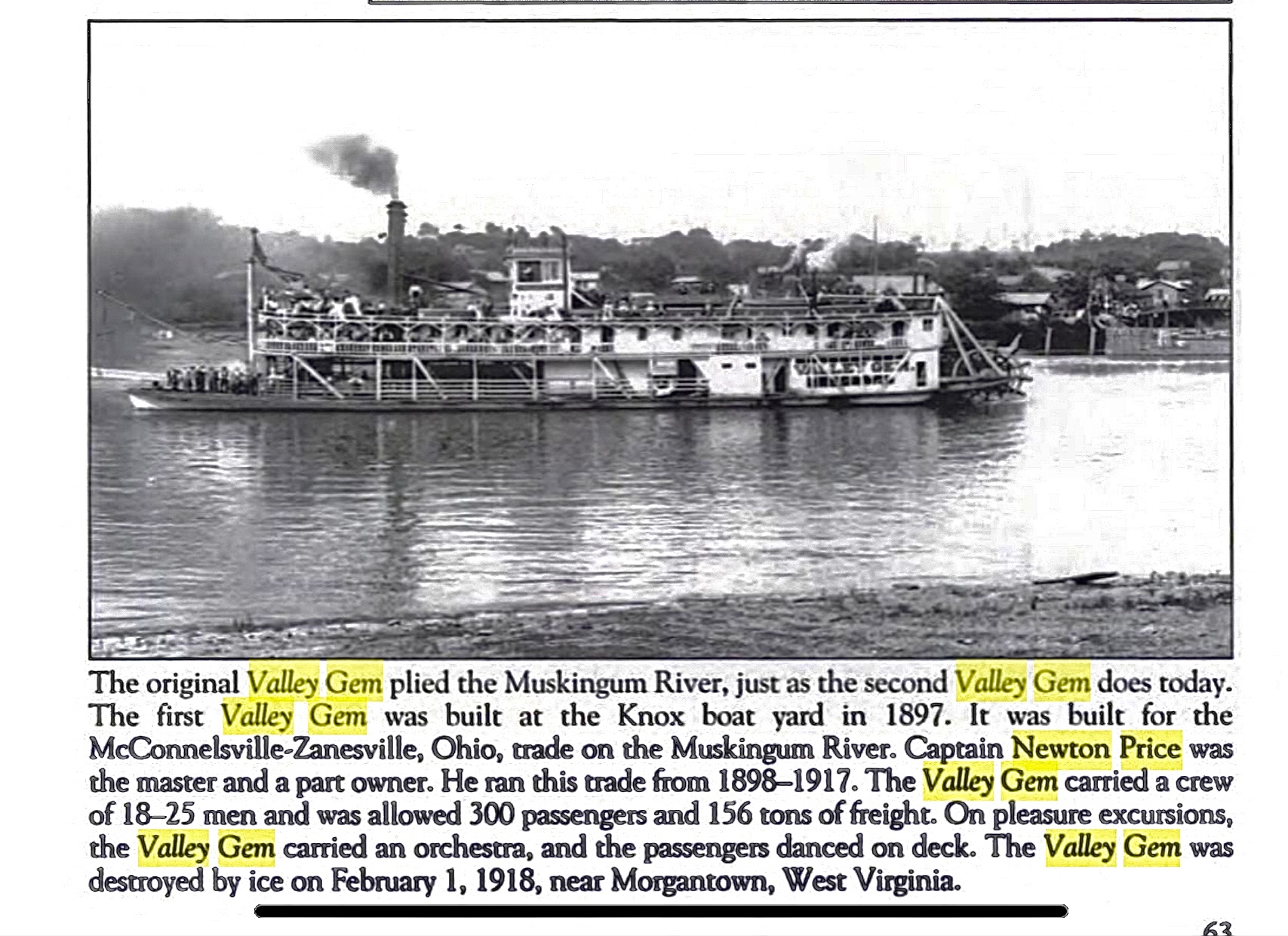
Valley Gem..... the name has a nice ring to it, especially since Marietta, Ohio is nestled in two valleys. Today’s VALLEY GEM sternwheeler cruise boat has been operated at Marietta for nearly fifty years by the Sands family. That boat’s namesake was a Muskingum River steamboat, also named VALLEY GEM.    Captain J. J. Sands explained that the VALLEY GEM was suggested by riverboat expert Frederick Way because that boat had the longest service on the Muskingum River without an accident.

The original VALLEY GEM was built at Marietta’s Knox and Sons boat yard in 1897. She was large enough to carry 300 passengers and 150 tons of freight but small enough to fit through the smaller lock chambers on the Muskingum River. Newton Price of McConnelsville was the captain and part owner of the VALLEY GEM.

VALLEY GEM  steamboat image on a postcard from icollect247.com

VALLEY GEM was one of over two hundred steamboats which ran on the Muskingum River. These boats were an integral part of the culture and economy of Southeast Ohio. They moved freight, farm products, passengers, and provided entertainment in the 1800’s up to about 1920. Many of them were built at Marietta’s Knox Boat Yard.

For steamboat enthusiasts, the original VALLEY GEM engineering details are as follows: She was a wooden hull sternwheel packet boat 125.4 feet long by 26.5 feet wide with 4.2 feet of draft. There were two boilers, 43 inches in diameter and 20 feet in length. The two steam engine cylinders had a 13 inch bore with a 5 foot stroke. That all added up to a state of the art steamboat which would touch the lives of thousands over nearly 20 years. She ran on the Muskingum River, mostly in the McConnelsville - Zanesville trade, from 1898 to 1917. 

The VALLEY GEM’s maiden voyage was on Friday, February 18, 1898. There were 99 passengers on board. The Zanesville Times Recorder was effusive in its description of the VALLEY GEM. Excerpts:

The steamer is indeed a gem. She is provided with each and all requirements of the United States government. The entire boat is lit up with electric lights. Her cabins and staterooms are elegantly furnished throughout. In all details and respects she is an A-1 steamer....Captain Price received many congratulations and high compliments upon his success in bringing out such a fine packet steamer.

Very laudatory verbiage, eh? How often today can a newspaper article also be your marketing message? All went well until the boat approached Zanesville. She suffered a “slight breakdown” in one of her engines, drifted downstream, and was “detained until a late hour last night” with necessary repairs. The passengers had to be offloaded from the boat. “The excursionists returned home by the steamer JEWEL and Zanesville and Ohio rail line.” It was not the ideal finish to a maiden voyage.


Steamboat VALLEY GEM at landing in Zanesville, Ohio circa early 1900's, from Muskingum Valley History Facebook page

Steamboat VALLEY GEM at unidentified location, viewed at picclick.co.uk


She ran a regular schedule from McConnelsville to Zanesville. There were also excursions and events on weekends. Captain Price entertained his Sunday School class on the boat in 1905. Crowds of 200-300 were typical for excursions; seems like a lot for a 125 foot long sternwheeler, smaller than today’s VALLEY GEM. 

There were often unexpected situations that the VALLEY GEM - and other steamboats, too - had to contend with. Examples:

3/2/1904. Riverboats usually tied up during winter. In 1904 the boat restart was delayed by ice in the river lasting 92 days, the longest stretch in 20 years. 

8/6/1899. Passengers were terrified by a severe electrical storm during a cruise. Many became hysterical; a pastor circulated and offered prayers.

9/3/1907. Two unidentified men opened fire on VALLEY GEM passengers with shotguns. Several were injured; none seriously. 

3/4/1898. The VALLEY GEM collided with a rival riverboat JEWEL. There was “ill will” from Captain Webster of the JEWEL who claimed the incident was intentional. Some area steamboats were heated rivals with the VALLEY GEM. They often raced each other to the same locks. It’s not clear if the VALLEY GEM was always the instigator. 

5/13/1899. VALLEY GEM collided with steamer ZANETTA as they raced to the Philo locks. The latter boat was heavily damaged. The two were especially bitter rivals. In 1901, the same two boats raced for the drawbridge at Gaysport. The VALLEY GEM was slightly ahead but the ZANETTA charged forward and ran into the VALLEY GEM. 

Circa 1900. A Mrs. Fanny Richardson of Malta, Ohio, recalled another racing episode between the same two boats. She hailed a ride on the ZANETTA from a country landing, unaware that the two boats were racing. Honoring river tradition, the ZANETTA reluctantly stopped and picked her up. But the boat’s crew was irate because they lost position in the race. She was shunned by all on the rest of the trip. These rivalries sound like a steamboat-era version of today’s road rage.

7/4/1908. A July 4 church excursion from Zanesville to McConnelsville on a very hot day did not turn out well for the 277 passengers. A mechanical problem delayed departure for two hours. On the return trip, several young people fainted from heat exhaustion after running to a McConnelsville baseball game and back to the boat. Others overdosed on ice cream and cold drinks and got sick. A Dr. Trout boarded at Philo to care for the afflicted passengers. Phone calls requesting doctors to meet the VALLEY GEM at Zanesville resulted in a panicked crowd of 400 jamming the wharf there.

Image and caption from Images of Marietta, White, Larry Nash Ph. D., and Emily Blankenship, Arcadia Publishing, 2004, viewed at https://books.google.com/books/about/Marietta.html?id=

The VALLEY GEM’s long run on the Muskingum River ended in 1917. The boat was sold to another company which operated her on the Monongahela River. The stated reason was Newton Price’s health, though declining business was likely a factor. Times were a-changing as automobiles, trucks, and trains were permanently disrupting life on the river. For the first time in 93 years the Muskingum River had no steamboat operating on it, though other boats later ran intermittently.

Sadly, the venerable VALLEY GEM sank in early 1918 when it was caught up in an ice jam at Morgantown WV and could not be salvaged. There was a sheriff’s sale and her equipment removed and sold. 

Image from WV History: wvhistoryonview.org. 

The wrecked VALLEY GEM from the stern. Notice the name plate: VALLEY GEM of 
McConnelsville Ohio.” The owner kept the boat's original name. New owners often gave their boat a new name, wiping out its previous identity.


Today’s VALLEY GEM sternwheel cruise boats were built and operated by Captain James E. Sands and his family. From the Valley Gem website:

Our History...
All of us like to dream about what we would like to do with our lives, but few of us have the determination to carry our dreams to completion. Captain James E. Sands, Sr., and his wife Peggy were an exception to the rule. After much personal sacrifice, they managed to put their first 98 passenger sternwheeler into operation in 1973. With the assistance of Capt. Fred Way, they named the boat Valley Gem, after a historic packet boat that plied the Muskingum River between Marietta and Zanesville, Ohio during the previous century. It was an immediate success. For more than ten years, he and his oldest son Jimmy Sands, also a licensed pilot, brought pleasure to thousands of passengers with trips on both the Ohio and Muskingum Rivers.

Captain Sands always felt he could improve upon the design of the Valley Gem. He spent several years designing a brand new boat. With the assistance of his friends, master welder Ivan Arnold, electrician Charles Shockey and mechanical engineer Tom Hudson, he completed the new Valley Gem Sternwheeler in 1989. It was designated the Flagship of the Muskingum Navy, with Captain Sands as Commodore. Sands specifically designed the boat for the Muskingum River.  It has two decks so that it can clear the low bridges. It is not wider so that it fits in the hand-operated locks. It is a well maintained all-weather boat with a heated or air-conditioned lower deck for passenger comfort. Then, in 1990 on the day of the Sternwheel Festival Races, tragedy struck the Sands family. Jimmy, at 32 years of age, died after a prolonged illness. Captain Sands, his wife Peggy and their son J.J. carried on.

Captain James Sands passed away in 1998, after living his dream of being a riverboat captain for 25 years. He knew and loved the rivers, and enjoyed sharing river stories with the passengers. His wife Peggy retired from the business in September 2003. She handled reservations for the boat for almost thirty years. Their son, Captain J.J., and his wife, Captain Heather now continue the family tradition, and you can meet them and enjoy a wonderful trip on an authentic sternwheeler here in historic Marietta throughout the year. They look forward to seeing you and extend a heartfelt welcome aboard.

The first VALLEY GEM was 70 feet long by 18 feet long and could hold 98 passengers. Captain James E. Sands, a former contractor then 45 years old, built the boat with a friend. “We worked on the boat for nine months and put 32 tons of steel in it.” The steel was acquired at no cost from a truck accident. Cruises in 1974 departed daily at 1, 2, 3, and 4 pm.  Fares were $1.50 for adults, 1.00 for children.


Captain Jim Sands first VALLEY GEM launched in the fall of 1973. Postcard from Walter Havighurst Special Collections at Miami University Library, Oxford OH, Bowden Postcard Collection Online

Captain Jim Sands piloting the VALLEY GEM pictured in a September 21, 1974 in a Dayton Journal Herald newspaper article.

Your author talked with Captain Sands when the VALLEY GEM started service. I was active in the Marietta Area Chamber of Commerce at the time. We were thrilled to see another tourist attraction added to Marietta’s historic attractions. I asked him if the boat would operate on a limited schedule, naively thinking that this would be part time and that there would not be enough demand for full time operation. I was wrong. He was all in. This was now his livelihood; the VALLEY GEM would operate every day (seasonally). It’s been like that non-stop for almost 50 years.

Captain Jason (“JJ”) Sands recalled that former President George H. W. Bush rode aboard the first VALLEY GEM during a stop at Marietta in the 1988 presidential campaign.  The campaign motorcade came to the VALLEY GEM boat landing. JJ’s late brother Jimmy was Captain of the VALLEY GEM for the cruise. Candidate Bush briefly piloted the boat “flawlessly.” 

Advance arrangements were quite thorough. Secret Service agents took possession of the VALLEY GEM during the visit. The boat was inspected for weapons. Divers went under to check the hull for munitions. The Secret Service set up portable armor plates in pilot house for protection. Several agents with sniper rifles were on board during Bush’s cruise.

The current VALLEY GEM is 157 feet long by 25 feet wide and weighs 100 tons - much larger than the first boat. She can carry up to 296 passengers. The paddle wheel is powered by a Diesel engine and a chain drive rather than the steam engine propulsion common until 100 years ago. 

Building this new and improved VALLEY GEM was an adventure. Since this was a larger “K boat” it required Coast Guard approval. Most vessels of this type were built by boat building companies familiar with the procedures. JJ explained that this bureaucratic process was a challenge for  “amateurs building a boat in a hayfield.” 

He said that the plans for the new boat had to be sent in three different times to Coast Guard officials who then failed to respond, claiming the plans didn’t exist.  Those plans were “discovered” and approved only after the Sands asked Charlie Bacarisse, then an advisor in the Bush 41 White House, to intervene.  Bacarisse had been a former deckhand on the VALLEY GEM and was present when candidate Bush visited Marietta. The construction site was an open field along the Ohio River below Marietta. A Coast Guard inspector with an attitude visited the site one day and stated dismissively, “there will never be a boat built here.” He was wrong.

Today’s VALLEY GEM which began service in 1989

The current VALLEY GEM has been in service now for over 30 years, carrying tens of thousands of visitors. Recently, the Discovery Plus cable TV channel was on board filming a segment. The episode host was Clint Harp, the carpentry artisan who often appeared on the Fixer Upper program on Home and Garden TV (HGTV) cable channel series featuring Chip and Joanna Gaines.

JJ remembered an impromptu rescue operation on a VALLEY GEM cruise with the Marietta College baseball team. A john boat transporting 3 crew members to shore from an Ohio River towboat. It was a very windy day; whitecaps and sizable waves kicked up on the river. The boat gradually took on water from the waves and capsized. Two of the guys on board climbed on top of the capsized boat. The lady passenger on the john boat would not let go of the bag with her belongings and nearly drowned. Luckily, the VALLEY GEM was passing by on a cruise and rescued all of them using the landing ramp.

The VALLEY GEM is a family operation run by James and Peggy’s son, Jason, and his wife, Heather. In an Ohio Magazine  article this spring, Heather Sands explains: “Jason is a mechanic, I do marketing, and our family friend Don Sandford is an electrician. (And) we all captain the VALLEY GEM. It is all personal and thoughtful. We want to make sure it is a family-oriented place because we are family.” You can learn more about the VALLEY GEM tours, events, and food service at valleygemsternwheeler.com.

The Sands family’s two VALLEY GEMS, and the original VALLEY GEM, each have their engineering pedigrees, stories, and events.  But they were all about people - people living, working, and having fun on the river.

Notes:
  • Steamer RUFUS PUTNAM made the initial Muskingum River steamboat voyage in January 1824 - going from Marietta up to the Putnam community near Zanesville. It was a daring voyage since there were no dams at the time. The trip had to be made when water levels were high and the current was swift and potentially dangerous. Read more about that voyage here: http://earlymarietta.blogspot.com/2015/09/the-little-steamboat-that-could.html
  • The Muskingum River Navigation System was one of the first lock and dam systems in the country, placed in service in 1841. All of the locks and dams are still operational today with limited hours for recreational craft. Consult the Muskingum River State Park website for schedules and updates.

Monday, March 30, 2020

The French Celeron Plates Expedition

Perhaps you've heard of the so-called "Celeron Plates." Or, maybe not. It's not headline material for most of us. But it has been endlessly fascinating for history scholars.

Pierre Joseph Celeron De Blainville*, a French military leader, led an expedition down the Ohio River Valley in 1749. The expedition buried lead plates at major tributaries, including the Muskingum River, to establish French claim to land in the Ohio River Valley. It was a curious enterprise built on the dubious premise that burying plates could establish a land claim. Who was this Celeron guy and why were they burying lead plates? First, some background.

The French and English were vying for control of America’s interior lands in the mid 1700's. The French pursued their claim to Ohio Valley lands based on earlier explorations by LaSalle in 1669 and 1682. The British had other ideas. They fought King George’s War from 1743-1748. The British were able to disrupt the French fur trade and undermine French influence with Native Americans in the upper Ohio River Valley. Also, Virginia colonists set up The Ohio Land Company (unrelated to the Ohio Company of Associates which later settled Marietta) intended to acquire land in the upper Ohio Valley.

CLICK TO ENLARGE. Map of colonial interests in 1750. New France was the blue area, British in red, Spanish brown. The border of red and blue lands in western PA and the upper Ohio Valley were being contested.


British inroads jolted the French into action. The governor of Canada commissioned Pierre Joseph Celeron De Blainville (“Celeron”) to lead an expedition down the Ohio Valley in 1749. Its purpose was to reassert French claims in the area, renew friendship with Indians, and chase out British traders.

Celeron was a French Canadian soldier born December 29, 1693, in Montreal. His father Jean-Baptiste Celeron was granted a lordship over Blainville, which accounts for the suffix “de Blainville.” Celeron became a cadet in the French colonial army at age 13. He was commissioned as ensign at age 20 and was a nearly a 40 year veteran when he began the Ohio River expedition. Celeron was selected in part for his “cool but tough” attitude towards the Indians in previous commands.

The expedition began near Montreal, Canada on June 15, 1749. It was an eclectic group, about 250 strong. There were French soldiers, Canadian militia, and a few dozen Indians. Randall and Ryan’s History of Ohio Volume I offers a colorful imagined description: “The flotilla ....formed a bizarre but picturesque outfit, the French soldiers and Canadians, in their gay costumes and semi-medieval armour, the half naked, copper-skinned savages (Indians) with their barbarian weapons, the flying banners of France, all crowded in frail white birch canoes, that floated on the blue waters of the river like tiny paper shells; it must have seemed like a tableau vivant (a static, posed group of actors) rather than an army...”


CLICK TO ENLARGE. Map of the route followed by Pierre Joseph Céloron de Blainville along the Ohio River in 1749, drawn by Father Joseph Pierre de Bonnecamps, viewed at Wikipedia.com.


A priest, Father Jean Pierre de Bonnechamps, was chaplain and also the dutiful navigator for the expedition. He used a sextant, drew maps, and made notes on the expedition. Their Indian diplomat/envoy was Phillips Thomas Joncaire, a French officer of Seneca Indian ancestry. He was often sent ahead to assuage Indians, who were predictably alarmed by such a large force of mostly white men.

It was a strenuous journey at the start for the expedition’s canoe flotilla. They had to paddle the length of Lake Ontario, portage around Niagara Falls, paddle further on Lake Erie, and portage again to Lake Chautauqua. A portage - moving men, canoes, and supplies across dry land to the next waterway - is an exhausting and time consuming task. From there they followed Conewango Creek to the Allegheny River and eventually to the Ohio River. 

Their primary mission was to bury lead plates designating French land claims. They did this at major tributaries of the Allegheny and Ohio Rivers. Each plate burial was accompanied by a ceremony. Soldiers lined up in formation. King Louis XV was proclaimed lord of that region. There were songs, cheers, and musket volleys fired. A tin plate erected on a tree gave notice of each buried plate which was placed near that tree.


CLICK TO ENLARGE.
12 x 20 foot mural at the Wheeling Civic Center - “French exploration of the Ohio Valley,” by Mark Missman. This painting illustrates the ceremony that accompanied the burial of each lead plate. The mural was designed to commemorate the presence of the French explorers and their Jesuit companions in the Upper Ohio Valley. One of the lead plates was buried at the confluence of the Ohio River and Wheeling Creek.


The burying of plates seems today like a curious way to make a land claim. This technique was a common method used in medieval Europe for land claims. But realistically, who would ever see them - after all, they were buried? And if the plates were found, their purpose and validity would surely be questioned. But the French were committed their mission.

One of the plates was buried at the mouth of the Muskingum River on August 15, 1749. A metal sign was posted on a tree to mark the location of the buried plate. The narrative on the sign was very formal; brevity was not part of the French communication style:

The 15th of August, 1749, we, Celoron, Knight of the Royal and Military Order of St. Louis, Captain commanding a detachment sent by the orders of Monsieur the Marquis de la Galissoniere, Governor-General of Canada, upon the Beautiful River, otherwise called the River Oyo, accompanied by the principal officers of our detachment, have buried at the foot of a maple tree, which forms a triangle with a red oak and an elm tree, at the entrance of the river Jenuanguekouan (Muskingum), at the western bank of that river, a leaden plate, and have attached to a tree on the same spot, the arms of the King. In testimony whereof we have drawn up and signed the present official statement, along with the Messrs. the officers at our camp, the 15th of August, 1749.

In 1798 a flood had washed away part of the Muskingum River bank, exposing the plate. It was discovered by boys swimming there. Not realizing its importance, they melted much of the lead plate for musket balls. Paul Fearing became aware of it. William Woodbridge, then of Marietta, had recently been to Gallipolis and knew some French. He was able to decipher enough of the plate to realize that it was deposited by the French as a land claim. The probable inscription, reconstructed based on other plates, is given below:

In the year 1749, in the reign of Louis the XV, King of France, we Celoron, commander of the detachment sent by the Marquis de la Galissoniere, Governor-General of New France, to reestablish peace in some villages of these Cantons, have buried this plate at the confluence of the Ohio and the river Yenanguekouan (Muskingum), the 15th of August, for a monument of the renewal of possession which we have taken of the said river Ohio, and of all those which fall into it, and of all the territories on both sides as far as the source of the said rivers, as the preceding Kings of France have possessed or should possess them, and as they are maintained therein by arms and by treaties, and especially by those of Riswick, Utrecht and of Aix la Chapelle


CLICK TO ENLARGE.
Image of the Celeron plate buried at the Muskingum River. Over half of the original plate was destroyed to make musket balls. From the American Antiquarian Society where the plate resides. About halfway down, note the word “Yenangue”, part of the hyphenated Yenanguekouan, an early Indian name for Muskingum. In the next line down, see “Rivière Oyo,” French for Ohio River.


The wording on the plates was somewhat confusing to historians and not always consistent. Charles B. Galbreath, an editor of the journal kept by Celeron, wryly observed that "The artist (who engraved the plates), Paul De Brosse, like Celeron himself, had evidently not taken first prize in spelling words of his native tongue and was somewhat careless..." Another author noted that “the French (wording) is none of the purest and the accents, apostrophes, and punctuation are wanting...”

Celeron’s expedition also sought to placate the region’s Indians and remove British traders. Neither goal was realistic and ultimately failed. On August 6, at the Indian village called Logstown northwest of Pittsburgh, Celeron found six English colonial traders present with large bundles of furs bound for Philadelphia. He ordered them out of the area and wrote a note to Governor Hamilton of Pennsylvania asking that he keep traders from trespassing on French land. Other British traders near Indian villages at the mouth of the Scioto River were asked to leave. Those requests and other actions to dislodge the British were largely ignored.

The expedition held numerous discussions with tribes in Pennsylvania and Ohio. Each exchange had an elaborate protocol, typical of communication between Indians and whites in that time period. A speech by one party was preceded by a gift of wampum belts to convey the importance, sincerity, or urgency of the topic. A similar speech was made when the other party responded, often on the day following. 

CLICK TO ENLARGE.
Robert Griffing painting of imagined expedition stop near Logstown in western Pennsylvania. Notice Indians present; there were Iroquois Indians in the expedition. The large tree was a cottonwood tree. From the diary of Father Joseph Pierre Bonnecamp: “We dined in a hollow cottonwood tree in which twenty-nine men could be ranged side by side.” 

Language used was flattering, deferential, and endlessly courteous, though often insincere. The speeches followed a common pattern. Celeron alternately scolded and cajoled the Indians to reject the British and embrace the French. The Indians usually demurred, sometimes feigned compliance, occasionally disagreed with him. 

Celeron invested hours and hours in communicating with the Indians - listening, composing speeches, enduring tedious ceremonies - mostly for naught. The Indians viewed Celeron’s intentions with contempt. They were too closely tied in with the British who offered them cheaper goods, trusted friendship, and rum - which Indians thought offered a quicker high than the whiskey supplied by the French.

The expedition continued down the Ohio River to the Great Miami, then northward to Lake Erie and eventually back to Montreal. Celeron Pierre Joseph DeBlainville was awarded a command in Detroit. The French and British continued as adversaries. The French and Indian War (1756-1763) eventually resolved the issue in favor of the British. The Treaty of Paris in 1763 awarded land from the Mississippi River east to the Appalachian mountains (which included the Ohio Valley) area to the British.

One of the expedition’s lead plates was buried at the Kanawha River near present day Point Pleasant WV. A boy discovered that plate in 1846, a curious reminder of the futile French claim made nearly 100 years earlier.


*His name also appears as “Celoron” and the title part of his name as “De Bienville.”


SOURCES:

Bumgardner, Stan, “Celeron de Blainville,” wvencyclopedia.org

Biography – CÉLORON DE BLAINVILLE, PIERRE-JOSEPH – Volume III (1741-1770) – Dictionary of Canadian Biography, viewed at http://www.biographi.ca/en/bio/celoron_de_blainville_pierre_joseph_3E.html 

Galbreath, C. B., Expedition of Celeron to the Ohio Country in 1749, Columbus, Ohio, F. J. Herr Publishing Company, 1921

Hulbert, Archer Butler, The Ohio River, a Course of Empire, New York, G. P. Putnam’s Sons, 1906

Howe, Henry, Historical Collections of Ohio, an Encyclopedia of the State, Volume 2, 1907

Ohio History Journal Vol 29, “Celeron’s Journal, edited by A. A. Lambing” and
"Account of the Voyage on the Beautiful River in 1749 Under the Direction of Monsieur de Celeron, by Father Bonnecamps.”

Vanderwerth, W. C., and Carmack, William R., Indian Oratory, Famous Speeches by Noted Indian Chiefs, University of Oklahoma Press, 1979.