Join the Conversation

Join the Conversation.
I invite your comments, suggestions, and additional information about any topic mentioned.
Showing posts with label Christmas. Show all posts

Tuesday, December 21, 2021

Rudolph’s Creation Story

My wife likes on-line trivia questions. Recently she asked me this question: Rudolph the Red-nosed reindeer was created for which department store? The choices were Macy’s, Bloomingdale’s, Neiman Marcus, or Montgomery Ward. 

My first reaction was shock that Rudolph was a marketing creation and, well, not real. He is so ingrained in Christmas lore, it seemed like he’d been around forever. The answer about which department store surprised me, too. Keep reading to see the trivia answer, followed by the Rudolph “creation story” originally posted by National Public Radio (NPR).
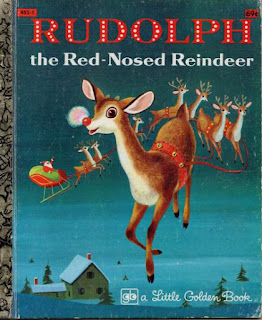
Popular image of Rudolph from a children’s book


Santa's reindeer are a vital part of his Christmas story, but did you know that Rudolph didn't exist until 1939? The beloved reindeer with the red nose was the creation of Robert L. May. May was a catalog writer for Chicago-based department store Montgomery Ward. Each Christmas, the store would give away free storybooks to the children. May decided to write the tale of a lonely outcast reindeer. Two million copies were printed and the story became a huge hit, inspiring songs, cartoons, and more.

NPR report 12/25/2013 (images inserted by author)
Everybody knows Rudolph was the last reindeer to join Santa's crew, but few people know about the department store copywriter who brought his story to the world.

The year was 1939, the Great Depression was waning and a manager at Montgomery Ward in Chicago decided that the store should create its own children's book for the annual holiday promotion.

The boss tapped Robert L. May, an ad man for the store, to take a crack at a story. May was a hit at holiday parties for his way with limericks and parodies. But May didn't see himself as a winner. He had always felt like a bit of an outcast, and, at 35, he felt he was far from reaching his potential, pounding out catalog copy instead of writing the Great American Novel as he had always dreamed he would.

He came back with the story of an underdog, red-nosed reindeer who was in the right place at the right time — just when Santa needed a reindeer with exceptional skills. "Can't you come up with anything better?" the boss asked, according to a May's 1975 telling in a story published in the Gettysburg Times.
But May believed in the story. He got his buddy in the art department to draw up some sketches and, together, they convinced the boss.
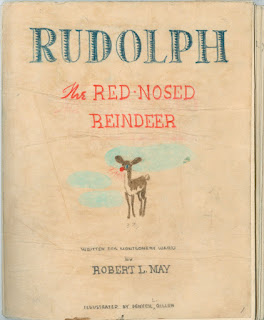
Image of original draft manuscript
https://www.npr.org/2013/12/25/256579598/writing-rudolph-the-original-red-nosed-manuscript


Months into the project, May's wife died from cancer. Robert became a widower and a single father. His boss offered to take the reindeer project off this plate. But May refused. "I needed Rudolph now more than ever," he later wrote. The book was a hit. Montgomery Ward's printed and distributed more than 2 million copies that year at branches across the country.

An original copy of the 1939 booklet "Rudolph the Red Nose Reindeer" distributed free to all children who visited Montgomery Ward stores during the Christmas season. This is the front cover. Fun fact: other names were considered (Romeo, Rodney, and Reginald, anyone?) but “Rudolph” won out.

While Rudolph was hitting it big, things grew worse for May. He was living on a copywriter's salary and spent years buried in debt from his wife's medical bills.

After World War II, Montgomery Ward's then-CEO Sewell Avery, for reasons that aren't exactly clear, gave May the rights to Rudolph. (His daughter tells us that the bosses never thought Rudolph had potential as more than a holiday promotion, but we'd like to think, for the sake of this cute little Christmas tale, that his humanity won him over.)

If ever there was going to be a time for May's luck to change, this would be it. It just so happened that May's brother-in-law (Johnny Marks) was a songwriter. He hadn't made it big yet, but he was getting there. May talked him into writing a song about Rudolph. That song was picked up by none other than the singing cowboy, Gene Autry. It sold more than 25 million copies and paved the way for the classic Rankin/Bass stop-animation film.

Thanks to Rudolph, Robert May's family was taken care of financially through the end of his life and beyond. And he always delighted in being the man who introduced the oddball reindeer and his triumphant tale to the world.

And as for Rudolph, well, he, as they say, went down in history.

View Robert May’s original story (a poem) by clicking on the link below, then scroll down in the article to find the manuscript link. This is the original draft; the final version had a few changes. Also, enjoy the artwork. Read or listen carefully; it is more detailed and longer than the familiar song. The verses were written in the same rhyming cadence as “The Night Before Christmas” poem. 


Merry Christmas!


Sources:

National Public Radio, “Morning Edition” broadcast, 12/25/2013, https://www.npr.org/2013/12/25/256579598/writing-rudolph-the-original-red-nosed-manuscript
“Rudolph the Red-Nosed Reindeer Turns 75,” National Museum of American History, https://americanhistory.si.edu/blog/rudolph-red-nosed-reindeer-turns-75
“Rudolph in Rauner,” Rauner Library Special Collections, Dartmouth College, https://raunerlibrary.blogspot.com/2009/12/rudolph-in-rauner.html
Triviagenius.com
Wikipedia

Monday, December 28, 2015

Marietta's First Christmas

The first Christmas in Marietta featured a 2 for 1 deal. No, it was not a "buy one get one" retail promotion. It was two holidays that were celebrated on the same day: Thanksgiving and Christmas were to be celebrated on December 25, 1788. 

A proclamation dated December 17, 1788 was issued by "His Excellency Arthur St. Clair, Esquire, Governor and Commander in Chief," stating that "For as much as it is encumbent on all men to acknowledge with gratitude their infinite obligations to Almighty God for benefits received...do hereby ordain that Thursday the 25th of December be observed as a day of solemn Thanksgiving and Praise..., and I do probihit all servile labor on that day."

It is unclear why Thanksgiving was not observed at the usual time. The Governors Chart of Laws, published by Rufus Putnam on April 9,1788, included both Thanksgiving and Christmas, among other holidays: "Be it ordained that all members of the colony must celebrate 22d February, 7th April, 4th July,  annually. Also in a proper manner observe the 28th November, 25th December, and 1st day January, annually."

Christmas then was not the mega-event that it has become today. Moreover, the New England settlers in Marietta were probably not used to celebrating Christmas. Their puritan ancestors had actually banned Christmas celebrations in 1659. They believed that Christmas was not biblical, had pagan origins, and in practice was more drunken revelry than pious observance. Christmas had been reinstated but was still only loosely observed by the bah-humbug New Englanders in the late 1700's.

1788 had been an historic yet challenging year. Marietta was a new (and the first!) settlement in the newly established Northwest Territory of the United States, the first such territory outside the original 13 states. The town was being laid out, a few houses were built, a fortified community elegantly named Campus Martius (Latin, meaning "Field of Mars") was started, and Indian treaty negotiations were well underway at nearby Fort Harmar. The surrounding lands were being surveyed, and 30 families had recently moved into town. It was a "crazy busy" place.

Yet there were stresses. Food was short at times since the first harvest was limited. Indians seemed friendly, but the peace seemed tenuous to many. There was discord among leaders and citizens. The weather that winter was severe; the rivers froze. Ice and snow made travel - and survival - a challenge. But, life went on. 

It was an event filled December, 1788 in Marietta. The diary of James Backus - a young Ohio Company shareholder, businessman, and civic official - supplies much of the commentary. Quotes are from his journal unless otherwise noted. 

On December 13 nearly 200 Indians were reportedly present for treaty negotiations; the following day there was a parade and military inspection. On December 15, there was a ball. It was the talk of the town, "All of the conversation of the Settlers centered in the Ball." Backus himself "Went to the Ball....drank good wine & came home groggy." He reported the next day: "Tuesday, 16. Fine morning but felt no better for the Ball." Judge Parsons, in a letter to his friend, the Reverend Manasseh Cutler, mentioned the ball in glowing terms - with no mention of a hangover: "We had the first Ball in our Country at which were present fifteen ladies as well accomplished in the manners of polite circles as any I have seen in the old states."

The ball was a pleasant distraction from the rigors of frontier living. However, Governor St. Clair viewed the revelry - and the frequent drunkenness of the Indians - with concern. The Indian negotiations were too sensitive and the threat to public safety too great to risk an alcohol fueled incident - from Indians or settlers. 

St. Clair issued a warrant on December 16 for the confiscation of all "spirituous liquors" until treaty negotiations were finalized. The same James Backus, as a recently commissioned deputy sheriff, was responsible for seizing the liquor. He does not mention this in his diary. He kept detailed records and issued receipts for the later return of the liquor. 

Community activity was henceforth more sedate and, well, sober. Dr Solomon Drown arrived in Marietta on December 19 and reported "more decorum (was) observed than in the British Parliament when I was there."

On Christmas/Thanksgiving morning, locals were jolted alert by a three gun salute from Fort Harmar answered by a three shot cannon blast from Campus Martius. Later there was a church service. Judge Parsons gave a sermon from Psalm 103, verse 2. 

Dr. Drown gave an account of the day to his family in Providence, "It being Christmas, public worship was introduced by reading...in the Church Prayer Book. Gen'l Parsons read a sermon adapted to the occasion. Good singing. I dined at General Goodale's and as this is such a new country, perhaps you will like to know our bill of fare. A boiled dish, Turkey, beef and bacon, cabbage, turnips and potatoes, butter, etc., A roast turkey 17 pounds. A turkey pie, custards, wheat bread, etc." There was no mention about those disruptive spirituous liquors.

Christmas Day at Fort Harmar may have been similar to that reported by soldier Joseph Buell's journal in 1787: "This being Christmas Day, the sergeants celebrated it by a dinner to which was added a plentiful supply of wine." Backus' journal notes that on December 26 there was "another ball." New Years Eve and New Years Day were also occasions for merriment and "musick." 

The new year of 1789 began with events of note. The Indian peace treaty was signed January 9. There was a gathering of Indian chiefs, a dinner, and parade. On that same day, General James Mitchell Varnum passed away quietly of tuberculosis. An elaborate funeral including citizens, leaders, military honors, and masonic rites followed. Later in January, a son was born to the family of Nathaniel Cushing; he was named James Varnum Cushing. The cycle of life moved on in the new settlement and surrounding territory.

Sources:
Phillips, Josephine E.,  "The Tide of Time, the Old Northwest Territory's First Christmas," The Tallow Light, Vol.1, No. 3, January, 1967.
Journal of James Backus, various entries, as reported in the Josephine Phillips article above.
Backus, William W., Geneological Memoir of the Backus Family, The Press of the Bulletin Co., Norwich CT, 1889, pages 37-42, accesssed at https://archive.org/stream/genealogicalmemo00back#page/38/mode/2up
The Week Staff, The Week, December 20, 2011, accessed at http://theweek.com/articles/479313/when-americans-banned-christmas
Howe, Henry, Historical Collections of Ohio, an Encyclopedia of the State, Volume II, C. J. Krehbiel, Cincinnati, Ohio, 1907, page 803, viewed at https://books.google.com/

Note: Special thanks to Campus Martius Museum Education Specialist Glenna Hoff for sending your author The Tallow Light article after a casual conversation and to Charlotte Keim for providing The Week article about Christmas.